Steps to Evaluate Solar as an Investment
- Get at least three installer quotes. Prices vary 20-40% between installers in the same city. Each quote should itemise equipment, labour, permitting, and interconnection fees. A national average as of early 2026 sits around $2.75-3.25 per watt installed, so a 6kW system runs $16,500-$19,500 before credits.
- Look up your actual electricity rate. Your utility bill shows the rate per kWh — not the total bill divided by usage, which includes fixed charges. The rate that matters is the marginal rate: the price of the last kWh you consume. Some utilities have tiered rates where solar offsets the most expensive tier first, making the payback faster than average-rate calculations suggest.
- Calculate your net cost after incentives. The federal residential credit (IRC Section 25D) ended for installations completed after December 31, 2025 under Public Law 119-21, so for most buyers today the installed price is the net federal cost: an $18,000 quote stays $18,000. State incentives and utility rebates are now the main levers, and they still apply in many states; check the DSIRE database for yours.
- Compare 25-year savings to your net cost. A 6kW system in a 5-sun-hour location produces 25.5kWh/day (after the 15% system losses this calculator assumes). At $0.16/kWh with 3% annual rate increases, that electricity is worth about $50,800 over 25 years. Prices and rates on this page are our own estimates as of the date shown; they change often. Enter your own figures for a current result. Against an $18,000 net cost, the return still beats most conservative investments. Use our solar panel output calculator to refine the daily production estimate for your specific setup.
How the Federal Solar Tax Credit Works
The federal residential clean energy credit (IRC Section 25D) is no longer available for new installations: Public Law 119-21 (July 4, 2025) ended it for expenditures after December 31, 2025, and the IRS treats an installation completed after that date as made after it. While it applied, from 2022 through the end of 2025, it returned 30% of system cost as a dollar-for-dollar federal credit, which is why 30% figures still circulate in older guides and installer marketing.
Buyers whose installations were completed by the December 31, 2025 deadline claim the credit on their 2025 return; it covered panels, inverters, racking, wiring, labour, battery storage, and certain roof work. For installations from 2026 onward there is currently no federal residential credit: run the calculator above with 0% federal, or with your state credit percentage where one exists.
State incentives are now the main game. New York offers up to $5,000 in state tax credits. Massachusetts has the SMART program paying per kWh produced. California's NEM 3.0 reduced export rates but pairing solar with batteries restores much of the value. Check the DSIRE database for current incentives in your state.
Sample Payback Periods by Region
| Scenario | Electricity Rate | Sun Hours | Net Cost (no federal credit) | Payback Period |
|---|---|---|---|---|
| Arizona (high sun) | $0.14/kWh | 6.5 hrs | $18,000 | ~10 years |
| Massachusetts (high rate) | $0.28/kWh | 4.0 hrs | $20,000 | ~9 years |
| Texas (moderate) | $0.13/kWh | 5.5 hrs | $17,000 | ~11 years |
| Oregon (low sun) | $0.12/kWh | 3.5 hrs | $19,000 | ~19 years |
| California (high rate + NEM 3.0) | $0.32/kWh | 5.5 hrs | $22,000 | ~6 years |
These estimates assume a 6kW system, 0.5% annual panel degradation, 3% annual electricity rate increases, and 15% system losses. Your actual payback depends on your specific utility rate structure, net metering policy, and local incentives.
High-rate states like California and Massachusetts consistently show the fastest paybacks despite having fewer sun hours than the Southwest, because the value of each kWh offset is much higher. Use our solar panel and battery sizing calculator to determine whether adding storage improves your economics under time-of-use billing.
Worked Examples
Average American Home Going Solar
Context
A homeowner in North Carolina installs a 6kW solar system for $18,000. Their electricity rate is $0.16/kWh, the area gets 5 peak sun hours per day, and they expect 3% annual rate increases. Panel degradation is 0.5% per year. With the federal residential credit (Section 25D) ended for installations completed after December 31, 2025, no federal credit applies.
Calculation
Net cost = $18,000 (no federal credit applies)
Year 1 daily production = 6kW × 5h × 0.85 (losses) = 25.5 kWh/day
Year 1 annual production = 25.5 × 365 = 9,308 kWh
Year 1 savings = 9,308 × $0.16 = $1,489
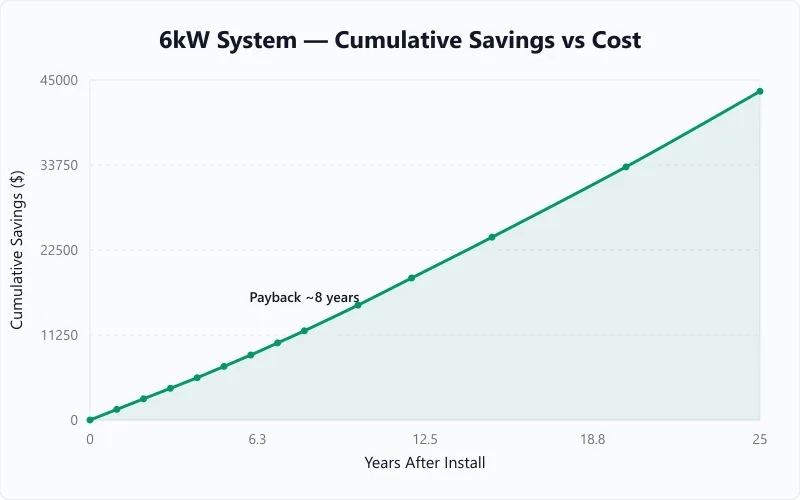
Cumulative savings exceed $18,000 in year 11
Interpretation
The system pays for itself in about 11 years. Over 25 years, cumulative savings reach roughly $50,000 depending on actual rate increases — about $32,800 net of the system cost, or roughly 1.8x the investment. Use the solar panel size calculator to confirm the array wattage matches your roof space and daily consumption.
Takeaway
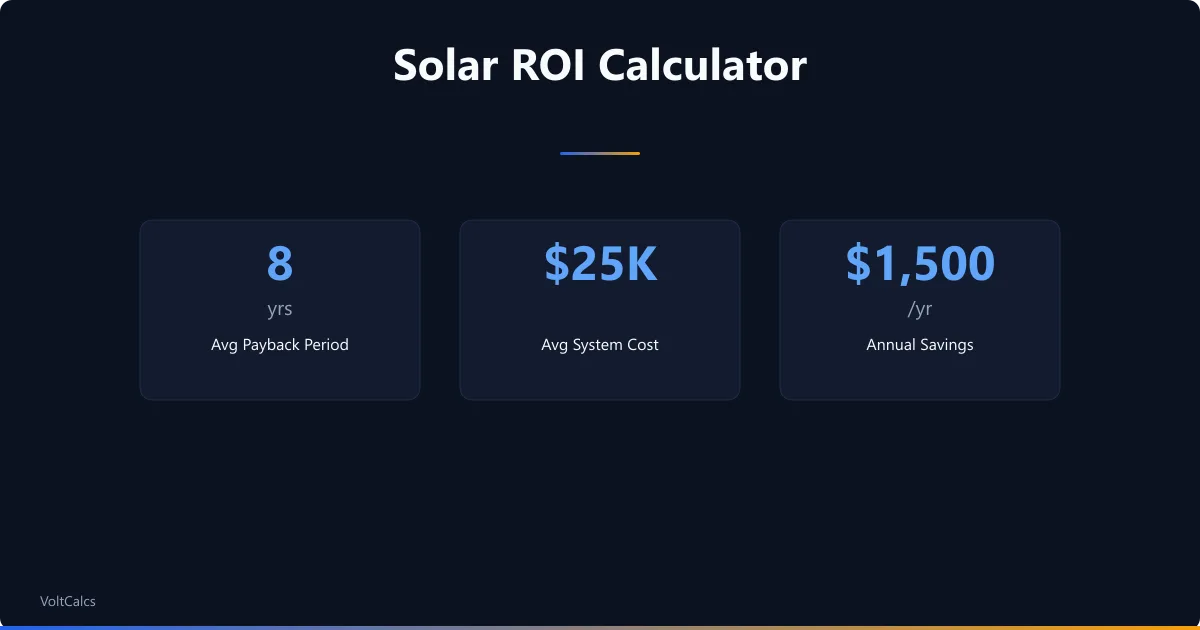
An 11-year payback on a system warrantied for 25 years still leaves 14 years of effectively free electricity — but the arithmetic is leaner than before: when the 30% federal credit applied (installations completed by December 31, 2025), this same system paid back in about 8 years. State and utility incentives are now the main levers for shortening payback.
High-Rate State Investment
Context
A homeowner in Massachusetts installs an 8kW system for $24,000. Their electricity rate is $0.28/kWh (among the highest in the US), the area averages 4.5 peak sun hours, and they expect 4% annual rate increases due to regional grid costs. Panel degradation is 0.5% per year. No federal credit applies (Section 25D ended December 31, 2025).
Calculation
Net cost = $24,000 (no federal credit applies)
Year 1 daily production = 8kW × 4.5h × 0.85 = 30.6 kWh/day
Year 1 annual production = 30.6 × 365 = 11,169 kWh
Year 1 savings = 11,169 × $0.28 = $3,127
Cumulative savings exceed $24,000 in year 7
Interpretation
Despite lower sun hours than the Southwest, the high electricity rate drives a roughly 7-year payback — still among the fastest in the country. Over 25 years, this system generates roughly $121,000 in cumulative savings (about $97,500 net of cost) at 4% annual rate increases. The cost per kWh calculator can help you verify your actual blended utility rate if you have tiered pricing.
Takeaway
High electricity rates trump high sun hours for ROI. Massachusetts homeowners often see better financial returns from solar than Arizona residents, even with 20% fewer sun hours, because each offset kWh is worth nearly twice as much.
Frequently Asked Questions
Glossary
Payback Period
The number of years it takes for cumulative electricity savings to equal the net cost of a solar installation. After payback, every kWh produced is effectively free. Most residential systems reach payback in 6-12 years depending on electricity rates and local sun hours.
Net Metering
A billing arrangement where excess solar electricity sent to the grid earns credits on your utility bill, typically at the full retail rate. Net metering effectively turns the grid into a free battery — you export surplus during the day and draw credited power at night. Policies vary widely by state and utility.
Panel Degradation Rate
The annual percentage decrease in a solar panel's electricity output as it ages. Most modern panels degrade 0.3-0.5% per year, meaning a panel rated at 400W produces about 380W after 10 years and 350W after 25 years. Manufacturers guarantee minimum output (typically 80-85% of rated) at the 25-year mark.
Not sure how many panels fit on your roof? Our solar power roof area calculator tells you the maximum array size for your available space.
Related calculators
Electricity Cost Calculator
See the daily, monthly, and annual electricity bill impact of running any device. Plug in wattage, hours, and your utility rate for a full cost breakdown.
Electrical
Electricity Bill Estimator
Estimate your full monthly electricity bill by category: HVAC, water heating, fridge, lighting, electronics, cooking, laundry, plus fixed delivery charges.
Electrical
Solar Panel Calculator
Free solar panel calculator: enter your daily energy use and sun hours to get the panel wattage and number of panels for a home, RV, or off-grid setup.
Solar
Solar Panel Output Calculator
Calculate daily and monthly energy output from your solar panels. Enter wattage, sun hours, and panel count for instant results.
Solar
Solar ROI depends on three things you can look up in 10 minutes: your electricity rate, your location's sun hours, and the installed cost from a local quote. Plug those real numbers in above — generic industry averages hide whether solar makes sense for your specific house. With the federal 30% credit gone (Section 25D ended for installations completed after December 31, 2025), your electricity rate and any state incentives are the biggest levers. Households charging an EV from a rooftop array see some of the cheapest per-mile driving costs in the US — our walkthrough of the four levers that drive EV charging cost shows how solar+EV ranks against the other driver profiles. Our solar payback period guide walks through the full calculation step by step, including how financing choices affect your return.
More Solar calculators
Browse all solar calculators — Panel output, battery bank sizing, charge time, and system design for off-grid, RV, and residential setups.
Last updated:
Written and maintained by Dan Dadovic, Commercial Director at Ezoic Inc. & PhD Candidate in Information Sciences. He works professionally as Commercial Director at Ezoic Inc., leading revenue strategy across digital publishing.
Disclaimer: Calculator results are estimates based on theoretical formulas. Actual performance varies with temperature, battery age, load patterns, and equipment condition. For critical electrical work, consult a licensed electrician.
Methodology reviewed by Doc. dr. sc. Damir Topić, Assistant Professor, FERIT Osijek.