What Common Appliances Cost to Run
| Appliance | Typical Watts | Daily Hours | Monthly Cost* | Yearly Cost* |
|---|---|---|---|---|
| LED bulb (10W) | 10 | 8 | $0.38 | $4.67 |
| Laptop | 50 | 8 | $1.92 | $23.36 |
| LED TV (65") | 80 | 5 | $1.92 | $23.36 |
| Refrigerator (33% duty) | 150 | 8 | $5.76 | $70.08 |
| Desktop PC + monitor | 300 | 6 | $8.64 | $105.12 |
| Gaming PC | 400 | 4 | $7.68 | $93.44 |
| Window AC (8,000 BTU) | 800 | 8 | $30.72 | $373.76 |
| Space heater | 1,500 | 8 | $57.60 | $700.80 |
| Electric dryer | 5,000 | 1 | $24.00 | $292.00 |
| Central AC (3 ton) | 3,500 | 8 | $134.40 | $1,635.20 |
Typical wattages are our own estimates; check your appliance's nameplate.
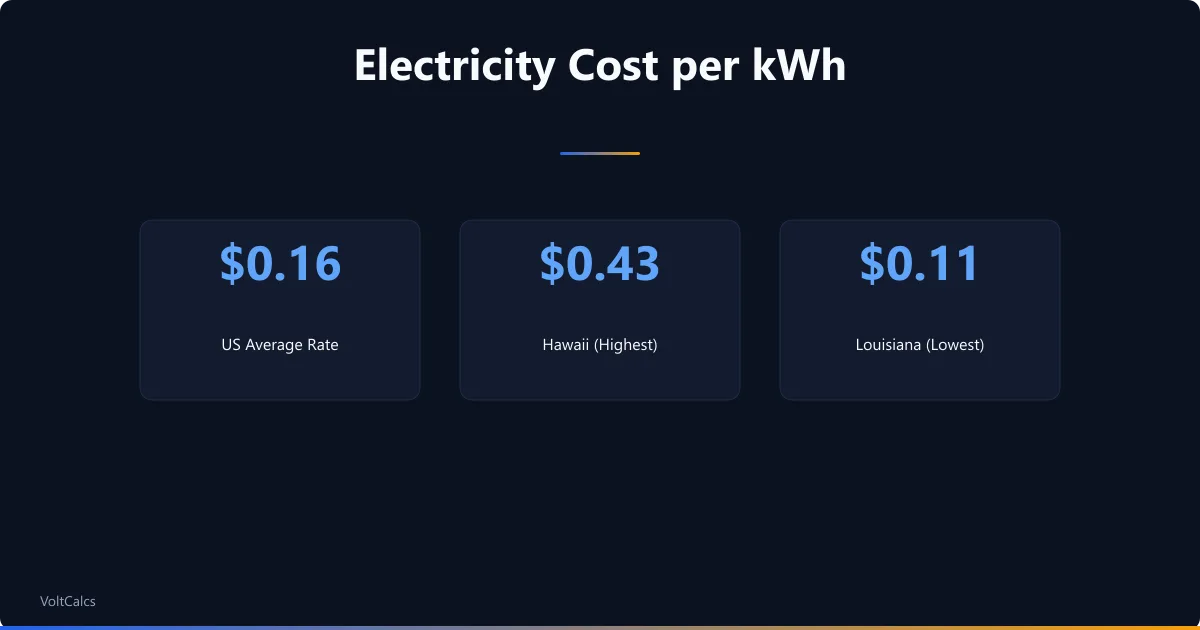
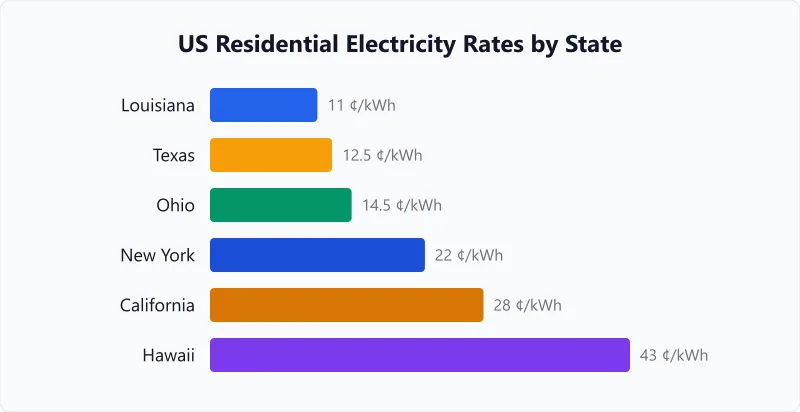
*Costs calculated at $0.16/kWh, close to EIA's 2024 average residential rate of 16.5 ¢ (early-2026 rates run about 19 ¢ by BLS). Prices and rates on this page are our own estimates as of the date shown; they change often. Enter your own figures for a current result. Your actual rate may be higher — especially in California ($0.27), New England ($0.25+), or Hawaii ($0.40+). Check your bill for the exact number, and remember that delivery charges and taxes can effectively double the per-kWh cost you see on the rate schedule.
Energy Hogs vs Efficient Alternatives
The biggest energy consumers in a typical home are heating, cooling, and hot water. A single 1,500W space heater running 8 hours a day costs nearly $60 per month. Two of them in a poorly insulated house, running through a cold winter, can add $700-1,000 to your annual electricity bill. Central air conditioning at 3,500W for 8 hours daily costs over $130 per month during summer; the cost-to-run-an-air-conditioner calculator works that figure from the unit BTU and SEER rating. To rank loads against each other and find the worst offenders, our appliance electricity cost calculator sorts typical household devices by annual cost.
Contrast that with modern efficient devices. A 65-inch LED TV running 5 hours daily costs under $2 per month. A laptop at 50W for a full workday: also under $2. LED bulbs are so efficient that lighting an entire house with 20 bulbs costs less per month than running one space heater for a single evening.
The biggest savings come from addressing the big loads, not sweating the small ones. Upgrading from a 15-year-old refrigerator (250W average) to a modern Energy Star model (100W average) saves about $70/year. Switching from electric resistance heating to a heat pump cuts heating costs by 50-70%. Adding insulation reduces both heating and cooling runtimes. These structural changes dwarf any savings from unplugging phone chargers or turning off lights — though those habits still help.
To understand how much energy you use overall and whether solar could offset it, our kWh calculator breaks down your total consumption by device and time period.
Practical Ways to Cut Your Electricity Bill
Start with the appliances that cost the most, not the ones that are easiest to unplug. Run the numbers through this calculator for every device you suspect is expensive. The results often surprise people. A slow cooker using 200W for 8 hours costs less than an oven using 2,500W for 1 hour to cook the same meal.
Switch remaining incandescent or CFL bulbs to LED. Use our amps draw calculator to see how little current an LED draws compared to the incandescent it replaces. A 60W-equivalent LED uses 8-10W and lasts 25,000+ hours. At $0.16/kWh, replacing ten 60W incandescents with LEDs saves about $30/year, and you buy fewer replacement bulbs.
Use smart power strips for entertainment centers and computer setups. A TV, soundbar, game console, and streaming stick on standby draw 30-50W combined, all day, every day. A smart strip cuts power to peripherals when the main device turns off, saving $25-40/year per setup.
Run your dishwasher and washing machine only when full. A half-full dishwasher uses the same 1,500W cycle as a full one. If you run it half-loaded every day instead of full every other day, you double the energy cost for the same number of dishes.
Consider time-of-use rates if your utility offers them. Running the dryer, dishwasher, and EV charger during off-peak hours (usually 9 PM to 6 AM) can cut the effective rate by 30-50% on those loads. The appliances do the same work; you just pay less for the electricity.
For the biggest long-term savings, solar panels can eliminate or dramatically reduce your electricity bill. Our solar ROI calculator estimates the payback period based on your location and current electricity costs.
Worked Examples
Space Heater Through Winter
Context
You run a 1,500W space heater in your home office for about 8 hours per day during the heating season (roughly November through March — about 150 days). Your electricity rate is $0.16/kWh. How much does this heater add to your annual bill?
Calculation
Daily energy: 1,500 W x 8 hours = 12,000 Wh = 12 kWh
Daily cost: 12 kWh x $0.16 = $1.92
Monthly cost (30 days): $1.92 x 30 = $57.60
Heating season cost (150 days): $1.92 x 150 = $288.00
Interpretation
One space heater adds nearly $300 to your electricity bill over a single heating season. If you have two running in different rooms, that doubles to $576. At rates above $0.20/kWh (common in California and New England), the same heater costs $360 per season — approaching the price of a mini-split heat pump that would cost 50-70% less to operate. For the full seasonal picture at any wattage and duty cycle, see our how much a space heater costs to run calculator.
Takeaway
Space heaters are cheap to buy but expensive to run. For rooms that need regular heating, a ductless mini-split heat pump costs $1,500-3,000 installed but pays for itself in 2-4 years through lower running costs. To see how many solar panels could offset your heating electricity, our solar panel size estimator shows the array size needed for your location.
Gaming PC Year-Round
Context
Your gaming PC draws about 400W under typical gaming load. You play for an average of 4 hours per day, year-round. Your electricity rate is $0.16/kWh. What does this hobby cost in electricity?
Calculation
Daily energy: 400 W x 4 hours = 1,600 Wh = 1.6 kWh
Daily cost: 1.6 kWh x $0.16 = $0.256
Monthly cost: $0.256 x 30 = $7.68
Yearly cost: $0.256 x 365 = $93.44
Interpretation
At under $8 per month, a gaming PC is surprisingly affordable to run — less than most streaming subscriptions. The PC also draws power in idle and sleep modes (50-100W), which could add another $70-140/year if left on 24/7. The monitor adds 30-80W depending on size and type.
Takeaway
The gaming PC itself is not a budget-breaker. The real cost multiplier is peripheral loads — the monitor, speakers, router, and any streaming or server hardware running alongside it. Add up everything on that desk using our electrical load calculator to get the complete picture of what your gaming setup draws in total.
Frequently Asked Questions
Glossary
Kilowatt-Hour
A unit of energy equal to using 1,000 watts for one hour. This is what your electricity meter measures and what you are billed for. A 100W light bulb running for 10 hours uses 1 kWh. At $0.16/kWh, that costs $0.16. Not to be confused with kilowatts (kW), which measure instantaneous power, not energy consumed over time.
Standby Power (Phantom Load)
The electricity consumed by devices that are turned off but still plugged in. TVs, game consoles, microwave displays, and chargers all draw small amounts of power (1-10W each) when not actively in use. Also called vampire draw. Collectively, standby loads account for 5-10% of a typical household's electricity bill.
Demand Charge
A fee some utilities add based on your highest instantaneous power draw (measured in kW) during the billing period, not your total energy usage (kWh). Common on commercial accounts and increasingly on residential accounts with time-of-use rates. Running your dryer, oven, and AC simultaneously creates a high demand peak that triggers a surcharge even if your total monthly kWh is low.
Planning to go off-grid? Our off-grid load calculator helps you total up your daily energy needs so you can size solar panels and batteries accurately.
Related calculators
Kilowatt-Hour (kWh) Calculator
Calculate kilowatt-hours and energy cost for any appliance or device. Enter watts, hours of use, and your electricity rate for instant results.
Electrical
Electricity Bill Estimator
Estimate your full monthly electricity bill by category: HVAC, water heating, fridge, lighting, electronics, cooking, laundry, plus fixed delivery charges.
Electrical
Appliance Electricity Cost Calculator
See exactly what each appliance costs to run by day, month, and year. Enter wattage, hours of use, and your rate to rank household energy hogs.
Electrical
Solar ROI Calculator
Calculate your solar panel payback period, 25-year savings, and return on investment. Enter system cost, size, and electricity rate.
Solar
One last tip: the electricity rate on your bill's rate schedule is almost never the rate you actually pay. Delivery charges, demand charges, fuel adjustments, and taxes typically add 30-100% on top of the base generation rate. When entering your rate in this calculator, use the all-in cost (total bill divided by total kWh) for the most accurate results. If your bill shows 2,000 kWh used and a total of $380, your effective rate is $0.19/kWh — not the $0.12 supply rate printed on the first page. Our guide to understanding electricity costs breaks down a real bill line by line and covers time-of-use pricing, demand charges, and reduction strategies.
More Electrical calculators
Browse all electrical calculators — Motor FLA, wire sizing, voltage drop, load calculations, and transformer fusing based on NEC standards.
Last updated:
Written and maintained by Dan Dadovic, Commercial Director at Ezoic Inc. & PhD Candidate in Information Sciences. He works professionally as Commercial Director at Ezoic Inc., leading revenue strategy across digital publishing.
Disclaimer: Calculator results are estimates based on theoretical formulas. Actual performance varies with temperature, battery age, load patterns, and equipment condition. For critical electrical work, consult a licensed electrician.
Methodology reviewed by Doc. dr. sc. Danijel Jerković-Štil, Assistant Professor, FERIT Osijek.