The 5-Step Solar Sizing Process
- Audit your loads. List every appliance with its wattage and daily hours of use. Multiply watts by hours for each to get watt-hours. A 60W fridge running 8 hours per day (compressor duty cycle) uses 480Wh. A 10W LED running 5 hours uses 50Wh. Add them all up for your total daily usage.
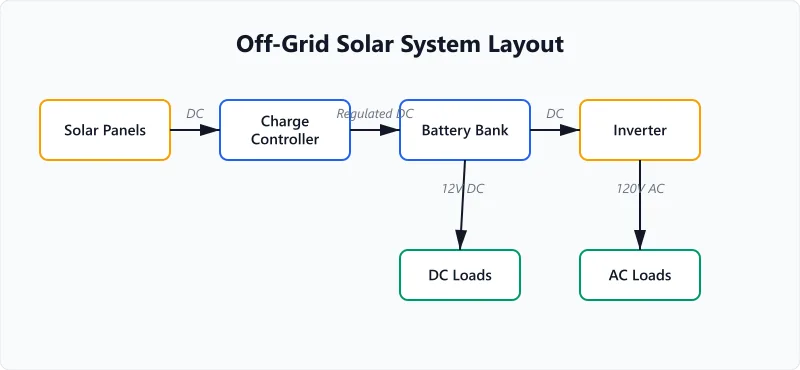
- Account for system losses. Divide your total by (1 - loss), which is a x1.25 multiplier at 20% losses and x1.33 at 25%. This is our own estimate; no published source backs these figures. Check your results against your product data or a licensed professional before acting. These losses come from charge controller conversion, battery charge/discharge inefficiency, wiring resistance, and inverter overhead. A 3,000Wh daily need becomes 4,000Wh after accounting for 25% losses.
- Calculate solar array size. Divide loss-adjusted daily usage by your worst-month peak sun hours. 4,000Wh / 4 hours = 1,000W of solar panels. Round up to the next panel — three 400W panels give you 1,200W, which provides a comfortable 20% buffer.
- Size the battery bank. Multiply daily usage by autonomy days, then divide by depth of discharge. For 3,000Wh x 2 days / 0.80 DoD = 7,500Wh of battery capacity. At 12V, that is 625Ah.
- Verify your charge controller. Your charge controller must handle the total panel current. Three 400W panels on a 12V system produce about 33A each at battery voltage — an MPPT controller rated for 100A would work.
Example: Sizing a Weekend Cabin System
Consider a small cabin with these loads: LED lights (40W for 5 hours = 200Wh), a 12V compressor fridge (50W average, runs 10 hours = 500Wh), phone and laptop charging (60W for 3 hours = 180Wh), and a water pump (100W for 0.5 hours = 50Wh). Total daily usage: 930Wh.
The cabin sits in Colorado with 4.5 worst-month peak sun hours. Allowing 20% for losses: 930 / (1 - 0.20) = 1,163Wh needed from panels. That is 1,163 / 4.5 = 258W of solar. Two 200W panels (400W total) give a solid 55% buffer above minimum.
For batteries, 2 days of autonomy: 930 x 2 / 0.80 = 2,325Wh. At 12V, that is 194Ah. Two 100Ah LiFePO4 batteries (200Ah total) meet this target with a small margin.
Total cost estimate as of early 2026: two 200W panels ($200-300), two 100Ah LiFePO4 batteries ($400-600), a 30A MPPT controller ($100-150), and a 1,000W pure sine inverter ($100-200). Prices and rates on this page are our own estimates as of the date shown; they change often. Enter your own figures for a current result. Complete system: roughly $800-1,250.
Common Off-Grid System Sizes
| System Size | Daily Output | Battery Bank | Typical Use |
|---|---|---|---|
| 400W panels / 200Ah 12V | 1,200-1,600Wh | 2x 100Ah LiFePO4 | Small cabin, shed, or boat |
| 800W panels / 400Ah 12V | 2,400-3,200Wh | 4x 100Ah LiFePO4 | Full-time RV or van life |
| 2,000W panels / 400Ah 24V | 6,000-8,000Wh | 8x 100Ah LiFePO4 (24V) | Off-grid tiny house |
| 5,000W panels / 800Ah 48V | 15,000-20,000Wh | 32x 100Ah LiFePO4 (48V) | Full-size off-grid home |
Worked Examples
Off-Grid Shed Workshop in Oregon
Context
Calculation
Daily usage = (1800×1) + (80×5) + (15×6) + (10×2) = 1,800 + 400 + 90 + 20 = 2,310Wh
Loss-adjusted: 2,310 / (1 - 0.20) = 2,888Wh
Solar array: 2,888 / 3 PSH = 963W → 3 × 400W panels (1,200W)
Battery bank (2 days autonomy): 2,310 × 2 / 0.80 = 5,775Wh ÷ 24V = 241Ah at 24V
Interpretation
Three 400W panels provide a 30% buffer over minimum in Oregon's overcast winters. The 241Ah requirement at 24V means three 100Ah 12V batteries in series pairs (6 batteries total for 24V 300Ah) gives comfortable headroom.
Takeaway
For a workshop with intermittent high-draw tools, make sure your inverter handles the table saw's startup surge. Use our battery size for inverter calculator to confirm the battery bank can deliver peak current without voltage sag.
Grid-Down Emergency Backup in Texas
Context
Calculation
Daily usage = (150×10) + (30×24) + (60×6) + (20×3) = 1,500 + 720 + 360 + 60 = 2,640Wh
Loss-adjusted: 2,640 / (1 - 0.22) = 3,385Wh
Solar (winter): 3,385 / 3.5 = 967W → 3 × 400W panels (1,200W)
Battery (3 days autonomy): 2,640 × 3 / 0.80 = 9,900Wh ÷ 12V = 825Ah at 12V
Interpretation
For 3 days without sun, the battery bank is substantial — nine 100Ah batteries at 12V. That's heavy and expensive ($2,200+). Reducing autonomy to 2 days cuts the bank to 6 batteries. The 1,200W array recharges the bank in about 2 sunny days from empty.
Takeaway
An emergency backup system with 3 autonomy days needs serious battery capacity. After sizing, check the solar battery charge time calculator to verify your panels can recharge fully between outage events.
Frequently Asked Questions
Glossary
Autonomy Days
The number of days a battery bank can power your loads without any solar input. Higher autonomy means more batteries and cost, but greater resilience during extended cloudy periods or storms.
System Voltage
The nominal voltage of the battery bank (typically 12V, 24V, or 48V). Higher voltages reduce current for the same power, allowing thinner cables and smaller fuses, which is why large systems use 24V or 48V.
Loss-Adjusted Usage
Your raw daily energy consumption multiplied by a loss factor (typically 1.15 to 1.25) to account for charge controller, battery, wiring, and inverter inefficiencies that consume energy before it reaches your appliances.
Charge Controller
An electronic device between the solar panels and battery bank that regulates charging voltage and current. MPPT controllers are more efficient than PWM, especially when panel voltage is much higher than battery voltage.
Check whether your planned battery bank can handle your loads with our battery runtime calculator.
Related calculators
Solar Battery Bank Size Calculator
Calculate the battery bank capacity your off-grid solar system needs. Enter daily usage, autonomy days, and system voltage.
Solar
How Many Batteries for a Solar System?
Figure out how many batteries your solar system needs for reliable off-grid power. Enter daily usage, autonomy, and battery specs.
Solar
Off-Grid Load Calculator
Calculate your total daily energy needs for off-grid living. Get recommended battery bank size and solar panel wattage for your system.
Solar
Solar ROI Calculator
Calculate your solar panel payback period, 25-year savings, and return on investment. Enter system cost, size, and electricity rate.
Solar
A properly sized off-grid system balances panel output, battery storage, and realistic loss factors. Undersizing any one component creates a bottleneck that drags down the whole system. When in doubt, round up — a 20% buffer on panels costs far less than running a generator every cloudy week. To convert your panel wattage into the amps your wiring and fuses need to handle, run the numbers through the solar watts to amps calculator.
More Solar calculators
Browse all solar calculators — Panel output, battery bank sizing, charge time, and system design for off-grid, RV, and residential setups.
Last updated:
Written and maintained by Dan Dadovic, Commercial Director at Ezoic Inc. & PhD Candidate in Information Sciences. He works professionally as Commercial Director at Ezoic Inc., leading revenue strategy across digital publishing.
Disclaimer: Calculator results are estimates based on theoretical formulas. Actual performance varies with temperature, battery age, load patterns, and equipment condition. For critical electrical work, consult a licensed electrician.
Methodology reviewed by Doc. dr. sc. Damir Topić, Assistant Professor, FERIT Osijek.