Solar Panel Wattage Guide by Application
| Panel Wattage | Daily Output (5 sun hrs, 14% loss) | Best For | Typical Price (2026) |
|---|---|---|---|
| 50-100W | 215-430Wh | Trickle charging, gate openers, single device | $50-90 |
| 100-200W | 430-860Wh | Boat electronics, RV supplement, camping | $80-180 |
| 200-300W | 860-1,290Wh | Small cabin, van conversion, RV primary | $150-250 |
| 300-400W | 1,290-1,720Wh | Large RV, small off-grid home, residential | $200-350 |
| 400-550W | 1,720-2,365Wh | Residential rooftop, medium off-grid | $250-450 |
Prices are approximate for monocrystalline panels from major brands. This is our own estimate; no published source backs these figures. Check your results against your product data or a licensed professional before acting. Budget panels can cost 20-30% less but may have lower efficiency and shorter warranties. Prices and rates on this page are our own estimates as of the date shown; they change often. Enter your own figures for a current result.
From Total Array Watts to a Panel Count
Sizing happens in two steps. First find the total array wattage your load needs: divide your daily watt-hours by your peak sun hours and your derate factor. A 3,000Wh daily load at 5 sun hours and 14% losses (the PVWatts default) needs 3,000 / (5 × 0.86) = 698W of panels. Second, divide that total by the wattage of the panel you want to use: 698 / 400 = 1.7, so two 400W panels. The total array figure drives your charge controller and wiring choices; the panel count is what you actually buy.
If you would rather start from a monthly utility bill than a daily watt-hour load, the home solar panel estimator works that way and reports the panel count and system size in kilowatts.
Bigger Panels vs More Panels
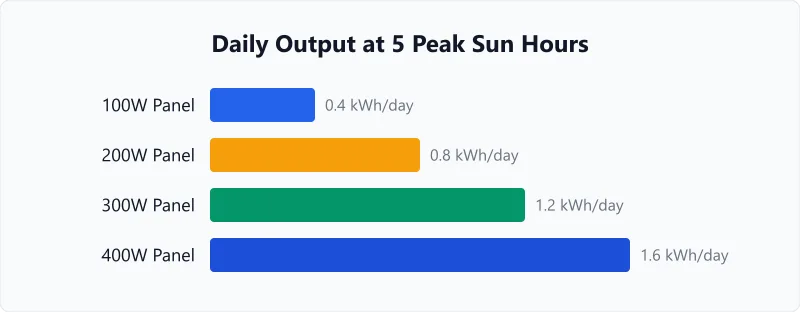
Fewer large panels (400W+) make sense when roof or ground space is limited, you want fewer mounting points, and your charge controller supports higher-voltage strings. A single 400W panel produces as much as two 200W panels but takes up less total area (panels have dead space around the frame) and needs half the wiring connections. Installers prefer large panels because they reduce labour time.
More small panels (100-200W) make sense for irregular mounting surfaces (curved RV roofs, boat decks, odd-shaped ground areas), portable setups where you fold and move panels, and systems where partial shading is unavoidable. Smaller panels with individual MPPT inputs or microinverters handle shade better because one shaded panel does not drag down the others.
Efficiency also favours larger panels. Modern 400W residential panels achieve 20-22% efficiency, while budget 100W panels sit around 17-19%. Higher efficiency means more watts per square foot — which matters when space is your constraint.
Example: Right-Sizing Panels for a Van Conversion
A typical van conversion uses 1,500Wh per day (12V fridge, lights, fan, phone/laptop charging). The van travels the US Southwest with 5.5 average peak sun hours. With 20% system losses: 1,500 / (5.5 x 0.80) = 341W minimum.
Option A: Two 200W panels (400W total). Cost (early 2026): ~$300-360. Fits on a standard Sprinter roof with room for a vent fan. Provides 17% buffer above minimum. Each panel is light enough for one person to lift onto the roof.
Option B: One 400W panel. Cost (early 2026): ~$250-350. Uses less roof space but is heavier and needs a larger charge controller input. A single panel failure means zero solar until replaced.
Option C: Four 100W flexible panels. Cost (early 2026): ~$320-400. Follows the van roof curve without a rack. Lighter total weight but lower efficiency and shorter lifespan (flexible panels degrade faster). Partial shading on one panel does not kill the array if each panel has its own MPPT channel.
For most van builds, Option A wins: two rigid 200W panels balance cost, reliability, and roof space.
Worked Examples
Choosing Panel Size for a Boat Deck Installation
Context
Calculation
Minimum array = 800 / (5.5 × 0.78) = 800 / 4.29 = 186.5W
With 25% buffer: 186.5 × 1.25 = 233W
Option: two 120W semi-flexible panels (240W total) or two 200W rigid panels (400W, but need flat mounting area)
Interpretation
Two 120W flexible panels (240W) barely exceeds the buffered minimum. Two 200W rigid panels (400W) provide a 72% margin, which is generous but handles cloudy days and panel degradation with ease. The rigid panels produce more reliably over time since flexible panels lose output faster.
Takeaway
For marine environments with salt spray and limited deck space, reliability per watt matters more than total wattage. After choosing panels, verify your battery bank handles overnight loads when panels produce nothing — the battery runtime calculator gives a clear answer.
Residential Grid-Tied System for Full Offset
Context
Calculation
Minimum array = 35,000 / (5.2 × 0.85) = 35,000 / 4.42 = 7,919W
With 20% buffer: 7,919 × 1.20 = 9,503W
Panel count (450W panels): 9,503 / 450 = 21.1 → 22 panels (9,900W system)
Interpretation
A 9.9kW system with 22 panels of 450W each. In summer with 7+ PSH, this system overproduces by 30-40% and banks net metering credits. In winter with 3.5 PSH, it underproduces, and those credits offset the deficit. Annual production should closely match the 12,775 kWh/year target.
Takeaway
Grid-tied systems with net metering can use annual averages rather than worst-month sizing. To track whether your system hits its target, monitor monthly kWh with the kWh calculator and compare against your utility bill.
Frequently Asked Questions
Glossary
Panel Efficiency
The percentage of incident sunlight converted to electricity. A 22% efficient panel converts 220W of the 1,000W per square meter that hits it under standard test conditions. Higher efficiency means more watts per unit of area.
Flexible Panel
A thin, bendable solar panel that can conform to curved surfaces like RV and boat roofs. They weigh less and need no mounting rack, but typically have lower efficiency (15-18%) and degrade faster than rigid panels.
Net Metering
A billing arrangement where excess solar energy sent to the grid earns credits that offset future grid draws. Net metering makes annual energy balancing possible, since overproduction in summer covers underproduction in winter.
Want to compare output across different panel counts? Our solar panel output calculator lets you adjust wattage and count for instant results.
Related calculators
How Many Solar Panels Do I Need?
Find how many solar panels your home needs from your monthly electricity bill. Get the panel count, system size in kW, and how much of the bill it offsets.
Solar
Solar Panel Output Calculator
Calculate daily and monthly energy output from your solar panels. Enter wattage, sun hours, and panel count for instant results.
Solar
Solar Panel Roof Area Calculator
Calculate how many solar panels fit on your roof and the total output potential. Enter roof dimensions and panel specs.
Solar
Solar Time Calculator
Calculate apparent solar time and solar noon for any location. Enter longitude and date to find when the sun is highest.
Solar
Panel size is a balance between energy needs, physical space, and budget. Do not overbuy panels to compensate for undersized batteries, and do not skimp on panels hoping for sunny-day averages. Match your panel array to your worst-month sun hours and real daily usage, then pick the panel wattage that fits your mounting situation. The cheapest panel per watt that physically fits is usually the right answer. To check whether your roof can physically fit the panel count you need, use the solar roof area calculator.
More Solar calculators
Browse all solar calculators — Panel output, battery bank sizing, charge time, and system design for off-grid, RV, and residential setups.
Last updated:
Written and maintained by Dan Dadovic, Commercial Director at Ezoic Inc. & PhD Candidate in Information Sciences. He works professionally as Commercial Director at Ezoic Inc., leading revenue strategy across digital publishing.
Disclaimer: Calculator results are estimates based on theoretical formulas. Actual performance varies with temperature, battery age, load patterns, and equipment condition. For critical electrical work, consult a licensed electrician.
Methodology reviewed by Doc. dr. sc. Damir Topić, Assistant Professor, FERIT Osijek.