
Common Camper Electrical Loads
| Appliance | Typical Wattage | Daily Hours | Daily Wh |
|---|---|---|---|
| 12V compressor fridge | 40-60W (avg) | 10-12 | 480-720 |
| LED interior lights | 20-40W total | 4-6 | 80-240 |
| Roof vent fan | 15-40W | 6-10 | 90-400 |
| Phone charging (x2) | 10-20W | 3 | 30-60 |
| Laptop | 50-80W | 3-5 | 150-400 |
| Water pump | 60-100W | 0.25-0.5 | 15-50 |
| Diesel heater fan | 10-30W | 8 (winter) | 80-240 |
| Coffee maker (12V) | 100-150W | 0.15 | 15-23 |
| Microwave (via inverter) | 1,000-1,200W | 0.15-0.25 | 150-300 |
| Induction cooktop (via inverter) | 1,200-1,800W | 0.3-0.5 | 360-900 |
Typical wattages are our own estimates; check your appliance's nameplate.
Wattages are approximate. Check each appliance's label or manual for exact draw. Inverter-powered AC appliances add 10-15% overhead for conversion losses.
Example: Weekend Warrior vs Full-Time Van Lifer
Weekend warrior (2-3 nights at a time): Fridge (500Wh), lights (120Wh), fan (150Wh), phone charging (40Wh), water pump (20Wh). Total: ~830Wh/day. With 2 days of autonomy and 80% DoD on a 12V system: 830 x 2 / 0.80 = 2,075Wh. This is our own estimate; no published source backs these figures. Check your results against your product data or a licensed professional before acting. At 12V: 173Ah. Two 100Ah LiFePO4 batteries (200Ah) cover this easily. Most weekenders can get by with a single 200Ah battery, using the vehicle alternator for recharging during drives.
Full-time van lifer (works remotely, cooks in the van): Fridge (600Wh), lights (200Wh), fan (300Wh), phone/tablet charging (60Wh), laptop for work (350Wh), water pump (30Wh), microwave lunch (200Wh), diesel heater winter (160Wh), miscellaneous (100Wh). Total: ~2,000Wh/day. With 2 days of autonomy: 2,000 x 2 / 0.80 = 5,000Wh. At 12V: 417Ah. That takes five 100Ah LiFePO4 batteries (500Ah), or three 200Ah units (600Ah); four 100Ah units come to 400Ah and fall 17Ah short. Adding an induction cooktop pushes daily usage to 2,500-3,000Wh and requires 6-7 batteries.
The difference between these two setups is about $600-800 in batteries (as of early 2026) and 60-80 lbs of weight. Prices and rates on this page are our own estimates as of the date shown; they change often. Enter your own figures for a current result. Full-timers also need more solar (400-600W vs 200W for weekenders) and a larger inverter (2,000W vs 1,000W).
How to Build Your Camper Battery Bank
- Choose your chemistry. LiFePO4 is the clear winner for campers: it is roughly half the weight of lead-acid (48-63% lighter by manufacturer weights), delivers more usable capacity, charges faster from alternator and solar, and lasts 5-10x longer. The only real argument for AGM is budget on a vehicle you will not own long-term.
- Pick your battery size. 100Ah 12V LiFePO4 batteries are the most popular camper format. They fit in standard battery trays, weigh 22-26 lbs each, and connect in parallel easily. 200Ah units exist but weigh 45-55 lbs and may be awkward to fit in tight van compartments.
- Wire batteries in parallel. For a 12V system, connect all batteries positive-to-positive and negative-to-negative. Use a bus bar for clean, secure connections. Keep cable lengths from each battery to the bus bar equal to ensure balanced charging and discharging.
- Add a battery monitor. A shunt-based monitor (like Victron SmartShunt or Renogy 500A) shows state of charge, current draw, and time remaining. Without one, you are guessing how much battery you have left. Budget $50-100 for this — without it, you are flying blind.
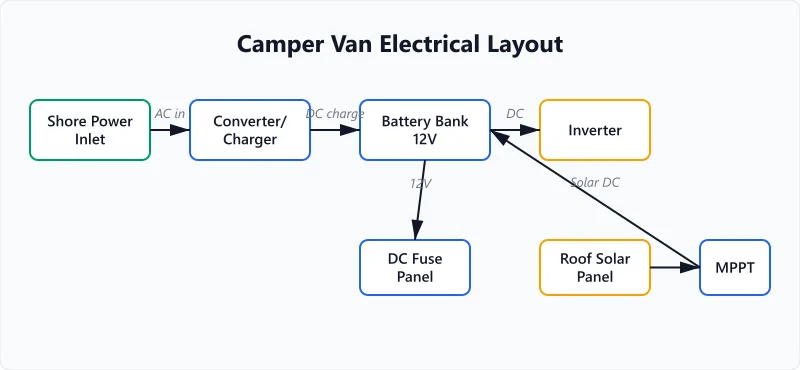
- Set up charging sources. Most campers use three charging methods: solar panels (primary when parked), alternator via a DC-DC charger (charges while driving), and shore power via a mains charger (when available at campgrounds). A good DC-DC charger (Victron Orion, Renogy DCC series) safely charges LiFePO4 from your vehicle alternator at 20-50A.
Worked Examples
Building a Battery Bank for a Teardrop Trailer
Context
Calculation
Daily usage = (10×4) + (15×2) + (35×10) = 40 + 30 + 350 = 420Wh
Bank (2 days autonomy) = 420 × 2 / 0.80 = 1,050Wh
At 12V: 1,050 / 12 = 87.5Ah
Result: 1 battery (100Ah) is sufficient
Interpretation
A single 100Ah LiFePO4 battery covers 2 days of this light load with 12.5Ah to spare. The cooler is the biggest draw by far — if the cooler is upgraded to a larger model, the margin shrinks. No need for a second battery unless the cooler draw exceeds 40W average.
Takeaway
Teardrop trailers thrive on minimal, efficient loads. A single 100Ah battery and a 100W solar panel make a complete, lightweight system. Check runtime for the cooler specifically with our 12V battery runtime calculator to confirm it runs through the night.
Full-Time Remote Worker in a Sprinter Van
Context
Calculation
Summer daily = 600+200+250+450+60+30+200 = 1,790Wh
Winter daily = 1,790 + 160 = 1,950Wh
Bank (2 days, winter) = 1,950 × 2 / 0.80 = 4,875Wh ÷ 12 = 406Ah
With 200Ah batteries: 406/200 = 2.03 → 3 batteries (600Ah provides 47% margin)
Interpretation
Three 200Ah batteries provide 600Ah — well above the 406Ah minimum. That extra 47% margin handles above-average usage days, winter efficiency losses, and future load additions (like an espresso machine). Weight: about 150 lbs total, manageable in a Sprinter's under-bed compartment.
Takeaway
Remote workers need generous battery margins because a dead battery means no work. Pair this bank with 400-600W of rooftop solar for daily recharging. The solar panel output calculator shows how many watt-hours that array delivers at your sun hours, so you can confirm it refills the 1,950Wh you use each day.
Frequently Asked Questions
Glossary
DC-DC Charger
A device that safely charges house batteries from a vehicle alternator by regulating voltage and current to match the battery chemistry's charge profile. Required for LiFePO4 batteries, which can draw dangerous current directly from an alternator without regulation.
House Battery
The auxiliary battery bank in a camper or RV that powers living-area loads (fridge, lights, electronics). Separate from the vehicle's starter battery, which only cranks the engine. The two systems should be isolated to prevent house loads from draining the starter battery.
Shore Power
AC mains electricity supplied at a campground or marina through a pedestal hookup. Shore power charges the house battery bank via a built-in charger and can run AC appliances directly. Not always available, which is why solar and alternator charging matter as backups.
Bus Bar
A solid copper or brass bar used to connect multiple battery cables in parallel. Bus bars provide secure, low-resistance connections and keep wiring organized. Each battery should have equal-length cables to the bus bar to ensure balanced current distribution.
Planning solar panels for your camper roof? Use the solar panel size calculator to match panel wattage to your daily usage.
Related calculators
RV Battery Runtime Calculator
Calculate how long your RV battery bank powers your camper. Enter your loads, battery size, and get real runtime.
Battery
How Many Batteries for a Solar System?
Figure out how many batteries your solar system needs for reliable off-grid power. Enter daily usage, autonomy, and battery specs.
Solar
Off-Grid Load Calculator
Calculate your total daily energy needs for off-grid living. Get recommended battery bank size and solar panel wattage for your system.
Solar
Solar Battery Bank Size Calculator
Calculate the battery bank capacity your off-grid solar system needs. Enter daily usage, autonomy days, and system voltage.
Solar
Camper battery sizing comes down to knowing your loads and how you travel. Weekend warriors can start small — a single 100-200Ah LiFePO4 battery plus a modest solar panel handles basic needs. Full-time van lifers with laptops, microwaves, and induction cooktops need a serious bank of 300-600Ah and 400W+ of solar. Start with the load table above, be honest about your usage, and let the calculator tell you the number. You can always add a battery later, but getting the initial size close avoids the frustration of running out of power on your first trip. Once your bank is sized, verify your solar panels can recharge it each day with the solar battery charge time calculator.
More Solar calculators
Browse all solar calculators — Panel output, battery bank sizing, charge time, and system design for off-grid, RV, and residential setups.
Last updated:
Written and maintained by Dan Dadovic, Commercial Director at Ezoic Inc. & PhD Candidate in Information Sciences. He works professionally as Commercial Director at Ezoic Inc., leading revenue strategy across digital publishing.
Disclaimer: Calculator results are estimates based on theoretical formulas. Actual performance varies with temperature, battery age, load patterns, and equipment condition. For critical electrical work, consult a licensed electrician.
Methodology reviewed by Doc. dr. sc. Damir Topić, Assistant Professor, FERIT Osijek.