Common Off-Grid Appliance Power Draws
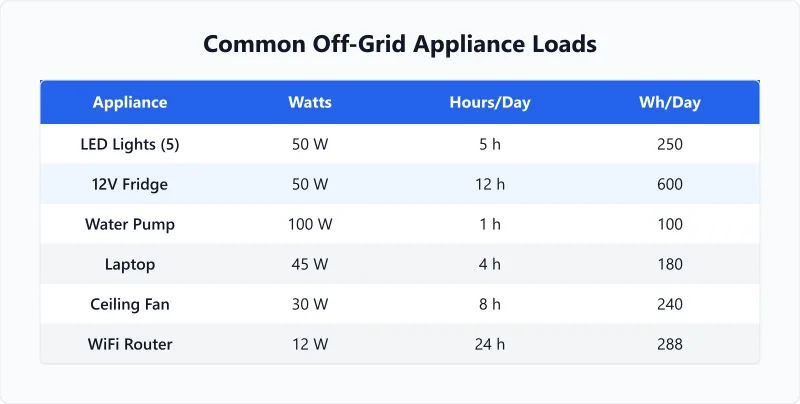
| Appliance | Typical Watts | Typical Hours/Day | Daily Wh |
|---|---|---|---|
| LED lights (whole house) | 40-100W | 6-10 | 240-1,000 |
| 12V compressor fridge | 40-60W avg | 10-14 | 400-840 |
| Full-size fridge (AC, via inverter) | 80-150W avg | 10-14 | 800-2,100 |
| Laptop | 50-100W | 4-8 | 200-800 |
| Phone charger | 5-15W | 2-4 | 10-60 |
| TV / monitor | 40-120W | 3-6 | 120-720 |
| Microwave | 1,000-1,500W | 0.15-0.3 | 150-450 |
| Washing machine | 400-600W | 0.5-1 | 200-600 |
| Well pump | 500-1,500W | 0.5-2 | 250-3,000 |
| Router / modem | 10-25W | 24 | 240-600 |
| Ceiling fan | 30-75W | 8-12 | 240-900 |
| Chest freezer | 50-100W avg | 8-12 | 400-1,200 |
Typical wattages are our own estimates; check your appliance's nameplate.
Average watts listed for compressor appliances reflect the duty cycle — a fridge rated at 120W does not run continuously. This is our own estimate; no published source backs these figures. Check your results against your product data or a licensed professional before acting. It cycles on and off, averaging 40-60W over the day. Use a Kill-A-Watt meter to measure actual consumption for the most accurate load audit.
How to Conduct a Complete Load Audit
- List every electrical device. Walk through each room and write down everything that plugs in or runs on batteries you plan to charge. Do not forget phantom loads (devices that draw power while "off" — TV standby, phone chargers left plugged in, clocks on microwaves). These add 50-200Wh/day in a typical home.
- Measure actual wattage. Nameplate ratings overstate real consumption. A laptop rated at 65W might draw only 30-40W during normal use. A Kill-A-Watt meter ($25-35) plugged between the appliance and the wall gives you the true draw in real time, plus cumulative kWh over 24 hours. This single tool pays for itself by preventing oversized (expensive) battery banks.
- Multiply watts by hours. For each appliance: actual watts × daily hours of use = daily Wh. A 60W LED light array running 8 hours uses 480Wh. A 100W laptop running 4 hours uses 400Wh. Be honest about usage. Underestimating hours is the most common load audit mistake.
- Add 20-30% for losses and margin. Inverter efficiency (85-93%), wiring resistance (2-3%), and battery charge/discharge losses (5-10%) eat into your available energy. Add a 20% buffer for a well-designed system, or 30% if you are using lead-acid batteries or long cable runs. This margin also covers appliances you forgot and the occasional high-use day.
- Total everything. Sum all appliance Wh values plus your loss margin. This is your daily energy budget: the single number that drives your entire solar panel and battery sizing decision.
Designing Around Your Load Audit
Your daily Wh total determines everything downstream: battery bank capacity, solar array size, charge controller rating, and inverter capacity. A 2,000Wh/day system is a different animal from a 6,000Wh/day system — not just bigger, but architecturally different. Below 3,000Wh/day, a 12V system with a single MPPT controller handles everything. Above 5,000Wh/day, you almost certainly want 24V or 48V to keep wire sizes and currents manageable.
The single best way to reduce your off-grid system cost is to reduce your loads before sizing the system. Swapping an old full-size fridge for a high-efficiency DC compressor fridge cuts 500-1,000Wh/day. Replacing incandescent bulbs with LEDs saves another 200-500Wh/day. Using a laptop instead of a desktop PC saves 300-600Wh/day. These efficiency upgrades cost far less than the extra batteries and panels needed to power inefficient appliances. Once your system is sized, the solar ROI calculator shows the payback period and 25-year savings.
Think about peak loads too, not just daily energy. A 1,500W microwave running through a 2,000W inverter draws 125A from a 12V battery bank for 3-5 minutes. The battery size for inverter calculator helps you ensure the bank has enough capacity to deliver that peak current without excessive voltage sag. If your peak load exceeds 2,000W, a 24V or 48V system halves (or quarters) the current draw and allows thinner, cheaper cables.
Worked Examples
Basic Off-Grid Cabin Weekend
Context
A weekend cabin in the mountains has three loads: LED lights at 60W running 8 hours, a laptop at 100W for 4 hours, and a phone charger at 10W for 6 hours. The system is 12V. No refrigeration — the cabin uses a propane cooler.
Calculation
LED lights: 60W × 8h = 480Wh
Laptop: 100W × 4h = 400Wh
Phone charger: 10W × 6h = 60Wh
Total daily load = 480 + 400 + 60 = 940Wh/day
With 25% margin for losses: 940 × 1.25 = 1,175Wh/day
Interpretation
At 940Wh/day (1,175Wh with margin), this is a modest system. A 200Ah 12V LiFePO4 battery bank at 80% DoD provides 1,920Wh of usable energy — enough for 2 days without any solar input. Two 200W solar panels with 4 peak sun hours produce about 1,380Wh/day after the 14% default losses, comfortably exceeding the daily load. Check the deep cycle battery runtime calculator to verify this bank handles your loads through a full night and cloudy morning.
Takeaway
A sub-1,000Wh daily load is the sweet spot for simple, affordable off-grid systems. One or two batteries and a couple of panels cover the basics without complex wiring or expensive charge controllers.
Full-Time Off-Grid Homestead
Context
A family lives year-round off-grid in rural Vermont. Loads include: a full-size fridge at 100W average for 24 hours, LED lights at 60W for 10 hours, a TV at 80W for 4 hours, a laptop at 100W for 6 hours, a washing machine at 500W for 1 hour, a well pump at 750W for 0.5 hours, and miscellaneous loads (router, chargers, clocks) at 200W for 3 hours. The system is 48V.
Calculation
Fridge: 100W × 24h = 2,400Wh
Lights: 60W × 10h = 600Wh
TV: 80W × 4h = 320Wh
Laptop: 100W × 6h = 600Wh
Washer: 500W × 1h = 500Wh
Well pump: 750W × 0.5h = 375Wh
Misc: 200W × 3h = 600Wh
Total = 2,400 + 600 + 320 + 600 + 500 + 375 + 600 = 5,395Wh, rounded to ~5,400Wh/day
With 25% margin: 5,400 × 1.25 = 6,750Wh/day
Interpretation
At nearly 5,400Wh/day before margin, this is a serious off-grid system. A 48V configuration keeps wiring manageable at these power levels. The well pump and washing machine create the highest instantaneous loads (750W and 500W) but run briefly. The fridge dominates the daily budget at 2,400Wh — upgrading to a high-efficiency DC fridge (500-700Wh/day) would cut total consumption by roughly 30%. Use the battery runtime calculator to check how long your planned battery bank runs the fridge alone during extended cloudy stretches.
Takeaway
Full-time off-grid living above 5,000Wh/day requires 48V architecture, 1,500W+ of solar panels, and a battery bank sized for at least 2 days of autonomy. The upfront cost is significant ($8,000-15,000 for batteries and panels as of early 2026), but zero electricity bills and energy independence are the payoff.
Frequently Asked Questions
Glossary
Load Audit
A systematic inventory of every electrical device in a building, recording its wattage and daily hours of use to calculate total energy consumption. A thorough load audit is the first and most important step in designing an off-grid power system, because every downstream decision — battery bank size, solar array wattage, charge controller rating — depends on knowing the daily Wh total accurately.
Autonomy Days
The number of consecutive days an off-grid battery bank can power all loads without any recharging from solar, wind, or a generator. Two autonomy days is standard for most residential off-grid systems, providing a buffer for cloudy weather without requiring an excessively large (and expensive) battery bank.
Phantom Load
The small but continuous power draw from devices that are switched "off" but remain plugged in. Examples include TV standby circuits, microwave clocks, phone chargers with no phone attached, and smart home devices. Phantom loads in a typical home total 50-200Wh/day — equivalent to leaving a 10W light on all day. In an off-grid system, eliminating phantom loads with switched outlets or power strips is one of the easiest ways to reduce your daily energy budget.
Got your daily Wh total? Our solar panel size estimator tells you the minimum panel wattage needed to cover that load.
Related calculators
Solar Panel and Battery Sizing Calculator
Size your complete off-grid solar system. Enter daily usage, sun hours, and battery specs to get panel and battery bank recommendations.
Solar
Solar Battery Bank Size Calculator
Calculate the battery bank capacity your off-grid solar system needs. Enter daily usage, autonomy days, and system voltage.
Solar
Electrical Load Calculator
Calculate your home's electrical load and NEC 220 demand for panel and service sizing. Enter loads and quantities for connected and demand estimates.
Electrical
Battery Size for Inverter Calculator
Find the right battery capacity for your inverter. Enter load, runtime, voltage and chemistry: lead-acid banks need more amp-hours than lithium.
Battery
A load audit is the foundation of every off-grid system. Skip it, and you are guessing at battery and panel sizes — which means either overspending on capacity you do not need or running short on power when it matters most. Include phantom loads from devices on standby, measure real wattage instead of trusting nameplate labels, and add a 20-30% safety margin for inverter losses and high-usage days. The 15 minutes spent counting watts here saves hundreds of dollars on correctly sized equipment. Our off-grid load calculation guide covers the full process from appliance audit through battery and solar sizing.
More Solar calculators
Browse all solar calculators — Panel output, battery bank sizing, charge time, and system design for off-grid, RV, and residential setups.
Last updated:
Written and maintained by Dan Dadovic, Commercial Director at Ezoic Inc. & PhD Candidate in Information Sciences. He works professionally as Commercial Director at Ezoic Inc., leading revenue strategy across digital publishing.
Disclaimer: Calculator results are estimates based on theoretical formulas. Actual performance varies with temperature, battery age, load patterns, and equipment condition. For critical electrical work, consult a licensed electrician.
Methodology reviewed by Doc. dr. sc. Damir Topić, Assistant Professor, FERIT Osijek.