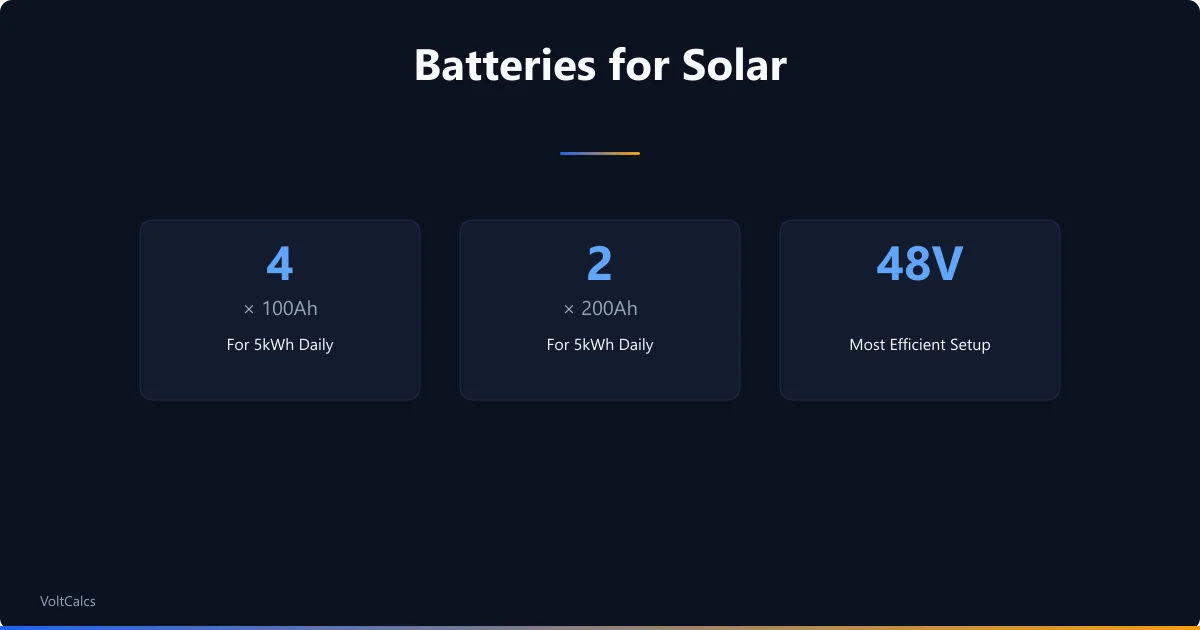
How the Battery Count Is Calculated
- Total energy required. Multiply daily usage by autonomy days. For 5,000Wh/day with 2 days of autonomy: 10,000Wh.
- Adjust for depth of discharge. Divide by DoD to get total raw capacity needed. 10,000 / 0.80 = 12,500Wh. This is the nameplate capacity your battery bank must have.
- Convert to amp-hours at system voltage. Divide watt-hours by system voltage. 12,500 / 24V = 520.8Ah at 24V.
- Calculate series batteries per string. Divide system voltage by single battery voltage. For a 24V system using 12V batteries: 24 / 12 = 2 batteries in series per string.
- Calculate parallel strings needed. Divide total Ah by single battery Ah. 520.8 / 100 = 5.2, round up to 6 parallel strings.
- Total battery count. Multiply series count by parallel count. 2 series x 6 parallel = 12 batteries. Each string has 2 batteries in series (for 24V), and you need 6 of these strings in parallel (for 600Ah total).
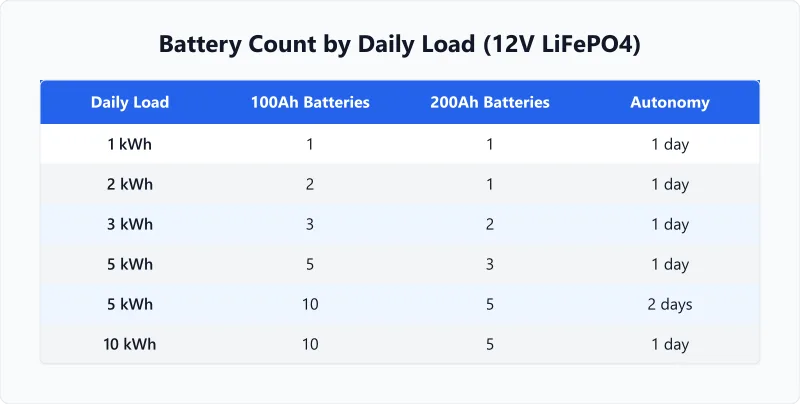
Example: Batteries for a Whole-House Solar System
A medium-sized off-grid home using 10,000Wh per day (refrigerator, lighting, well pump, electronics, occasional microwave). The owner wants 3 days of autonomy on a 48V system using 12V 100Ah LiFePO4 batteries at 80% DoD.
Total energy: 10,000 x 3 = 30,000Wh. After DoD adjustment: 30,000 / 0.80 = 37,500Wh. Convert to Ah at 48V: 37,500 / 48 = 781Ah.
Series batteries per string: 48V / 12V = 4 batteries in series. Parallel strings: 781 / 100 = 7.8, round up to 8 strings. Total: 4 x 8 = 32 batteries.
At roughly $250 per 100Ah LiFePO4 battery as of early 2026, that is $8,000 for the battery bank alone. This is why whole-house off-grid systems are a major investment — and why reducing daily usage (efficient appliances, gas cooking, solar water heating) pays off so directly. Cutting usage from 10kWh to 7kWh runs the same steps to 26,250Wh, 547Ah at 48V, and 6 strings of four: 24 batteries. That saves 8 batteries and $2,000.
Choosing the Right Battery Chemistry
LiFePO4 is the default choice for new off-grid solar builds. It handles 3,000-5,000 cycles at 80% DoD, charges fast, and requires zero maintenance. The high DoD means fewer total batteries. Downsides: higher upfront cost as of early 2026 ($200-300 per 100Ah) and cannot charge below 0°C without a heated enclosure.
AGM (Absorbed Glass Mat) was the go-to before LiFePO4 prices dropped. It is maintenance-free and handles freezing well, but only delivers 50% DoD safely and lasts 400-600 cycles. You need nearly twice as many AGM batteries as LiFePO4 for the same usable capacity, and you will replace them 5-8 times over the life of a LiFePO4 bank.
Flooded lead-acid costs the least upfront as of early 2026 ($80-120 per 100Ah) but demands monthly water-level checks, vents for hydrogen gas, and the same 50% DoD and short cycle life as AGM. Suitable only if your budget is tight and you do not mind regular maintenance.
For most solar systems built today, LiFePO4 costs less over its lifetime, takes up less space, weighs less, and needs no maintenance. The upfront price premium disappears when you factor in replacements and the larger bank size needed for lead-acid chemistry.
Worked Examples
Battery Count for a Remote Communications Relay
Context
Calculation
Total energy = 1,200Wh × 7 days = 8,400Wh
DoD adjusted = 8,400 / 0.80 = 10,500Wh
Amp-hours at 12V = 10,500 / 12 = 875Ah
Series per string = 12V / 12V = 1
Parallel strings = 875 / 100 = 8.75 → 9 strings
Total batteries = 1 × 9 = 9 batteries
Interpretation
Nine 100Ah batteries is a serious commitment for a 50W load, but 7 days of autonomy demands it. The system survives a full week of zero sun — critical for mountaintop installations where access during storms is impossible.
Takeaway
High-autonomy systems inflate battery counts fast. Reducing autonomy from 7 to 4 days drops the bank from 9 to 5 batteries. Balance reliability needs against cost, and confirm your panels can recharge the full bank with the solar battery charge time calculator.
Comparing 100Ah vs 200Ah Batteries for a Tiny House
Context
Calculation
Total energy = 4,000 × 2 = 8,000Wh. DoD adjusted = 8,000 / 0.80 = 10,000Wh
At 24V: 10,000 / 24 = 416.7Ah. Series per string = 24/12 = 2.
With 100Ah batteries: 416.7/100 = 4.2 → 5 parallel strings × 2 series = 10 batteries
With 200Ah batteries: 416.7/200 = 2.1 → 3 parallel strings × 2 series = 6 batteries
Interpretation
The 200Ah option uses 6 batteries vs 10, reducing connection points and simplifying the build. Cost is comparable — six 200Ah batteries run about $1,500-1,800 vs ten 100Ah at $2,000-2,500 (as of early 2026). At the 50-60 lbs per 200Ah battery quoted in the FAQ below, the six-battery bank comes to about 300-360 lbs. Prices and rates on this page are our own estimates as of the date shown; they change often. Enter your own figures for a current result.
Takeaway
Fewer, larger batteries mean a simpler and often cheaper build. Once you've chosen your battery count, verify the bank runs your loads overnight with the deep cycle battery runtime calculator.
Frequently Asked Questions
Glossary
Series String
A set of batteries connected positive-to-negative to increase total voltage while keeping capacity the same. For a 48V system using 12V batteries, each string needs 4 batteries in series. Series wiring is required to match the system voltage.
Parallel Strings
Multiple series strings connected together (positive-to-positive, negative-to-negative) to increase total capacity. Adding parallel strings increases the bank's amp-hour rating without changing voltage.
Nameplate Capacity
The total amp-hour rating printed on a battery, which is larger than usable capacity. A 100Ah battery at 80% DoD provides only 80Ah of usable energy. Battery bank sizing must start from nameplate capacity divided by DoD.
Battery Management System
An electronic circuit inside LiFePO4 batteries that monitors cell voltages, temperature, and current. The BMS disconnects the battery if any cell reaches dangerous conditions, preventing damage and fire. Quality BMS units also balance cells during charging.
Need to size the solar panels to charge this battery bank? Use our solar panel and battery sizing calculator for the complete picture.
Related calculators
Solar Battery Bank Size Calculator
Calculate the battery bank capacity your off-grid solar system needs. Enter daily usage, autonomy days, and system voltage.
Solar
Solar Panel and Battery Sizing Calculator
Size your complete off-grid solar system. Enter daily usage, sun hours, and battery specs to get panel and battery bank recommendations.
Solar
How Many Batteries for a Camper?
Calculate how many batteries your camper or van needs based on your appliance list and travel style.
Solar
Off-Grid Load Calculator
Calculate your total daily energy needs for off-grid living. Get recommended battery bank size and solar panel wattage for your system.
Solar
Battery count is where solar system costs get real. Every unnecessary battery is $200-300 (as of early 2026) you did not need to spend, and every missing battery is a night without power. Do the math carefully, use honest usage numbers, and pick your chemistry based on lifetime cost — not sticker price. This calculator removes the guesswork so you buy exactly what the system needs. To understand the runtime trade-offs between LiFePO4 and lead-acid, read our LiFePO4 vs lead-acid comparison.
More Solar calculators
Browse all solar calculators — Panel output, battery bank sizing, charge time, and system design for off-grid, RV, and residential setups.
Last updated:
Written and maintained by Dan Dadovic, Commercial Director at Ezoic Inc. & PhD Candidate in Information Sciences. He works professionally as Commercial Director at Ezoic Inc., leading revenue strategy across digital publishing.
Disclaimer: Calculator results are estimates based on theoretical formulas. Actual performance varies with temperature, battery age, load patterns, and equipment condition. For critical electrical work, consult a licensed electrician.
Methodology reviewed by Doc. dr. sc. Damir Topić, Assistant Professor, FERIT Osijek.