Standard Solar Panel Sizes
| Panel Type | Typical Wattage | Dimensions (LxW) | Area |
|---|---|---|---|
| Residential 60-cell | 300-350W | 65" x 39" (1.65m x 1.0m) | 17.6 sq ft |
| Residential 66-cell | 370-410W | 69" x 41" (1.75m x 1.05m) | 19.6 sq ft |
| Residential 72-cell | 400-450W | 77" x 39" (1.96m x 1.0m) | 20.9 sq ft |
| Commercial 72-cell | 450-550W | 89" x 45" (2.26m x 1.13m) | 27.8 sq ft |
| Portable/RV | 100-200W | 47" x 21" (1.2m x 0.54m) | 6.9 sq ft |
Panel dimensions vary by manufacturer. Always check the spec sheet for exact measurements before planning your layout. The trend is toward larger, higher-wattage panels — what was a premium 400W panel in 2023 is now standard.
How to Estimate Your Usable Roof Area
- Start with total roof dimensions. Measure or estimate the length and width of each roof face. For a simple gable roof, each side is roughly half the total footprint. A 30' x 50' house has two roof faces of approximately 750 sq ft each (assuming a standard pitch).
- Subtract obstacles. Vents, plumbing stacks, chimneys, skylights, and dormers all eat into panel space. A typical residential roof loses 50-100 sq ft to obstacles, plus the buffer zone around them where panels cannot sit.
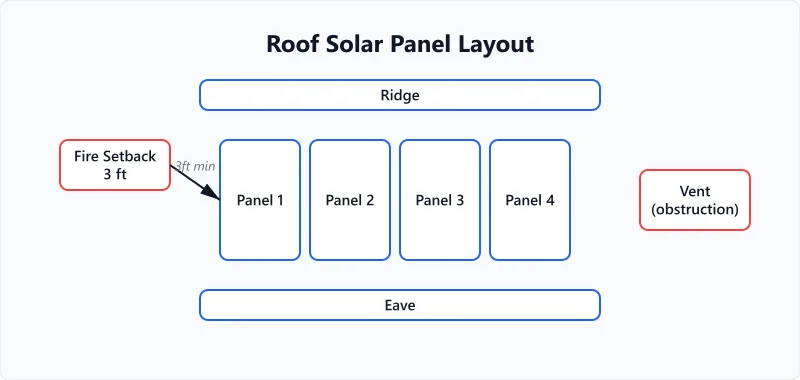
- Apply fire code setbacks. Most jurisdictions require 3-foot setbacks from roof edges and ridges for firefighter access (IFC 605.11.3.2 pathways). This alone can reduce usable area by 15-25% on a standard residential roof.
- Consider shading. Any area that gets more than 2 hours of shade during peak sun hours (10am-2pm) is not worth installing panels on. Nearby trees, neighbouring buildings, and even other roof features cast shadows that shift throughout the day and year.
- Apply the 55-65% rule. After all deductions, most residential roofs end up with 55-65% usable area. Start with 60% if you do not have a detailed layout. A professional site survey can give you an exact number using satellite imagery and shade analysis tools.
How Roof Orientation Changes Everything
A south-facing roof (in the northern hemisphere) produces 100% of potential output. But not everyone has a perfect south-facing roof, and the output difference between orientations is bigger than most people expect.
Southeast or southwest-facing roofs produce 90-95% of true-south output — barely noticeable. East or west-facing roofs drop to 75-85%, depending on latitude. A north-facing roof produces only 50-65% and is generally not worth installing panels on unless no other option exists.
Roof pitch matters too. The ideal tilt angle equals your latitude (roughly 30-40 degrees for most of the continental US). A flat roof loses 5-10% versus optimal tilt. A steep 45-degree roof aimed south works well at northern latitudes but loses output at southern ones where the sun is higher.
The practical takeaway: if your south-facing roof is small but your east/west faces are large, the east/west faces often produce more total energy despite lower per-panel efficiency. Maximise total array size, not per-panel perfection.
Worked Examples
Maximizing a Small Cape Cod Roof
Context
Calculation
Usable south face: 600 sq ft × 0.55 (setbacks + obstacles) = 330 sq ft
Panels that fit: 330 / 21.5 sq ft per panel = 15.3 → 15 panels
Total capacity: 15 × 400W = 6,000W (6kW)
Interpretation
A 6kW system on a small Cape Cod is respectable. At 5 peak sun hours with 14% losses (the PVWatts default), daily output is about 25.8kWh — close to the US average home consumption. The north face isn't worth installing on because output drops to 50-65% of rated capacity.
Takeaway
Roof constraints limit your array, but 6kW covers most of a typical home's grid usage. To figure out how much energy each of those 15 panels actually delivers, run the numbers through our solar panel output calculator.
Planning a Ground-Mount Alternative When Roof Space Is Limited
Context
Calculation
Rooftop: 500 × 0.50 (heavy shade deduction) = 250 sq ft usable
Roof panels: 250 / 21.5 = 11.6 → 11 panels × 400W = 4,400W
Ground mount needed: 20,000Wh / (5h × 0.86) = 4,651W minimum
Ground mount panels: 4,651 / 400 = 11.6 → 12 panels × 400W = 4,800W
Ground mount area: 12 × 21.5 × 1.3 (inter-row spacing) = 335 sq ft
Interpretation
The roof can only fit 4.4kW — short of the 4.65kW minimum. A 12-panel ground mount easily hits 4.8kW in just 335 sq ft of yard, positioned in full sun away from the oak trees. Ground mounts also allow optimal tilt for maximum output.
Takeaway
When trees shade your roof, a ground mount often outperforms a larger rooftop array. Once you've chosen the ground mount, figure out battery storage with our solar battery bank size calculator to pair the right bank with your 4.8kW array.
Frequently Asked Questions
Glossary
Usable Roof Area
The portion of a roof where solar panels can physically be installed after subtracting obstacles (vents, chimneys, skylights), fire code setbacks, and shaded zones. Typically 55-65% of total roof area for residential homes.
Fire Code Setback
Required clear space between solar panels and roof edges, ridges, and valleys mandated by building codes (IFC 605.11). These pathways give firefighters access during emergencies and typically require 3-foot clearances.
Panel Efficiency
The percentage of sunlight energy that a panel converts to electricity. Modern residential panels achieve 20-22% efficiency, meaning a 21.5 sq ft panel at 1,000 W/m² produces about 400W.
Azimuth
The compass direction a roof face or panel faces, measured in degrees from true north. Due south is 180° in the northern hemisphere and provides optimal solar exposure for fixed-tilt systems.
Need to match panel count to your actual energy usage? Our solar panel size calculator recommends the right wattage and quantity for your loads.
Related calculators
Solar Panel Calculator
Free solar panel calculator: enter your daily energy use and sun hours to get the panel wattage and number of panels for a home, RV, or off-grid setup.
Solar
How Many Solar Panels Do I Need?
Find how many solar panels your home needs from your monthly electricity bill. Get the panel count, system size in kW, and how much of the bill it offsets.
Solar
Solar Panel Output Calculator
Calculate daily and monthly energy output from your solar panels. Enter wattage, sun hours, and panel count for instant results.
Solar
Solar Panel Angle Calculator
Find the optimal tilt angle for your solar panels by latitude and season. Maximize energy output with the right panel angle.
Solar
Roof area is the hard physical constraint on any rooftop solar project. Before comparing quotes or selecting panels, know your usable square footage. The calculator gives you a fast estimate, but a professional site survey with shade analysis is worth the cost before committing to a system — it catches problems (unexpected shading, structural limits, code setbacks) that square footage alone misses. To evaluate the financial return on your planned rooftop system, run the numbers through our solar ROI calculator.
More Solar calculators
Browse all solar calculators — Panel output, battery bank sizing, charge time, and system design for off-grid, RV, and residential setups.
Last updated:
Written and maintained by Dan Dadovic, Commercial Director at Ezoic Inc. & PhD Candidate in Information Sciences. He works professionally as Commercial Director at Ezoic Inc., leading revenue strategy across digital publishing.
Disclaimer: Calculator results are estimates based on theoretical formulas. Actual performance varies with temperature, battery age, load patterns, and equipment condition. For critical electrical work, consult a licensed electrician.
Methodology reviewed by Doc. dr. sc. Damir Topić, Assistant Professor, FERIT Osijek.