Start With the Number on Your Bill
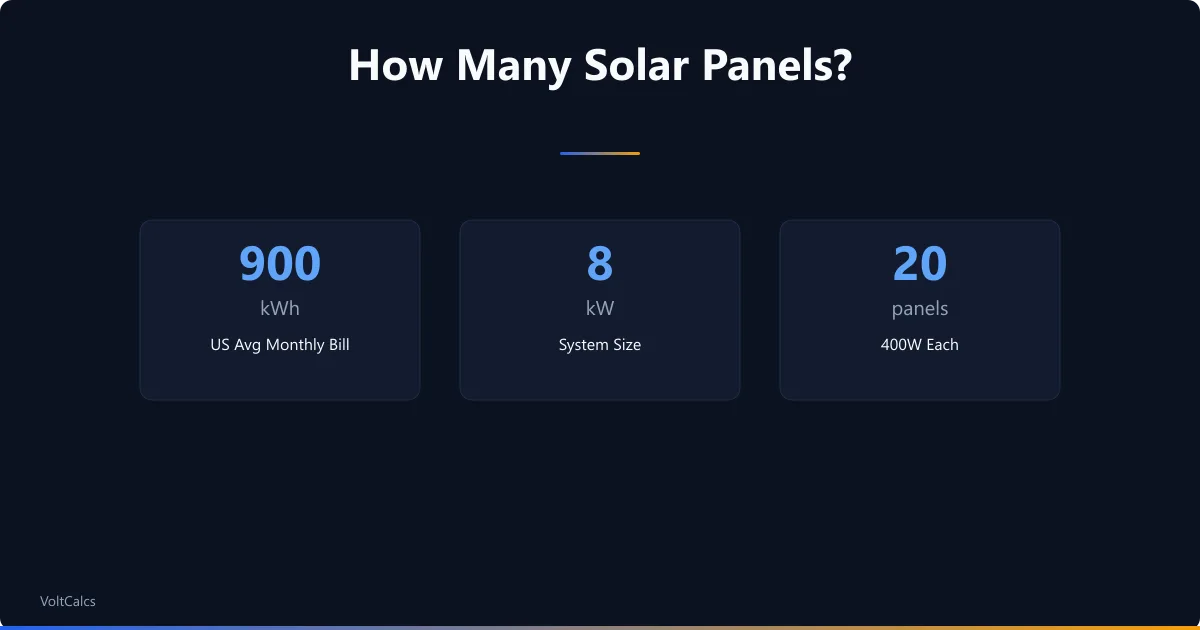
- Find your monthly kWh. Your electricity bill lists the kilowatt-hours you used. Take a recent bill, or average the last 12 months to even out summer and winter swings. The US average is about 900 kWh per month.
- Pick the month you want to cover. To offset your highest-use month (summer AC or winter heating), use that month's kWh. Grid-tied homes with net metering can instead size to the annual average and let credits balance the year.
- Account for changes coming. An electric car adds roughly 3,000 to 4,000 kWh a year (about 250 to 330 kWh per month). A heat pump or pool pump adds more. Fold those into your figure before sizing.
- No bill yet? For a new build or addition, our kWh calculator turns appliance wattages and run times into a monthly kWh figure.
The Same Home Needs More Panels in Seattle Than Phoenix
Two identical homes with identical bills can need very different panel counts, because sunlight is not spread evenly across the country. Peak sun hours (the daily hours of full-strength sun a location receives) range from about 4.0 in the Pacific Northwest to nearly 6.7 in the desert Southwest. A Phoenix roof gathers two-thirds more energy per panel than a Seattle roof of the same size.
That is why panel count tracks your address as much as your usage. A 900 kWh-per-month home, about the US average, needs roughly 20 panels at 4.5 sun hours, about 13 in sunny Phoenix, and 22 in cloudy Seattle. Pull your own location's sun-hour figure from NREL PVWatts rather than trusting a national number, then enter it above.
Panels Needed by Monthly Bill and Region
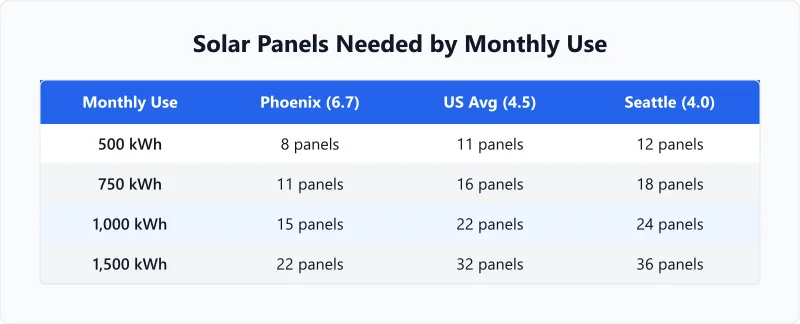
Use this as a quick reference before you run your own numbers. Counts assume 400W panels and PVWatts-default losses; your exact figure depends on your bill and local sun. The regional sun-hour figures in this table are rounded planning values. This is our own estimate; no published source backs these figures. Check your results against your product data or a licensed professional before acting.
| Monthly Use | Phoenix (6.7 sun hrs) | US average (4.5) | Seattle (4.0) |
|---|---|---|---|
| 500 kWh | 8 panels | 11 panels | 12 panels |
| 750 kWh | 11 panels | 16 panels | 18 panels |
| 1,000 kWh | 15 panels | 22 panels | 24 panels |
| 1,500 kWh | 22 panels | 32 panels | 36 panels |
The pattern is consistent: a sunnier location can cut your panel count by a third or more for the same electricity bill.
Worked Examples
Sizing a Phoenix Home From Its Power Bill
Context
Calculation
Annual use = 1,100 × 12 = 13,200 kWh
System needed = 13,200 / (6.68 × 365 × 0.86) = 6,295 W
Panels = 6,295 / 400 = 15.7, rounded up to 16 panels (6.4 kW installed)
Production = 6.4 × 6.68 × 365 × 0.86 = 13,420 kWh, about 102% of usage
Interpretation
Sixteen 400W panels, a 6.4 kW system, cover the full 13,200 kWh in an average year with a slim 2% cushion from rounding up. Phoenix's high sun hours keep the count low; the same bill in a cloudier city would need several more panels.
Takeaway
In a high-sun region a typical home offsets its bill with a modest 6 to 7 kW array. Before ordering, confirm the roof holds 16 panels with the solar roof area calculator.
How Many Panels for a Gas-Heat Chicago Home
Context
Calculation
Annual use = 800 × 12 = 9,600 kWh
System needed = 9,600 / (4.18 × 365 × 0.86) = 7,316 W
Panels = 7,316 / 400 = 18.3, rounded up to 19 panels (7.6 kW installed)
Production = 7.6 × 1,312 = 9,972 kWh, about 104% of usage
Interpretation
Nineteen panels land a little above the 9,600 kWh target. Chicago needs three more panels than Phoenix despite the smaller bill, purely because it gets about 37% less sun.
Takeaway
Cold-climate homes on gas heat often need fewer panels than all-electric homes in sunnier states, since usage matters as much as sunshine. If you later switch to a heat pump, recalculate with the higher kWh, and see why real output sits below nameplate in our solar panel output guide.
Frequently Asked Questions
Glossary
Peak Sun Hours (PSH)
The number of hours per day that sunlight averages 1,000 watts per square meter, the lab condition panels are rated at. A location with 5 peak sun hours gives each watt of panel roughly 5 watt-hours of daily production before losses. It is the single biggest reason two homes with the same bill need different panel counts.
Bill Offset
The share of your annual electricity use that solar replaces. A 100% offset means yearly production matches yearly consumption; net metering lets summer surplus cover winter shortfalls so the books balance over twelve months.
Derate Factor
The fraction of a panel's rated power that actually reaches your meter after wiring, inverter, heat, dust, and shading losses. PVWatts uses about 0.86 (14% losses) as its default. A lower derate factor means more panels for the same offset.
Nameplate Wattage
The rating stamped on a panel, measured under standard test conditions. Real output sits below nameplate most of the time because of heat and imperfect sun angles, which is why sizing builds in a loss allowance instead of using the sticker number directly.
Sizing an off-grid cabin, van, or RV to a daily watt-hour load rather than a monthly bill? The solar panel calculator works in watt-hours and panel wattage instead.
Related calculators
Solar Panel Calculator
Free solar panel calculator: enter your daily energy use and sun hours to get the panel wattage and number of panels for a home, RV, or off-grid setup.
Solar
Solar Panel Roof Area Calculator
Calculate how many solar panels fit on your roof and the total output potential. Enter roof dimensions and panel specs.
Solar
Solar ROI Calculator
Calculate your solar panel payback period, 25-year savings, and return on investment. Enter system cost, size, and electricity rate.
Solar
How Many Batteries for a Solar System?
Figure out how many batteries your solar system needs for reliable off-grid power. Enter daily usage, autonomy, and battery specs.
Solar
The honest answer to how many solar panels you need is a small range, not a single number, because sun hours, panel wattage, and next year's loads all move it. Start from your real monthly kWh, use your own location's sun hours, and round up to whole panels. If keeping the lights on during outages matters as much as cutting the bill, you will also want storage, and our batteries for a solar system calculator sizes that side. Get the panel count right first, then build the rest of the system around it.
More Solar calculators
Browse all solar calculators — Panel output, battery bank sizing, charge time, and system design for off-grid, RV, and residential setups.
Last updated:
Written and maintained by Dan Dadovic, Commercial Director at Ezoic Inc. & PhD Candidate in Information Sciences. He works professionally as Commercial Director at Ezoic Inc., leading revenue strategy across digital publishing.
Disclaimer: Calculator results are estimates based on theoretical formulas. Actual performance varies with temperature, battery age, load patterns, and equipment condition. For critical electrical work, consult a licensed electrician.
Methodology reviewed by Doc. dr. sc. Damir Topić, Assistant Professor, FERIT Osijek.