How the Battery Runtime Formula Works
The calculator turns your battery into watt-hours, takes the share you are willing to use, subtracts the losses between battery and load, and divides by your load. On LiFePO4 that is the whole of it.
Runtime (hours) = (Capacity x Nominal Voltage x DoD x Efficiency) / Load
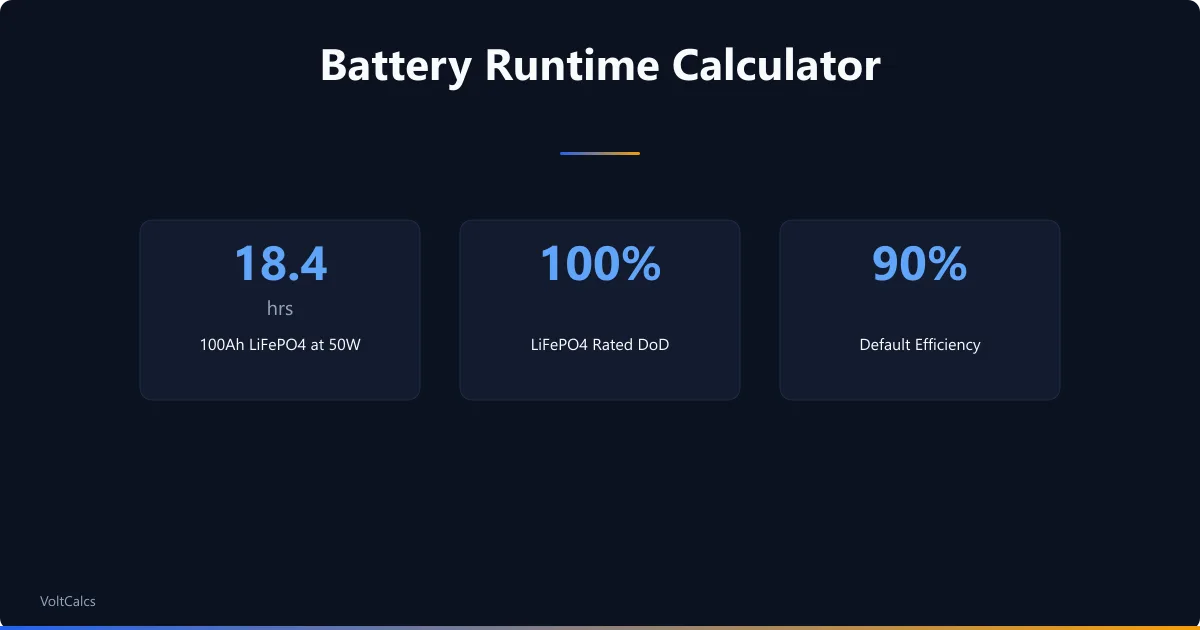
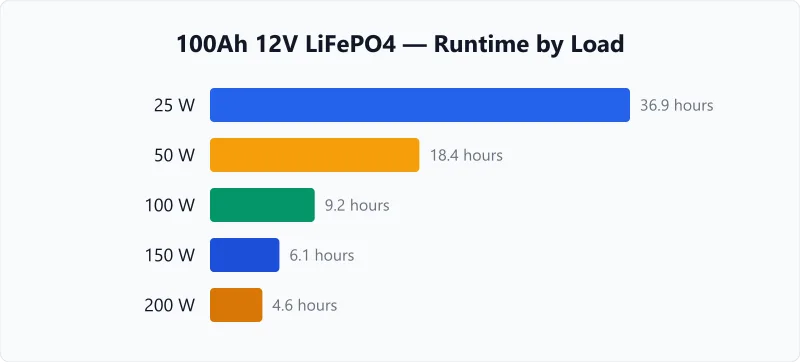
A 100Ah 12V LiFePO4 battery at 80% DoD and 90% efficiency powering a 100W load: (100 x 12.8 x 0.80 x 0.90) / 100 = 9.22 hours. The 12.8V is not a typo — Victron prints "Nominal voltage 12,8 V" and "1280 Wh" for its 100Ah LiFePO4 block, so feeding a flat 12 understates the pack by 6%. That same battery on a 50W LED worklight lasts 18.4 hours, enough for two full nights. The 90% efficiency default is Victron's own printed maximum for the Phoenix VE.Direct 500VA and 800VA inverters at 12V; its 250VA and 375VA models print 87% and 89%.
Lead-acid does not work that way, and the calculator no longer pretends it does. Pick flooded, AGM or gel and the runtime is computed from a discharge-rate correction fitted to figures the makers print: Trojan's T-105 sheet, Lifeline's GPL-31T minutes-of-discharge rows, and Victron's AGM and gel derate table. Across those printed points the fit reproduces flooded within about 10%, AGM within about 6% and gel within about 2%.
The formula assumes a constant load, which rarely happens in practice. A refrigerator cycles on and off, pulling 150W during the compressor run and near-zero in between. For cycling loads, use the average power draw over a full cycle. Our battery runtime guide walks through more worked examples across different battery types and load scenarios.
Depth of Discharge Changes Everything
Depth of discharge (DoD) is the variable most people leave at whatever the box says. It decides both how long you run and how many times you get to do it. Victron prints the trade for its own AGM line: 400 cycles at 80% discharge, 600 at 50%, and 1500 at 30%. Run the pack harder and you buy hours today with cycles later.
LiFePO4 changes the arithmetic. Battle Born rates its 100Ah block at "100% Depth of Discharge" outright, and Victron's LiFePO4 sheet prints 2500 cycles at 80% DoD, 3000 at 70% and 5000 at 50% — at the deepest setting it still outlasts a lead-acid pack run gently.
AGM sits between the two, and its maker is specific: Concorde's manual for the Lifeline line says the average depth of discharge should be "no greater than 50% of the battery's 20 hour rating". Gel is the same story with slightly better numbers, Victron printing 750 cycles at 50% against 500 at 80%.
The practical takeaway has changed with the engine. A 200Ah flooded bank at 50% DoD holds 1,200 Wh; a 100Ah LiFePO4 pack at 100% holds 1,280 Wh. Run both at 100W on this calculator and the flooded bank returns 10.3 hours against the lithium pack's 11.5, because the flooded correction takes its cut and the lithium one does not. Add that lead-acid is far heavier for the same usable energy and the cost-per-cycle maths usually favours lithium. Our depth of discharge guide breaks down the chemistry-by-chemistry DoD limits and their lifespan impact.
What the Chemistry Selector Changes
Switch the chemistry and you switch the method, not just a number.
On LiFePO4 the calculator uses the plain energy identity. That is honest here because the label is measured at a 1C discharge: Victron footnotes its nominal-capacity row "Discharge current 1C", so a 100Ah pack really does give 100Ah at loads up to 100A. The only correction is the nominal voltage, 12.8V per 12V block.
On flooded, AGM and gel the rated amp-hours are measured at the 20-hour rate, and the pack delivers less than that at any heavier load. Trojan's own T-105 sheet prints the spread on one row: 250Ah at the 100-hour rate, 225Ah at 20 hours, 207Ah at 10 hours, 185Ah at 5 hours. The calculator works out the current your load actually draws, expresses it as a fraction of the 20-hour rating, and reads the runtime off a curve fitted to those printed points.
Two things follow. Runtimes on lead-acid are shorter than the bare formula gives, by more as the load grows. And when your load falls outside the range of points the makers print, the result says so instead of extrapolating quietly.
Worked Examples
Running a CPAP Machine Through the Night
Context
You camp with a 100Ah LiFePO4 battery and a CPAP machine that draws 30W on average. You need 8 hours of runtime and want to keep 20% reserve.
Calculation
A 100Ah LiFePO4 block is nominally 12.8 V, so total energy = 100 Ah x 12.8 V = 1,280 Wh
Usable at 80% DoD = 1,280 x 0.80 = 1,024 Wh; delivered at 90% efficiency = 1,024 x 0.90 = 921.6 Wh
Runtime = 921.6 / 30 = 30.7 hours
Interpretation
30.7 hours gives you three full nights on a single charge. On the highest pressure setting, around 60W, it is 15.4 hours — still a full night with margin.
Takeaway
A 100Ah LiFePO4 is more than enough for CPAP use. To figure out how long your solar panels need to recharge it, run the numbers through our solar battery charge time calculator.
Powering an RV Through a 48-Hour Outage
Context
A storm knocks out power. Your RV has two 200Ah 12V batteries in parallel (400Ah total). Your essential loads — fridge, lights, phone charging — draw 150W combined. You use lead-acid batteries limited to 50% DoD.
Calculation
Usable at DoD = 400 Ah x 12 V x 0.50 = 2,400 Wh, which is what the tile shows
For flooded lead-acid the runtime comes from the rate correction, not that figure. The 150 W load at 88% efficiency draws 14.2 A, which is 0.036 of the 400 Ah twenty-hour rating
At that rate the fit gives 28.0 hours to a full discharge; half of it, at 50% DoD, is 14.0 hours
Interpretation
14.0 hours falls far short of 48. You would need to cut loads or add capacity to survive a two-day outage. The light 0.036C draw is why the corrected figure lands within a tenth of the bare formula here; push the same bank to 500 W and the two answers separate.
Takeaway
For extended outages, calculate exactly how much battery capacity you need with our battery size for inverter calculator — it works backwards from your target runtime.
Frequently Asked Questions
Glossary
Depth of Discharge
The percentage of a battery's total capacity that you actually use before recharging. Lead-acid batteries should not exceed 50% DoD to preserve lifespan. LiFePO4 batteries can safely discharge to 80-100% DoD.
System Efficiency
The share of stored energy that reaches your device after losses in wiring, the inverter and the battery's own internal resistance. Victron prints 87-91% as the maximum for its 250-800VA Phoenix inverters, and its measured curve for a 3kVA unit falls to 71% at a 50W load. A DC load with no inverter is 100%.
Usable Energy
The watt-hours available from a battery after depth of discharge is applied (the calculator's 'Usable at DoD' card). A 100Ah 12V LiFePO4 block is nominally 12.8V, so it holds 1,280 Wh total, 1,024 Wh usable at 80% DoD, and 921.6 Wh delivered after 90% system efficiency. The same nameplate in flooded lead-acid is 1,200 Wh total and 600 Wh usable at the 50% its maker recommends.
Planning a solar system? Use our solar panel output calculator to see how much energy your panels produce daily.
Related calculators
12V Battery Runtime Calculator
Calculate how long a 12 volt battery lasts under any load, with flooded, AGM, gel and LiFePO4 each corrected for discharge rate.
Battery
Deep Cycle Battery Runtime Calculator
Estimate deep cycle battery runtime for marine, RV, and off-grid use. Accounts for depth of discharge and system efficiency.
Battery
Watt Hours to Amp Hours Calculator
Convert watt-hours to amp-hours at any voltage. Use this to compare batteries rated in different units.
Battery
Off-Grid Load Calculator
Calculate your total daily energy needs for off-grid living. Get recommended battery bank size and solar panel wattage for your system.
Solar
Two numbers decide whether your plan survives contact with reality: the chemistry you picked and the load you were honest about. Get either wrong and the hours on screen are fiction. For anything you actually depend on, Concorde prints the rule in sizing terms rather than percentages — if you need 100 Ah on average, fit at least 200 Ah, which holds the average depth of discharge at half. Temperature and age then take their own cut on top. For application-specific calculators with tailored presets, see the marine battery runtime, laptop battery runtime, and e-bike range calculators.
More Battery calculators
Browse all battery calculators — LiFePO4, lead-acid, AGM, and lithium-ion runtime, charge time, and capacity sizing.
Last updated:
Written and maintained by Dan Dadovic, Commercial Director at Ezoic Inc. & PhD Candidate in Information Sciences. He works professionally as Commercial Director at Ezoic Inc., leading revenue strategy across digital publishing.
Disclaimer: Calculator results are estimates based on theoretical formulas. Actual performance varies with temperature, battery age, load patterns, and equipment condition. For critical electrical work, consult a licensed electrician.
Methodology reviewed by Doc. dr. sc. Damir Topić, Assistant Professor, FERIT Osijek.