How to Calculate Your Off-Grid Daily Energy Needs
Last updated:
11 min read
The foundation of any off-grid system is one number: your actual daily energy usage in watt-hours. Get this number wrong and everything downstream fails — your battery bank is too small, your solar array cannot keep up, and you run out of power on the third cloudy day. Get it right and the rest of the system design falls into place.
Our off-grid load calculator automates this process. This guide explains the methodology so you understand what the numbers mean and can catch mistakes that a calculator cannot — like forgetting the well pump or underestimating winter lighting hours.
Common Appliance Power Draws
Start with the devices you plan to run. Power draw in watts tells you how fast energy is consumed; hours of daily use tells you the total energy budget in watt-hours (Wh).
| Appliance | Watts | Typical Daily Hours | Daily Wh |
|---|---|---|---|
| LED lighting (per room) | 8-15W | 5-8 hrs | 40-120 Wh |
| Laptop | 30-65W | 4-8 hrs | 120-520 Wh |
| Phone charging | 5-20W | 2-3 hrs | 10-60 Wh |
| 12V DC fridge (efficient) | 40-60W | 8-12 hrs (duty cycle) | 320-720 Wh |
| Standard AC fridge | 100-200W | 8-12 hrs (duty cycle) | 800-2,400 Wh |
| Chest freezer | 50-100W | 6-10 hrs (duty cycle) | 300-1,000 Wh |
| Well pump (1/2 HP) | 500-750W | 1-2 hrs | 500-1,500 Wh |
| Washing machine | 300-500W | 1-2 hrs (per load) | 300-1,000 Wh |
| Microwave | 800-1,200W | 0.25-0.5 hrs | 200-600 Wh |
| Wi-Fi router | 5-15W | 24 hrs | 120-360 Wh |
| Ceiling fan | 15-75W | 6-10 hrs | 90-750 Wh |
| Window AC (5,000 BTU) | 450-550W | 6-10 hrs | 2,700-5,500 Wh |
| Space heater (electric) | 750-1,500W | 4-8 hrs | 3,000-12,000 Wh |
Notice the enormous range in fridge energy use. A 12V DC compressor fridge designed for off-grid use (like a Dometic or Vitrifrigo) consumes 320-720 Wh/day. A standard household AC fridge running through an inverter can consume 800-2,400 Wh/day. The fridge choice alone can make or break a modest off-grid system.
Also notice the space heater at the bottom of the table. Electric resistance heating is the most energy-intensive load most people consider. A 1,500W heater running 8 hours consumes 12,000 Wh — more than the rest of a typical off-grid cabin combined. Off-grid heating should come from propane, wood, or a heat pump, not electric resistance. This is where our electrical load calculator helps you identify which loads are practical for your system size.
The Load Calculation Process
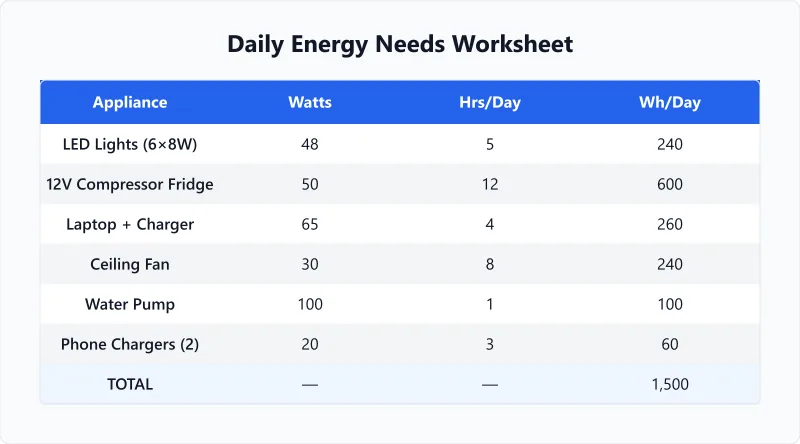
Follow these steps to build your daily energy budget. Write everything down — the list becomes your system design document.
- List every device you will run. Walk through your space room by room. Include lighting, appliances, electronics, pumps, and anything that plugs in or wires to the battery bank. Do not forget "invisible" loads: modem, router, smoke detectors, CO detectors, security cameras, battery chargers for tools, and well pump controllers that draw standby power 24/7.
- Record the wattage of each device. Check the nameplate label, the product manual, or measure with a Kill-A-Watt meter. Nameplate watts are maximum draw — many devices use less during normal operation. A fridge labeled "200W" runs its compressor intermittently, so its average draw over 24 hours is much lower. For intermittent loads, use the duty-cycle adjusted average, not the peak. The Department of Energy provides average wattage estimates (page no longer available at time of checking) for common household appliances if you cannot find the nameplate.
- Estimate daily hours of use for each device. Be honest, not optimistic. Lights that you think run "3-4 hours" probably run 5-6 hours in winter when it gets dark at 4:30 PM. The fridge runs 24/7 but the compressor cycles — estimate 8-12 hours of actual compressor runtime per day depending on ambient temperature and how often you open the door.
- Multiply watts by hours to get daily watt-hours. This is the core calculation: Watts x Hours = Wh per day. Sum all devices to get your total daily energy budget. A realistic small cabin comes in at 2,000-4,000 Wh/day. A full-size off-grid home with modern conveniences (but no electric heating) runs 6,000-12,000 Wh/day.
- Add a 20-25% safety margin. Parasitic losses (inverter standby draw, wire losses, charge controller overhead) consume 10-15% of your battery energy before it reaches your devices. Battery round-trip efficiency costs another 2-5% for LiFePO4 or 15-20% for lead-acid. Add 20% to your total for a LiFePO4 system, 25% for lead-acid.
- Adjust for seasonal variation. If your winter usage differs by 30%+ from summer (more lighting, less refrigeration, possible electric blankets), calculate both a winter and summer daily budget. Size your battery bank and solar array for the harder season — usually winter, because days are shorter and loads are often higher.
Worked Example: Two-Bedroom Off-Grid Cabin
A couple in rural Vermont is building a year-round off-grid cabin. They plan to heat with a wood stove and cook with propane, so electric heating is not in the load calculation. Here is their appliance audit:
Kitchen: 12V DC fridge (50W avg, 10 hrs/day = 500 Wh), microwave (1,000W, 15 min/day = 250 Wh), coffee maker (900W, 10 min/day = 150 Wh).
Living area: LED lighting (4 fixtures x 12W x 6 hrs = 288 Wh), Wi-Fi router (12W x 24 hrs = 288 Wh), 2 laptops (50W each x 4 hrs = 400 Wh), phone charging (15W x 4 hrs = 60 Wh).
Bedroom/bath: LED lighting (2 fixtures x 10W x 3 hrs = 60 Wh), bathroom exhaust fan (30W x 1 hr = 30 Wh).
Utility: Well pump (750W x 1.5 hrs = 1,125 Wh), washing machine (400W, 3 loads/week averaged = 171 Wh/day), circulation pump for wood stove hydronic loop (60W x 8 hrs winter = 480 Wh).
Total daily load: 3,802 Wh. With 20% safety margin (LiFePO4 system): 4,562 Wh/day.
This is a realistic number for a cabin without electric heating or air conditioning. The well pump is the largest single load — if they had municipal water, the total drops to about 2,900 Wh before margin. The microwave and coffee maker are high-wattage but short-duration, so their daily impact is moderate. As outlined in our solar battery bank sizing guide, you can convert this daily energy figure directly into battery and panel requirements.
From Energy Budget to System Size
Battery bank sizing starts with autonomy — how many days of stored energy you need without sun. For a grid-independent cabin, 2-3 days of autonomy is standard. The Vermont cabin needs 4,562 Wh/day x 2.5 days = 11,405 Wh of usable battery storage. At 48V (a good voltage for a cabin system), that is 238Ah of usable capacity. With LiFePO4 at 90% DoD: 264Ah rated capacity. Two 48V 150Ah LiFePO4 batteries provide 300Ah — covering the requirement with margin. Use the solar battery count calculator to run your own numbers.
Solar array sizing depends on your location's peak sun hours, which our solar panel output guide explains in depth. Vermont averages 3.5-4.5 peak sun hours per day depending on season and panel tilt. To produce 4,562 Wh/day from a solar array with 80% system efficiency (accounting for soiling, wiring, charge controller, and temperature losses): 4,562 / 0.80 / 3.5 = 1,629W of solar panels in winter. Round up to 1,800-2,000W of panels for margin.
Inverter sizing is driven by peak load, not daily energy. The largest simultaneous loads are the well pump startup surge (1,500-2,000W) plus the microwave (1,000W) plus lighting (48W) = roughly 3,000W sustained with a 4,000W surge. A 3,000W continuous / 6,000W surge inverter handles this comfortably.
Reference System Configurations
These configurations represent typical off-grid builds at different scales, based on NREL cost benchmarks (page no longer available at time of checking) and real-world installations.
| System Scale | Daily Load | Battery Bank | Solar Array | Inverter | Est. Cost (as of early 2026) |
|---|---|---|---|---|---|
| Weekend cabin | 1,000-2,000 Wh | 5-10 kWh (LiFePO4) | 600-1,200W | 1,000-2,000W | $4,000-$8,000 |
| Small year-round cabin | 3,000-5,000 Wh | 10-20 kWh | 1,500-2,500W | 3,000-5,000W | $12,000-$22,000 |
| Full-size off-grid home | 6,000-12,000 Wh | 20-40 kWh | 3,000-6,000W | 5,000-8,000W | $25,000-$50,000 |
| Large home with AC | 15,000-25,000 Wh | 40-80 kWh | 6,000-12,000W | 8,000-12,000W | $50,000-$100,000+ |
The jump from "small cabin" to "full-size home" is stark. Air conditioning, electric water heating, and multiple large appliances push daily loads to 15,000+ Wh, which requires massive (and expensive) battery and solar capacity. This is why most off-grid homeowners shift heating, water heating, and cooking to propane — it removes the three largest electrical loads and brings the system into a manageable size and budget.
Seasonal Load Variations and How to Plan for Them
Off-grid energy demand swings dramatically between seasons — and it swings in the wrong direction. Winter brings higher loads (more lighting hours, circulation pumps, electric blankets) at the exact time solar production drops. Summer brings air conditioning or fan loads at the exact time batteries run hottest and lose some capacity. A system sized for a mild October day will fail in January and again in August.
Here is what a realistic seasonal load profile looks like for the Vermont cabin from the worked example above.
| Category | Summer Daily Wh | Winter Daily Wh | Change |
|---|---|---|---|
| LED lighting | 210 Wh (4 hrs avg) | 420 Wh (8 hrs avg) | +100% |
| 12V DC fridge | 600 Wh (warmer ambient) | 400 Wh (cooler ambient) | -33% |
| Wood stove circulation pump | 0 Wh | 480 Wh | N/A |
| Electric blanket (2 people) | 0 Wh | 320 Wh | N/A |
| Ceiling fans | 300 Wh | 0 Wh | N/A |
| All other loads | 2,150 Wh | 2,250 Wh | +5% |
| Total | 3,260 Wh | 3,870 Wh | +19% |
| With 20% margin | 3,912 Wh | 4,644 Wh | +19% |
Winter loads run 19% higher than summer in this example, and this cabin does not use electric heating. Cabins with electric space heaters or heat tape on water lines can see winter loads 2-3x higher than summer. At the same time, Vermont drops from about 5 peak sun hours in June to 2.5 in December — solar production cuts in half while demand climbs.
The practical answer is to size for the hardest month. Calculate your December daily load, then divide by December peak sun hours with system losses. That gives you a solar array big enough to survive winter without running a generator every night. In summer, the extra production keeps batteries at 100% by midday and extends their lifespan through shallow cycling.
If your winter loads include a seasonal device — a circulation pump that only runs November through March, or a stock tank heater for livestock — build two separate load sheets. Label them "Summer baseline" and "Winter peak." The battery bank sizing calculator lets you run both scenarios quickly and compare the battery and solar requirements side by side.
One seasonal trap that catches first-time off-gridders: propane consumption rises in winter too. If you heat with propane and your propane supply runs low, the temptation is to plug in a space heater "just for a few hours." A 1,500W space heater running 6 hours eats 9,000 Wh — more than double the cabin's entire daily budget. Build enough propane storage or firewood supply to avoid falling back on electric resistance heating. Our propane generator runtime guide covers fuel planning in detail.
Common Mistakes That Blow Up Off-Grid Budgets
Forgetting phantom loads. A Wi-Fi router, modem, smoke detectors, and clock displays draw 30-80W combined, 24 hours a day. That is 720-1,920 Wh/day — potentially 20-50% of a small cabin's entire budget. Audit every plug and hardwired device.
Using nameplate watts instead of measured watts. A label that says "200W" is the peak draw, not the average. A fridge cycles its compressor, a laptop adjusts CPU power, a ceiling fan has speed settings. Measure actual draw with a Kill-A-Watt meter for at least 24 hours to get the real average. Our amps draw calculator uses duty-cycle-adjusted averages for common appliances to give you realistic numbers.
Ignoring seasonal changes. A cabin that needs 3,000 Wh/day in summer might need 5,000 Wh/day in winter due to longer lighting hours, shorter solar days, and heated water circulation pumps. If you size the system for summer and move in during January, you will be running a generator every night.
Underestimating the well pump. A 1/2 HP submersible well pump draws 750W and runs every time someone turns on a faucet, flushes a toilet, or waters the garden. If multiple fixtures run simultaneously, the pump cycles more frequently. Well pumps typically consume 1,000-1,500 Wh/day in a two-person household — more with irrigation. Pressure tank size affects cycling frequency: a larger tank means fewer pump starts and less total runtime.
The most reliable off-grid systems are designed by people who measured their loads honestly, added margin, and sized for winter. The solar panel and battery sizing calculator gives you the framework, but the accuracy of the output depends entirely on the accuracy of your appliance list and usage estimates.
Frequently Asked Questions
Written and maintained by Dan Dadovic, Commercial Director at Ezoic Inc. & PhD Candidate in Information Sciences. He works professionally as Commercial Director at Ezoic Inc., leading revenue strategy across digital publishing.
Disclaimer: Calculator results are estimates based on theoretical formulas. Actual performance varies with temperature, battery age, load patterns, and equipment condition. For critical electrical work, consult a licensed electrician.
Methodology reviewed by Doc. dr. sc. Damir Topić, Assistant Professor, FERIT Osijek.