How to Size a Battery Bank for Your Inverter
- List every device you will run. Write down each device and its wattage. Include items that cycle on and off (like refrigerators) at their average wattage, not peak. Add a 10% buffer for devices you forgot.
- Determine your runtime need. For power outage backup, 4-8 hours covers most grid outages. For off-grid cabins, 12-16 hours covers overnight loads. For critical medical equipment, plan for 24+ hours with a recharging source.
- Choose your battery voltage. Match the inverter input. 12V systems are simplest for under 2,000W. 24V and 48V systems are better for larger loads because they halve or quarter the current, reducing cable size and losses.
- Apply the formula. Required Ah = (Load x Runtime) / (Voltage x DoD x Efficiency). A 500W load for 4 hours on a 12V LiFePO4 bank at 80% DoD and 88% efficiency: (500 x 4) / (12.8 x 0.80 x 0.88) = 222Ah. The 12.8 is the nominal voltage Victron prints for a 12V lithium block, not the 12 on the label. Round up to the nearest available battery size — a 300Ah battery bank gives you headroom.
Example: Sizing a Home Backup Battery
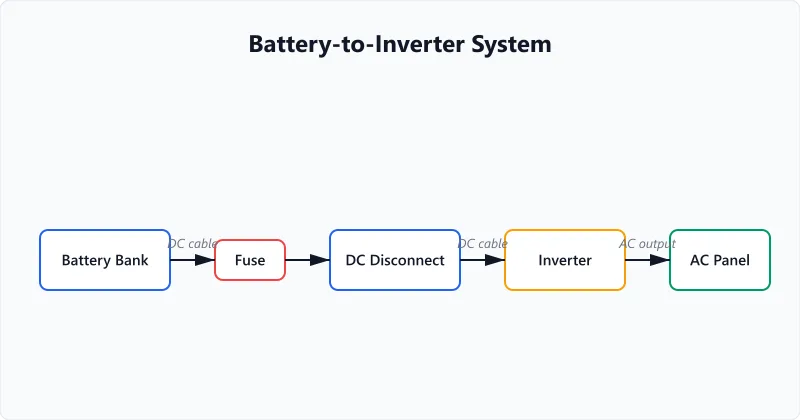
A homeowner wants to keep essentials running during a 6-hour power outage using a 3,000W pure sine wave inverter on a 48V system.
Essential loads: refrigerator (150W avg), internet router (15W), LED lights (60W), phone chargers (30W), sump pump (400W average, runs 20% of the time = 80W effective). Total: 335W.
Required energy: 335W x 6 hours = 2,010Wh. Factor in inverter efficiency (90%): 2,010 / 0.90 = 2,233Wh from the battery. At 48V nominal (51.2V on lithium) with 80% DoD: 2,233 / (51.2 x 0.80) = 55Ah.
A single 48V 100Ah LiFePO4 battery (5,120Wh total, 4,096Wh usable) handles this with room to spare. The homeowner could run these loads for about 11 hours, or add a space heater for part of the outage.
Why Lead-Acid Needs a Bigger Bank Than the Sum Says
A battery's amp-hour rating is measured at one particular speed. Trojan rates its T-105 at 225Ah over 20 hours, and the same sheet prints 207Ah over 10 hours, 185Ah over 5 hours and 250Ah over 100 hours. The battery has not changed; the number you are allowed to claim has. Pull harder and lead-acid gives up capacity.
That is why this calculator asks which chemistry you are buying. On lead-acid it inverts a rate correction fitted to figures manufacturers print: Trojan's T-105 discharge table for flooded, Lifeline's published minutes-at-amps together with Victron's effective-capacity column for AGM, and Victron's gel column for gel. The fit reproduces those printed points within about 10% for flooded, 6% for AGM and 2% for gel. On LiFePO4 there is no rate term to apply, because Victron footnotes its own capacity rating "discharge current 1C": the label figure is already measured at the speed a small off-grid system runs at.
Take an off-grid cabin pulling 300W for 12 hours on a 24V bank at 50% depth of discharge through a 90% inverter. Flooded lead-acid needs a 342Ah bank. The same job on LiFePO4, at 80% depth of discharge because Battle Born prints 100% depth of discharge for its cells, needs 195Ah. That gap is the honest cost of lead-acid, and it is not visible in a sizing formula that only multiplies volts by amp-hours.
The tool says so when it is guessing. Push the discharge rate past the fastest point on the printed tables and it tells you the real bank is larger than the figure shown; drop below the slowest point and it tells you the figure is an extrapolation the other way. Compare the same numbers from the runtime side with the lead-acid runtime calculator, which uses the same fitted correction.
Worked Examples
Sizing a Battery Bank for a Power Outage Kit
Context
You want 8 hours of backup for essential loads: fridge (100W avg), router (15W), LED lights (30W), phone charging (10W) = 155W total. Using 12V LiFePO4 batteries at 80% DoD.
Calculation
Total energy: 155 W x 8 hrs = 1,240 Wh
After inverter loss: 1,240 / 0.88 = 1,409 Wh from batteries
Battery Ah at the 12.8V lithium nominal: 1,409 / (12.8 x 0.80) = 137.6 Ah minimum
Interpretation
A single 200Ah 12V LiFePO4 battery covers this with 45% to spare: it carries the same load for 11.6 hours. A 100Ah battery falls about 38 Ah short.
Takeaway
After sizing the battery, check that your inverter can handle the startup surge from the fridge compressor. Use our amps draw calculator to convert your wattage to amps on the AC side.
Battery Bank for a 3000W Inverter in a Workshop
Context
Your off-grid workshop runs power tools drawing 2,000W average for 4-hour sessions. You use a 3,000W inverter on a 24V AGM bank at 50% depth of discharge, the deepest Concorde recommends for its Lifeline AGM batteries.
Calculation
Energy: 2,000 x 4 = 8,000 Wh
Current the batteries actually supply: (2,000 / 0.90) / 24V = 92.6 A
AGM at that rate, 50% DoD: 92.6 x (4 / (0.50 x 0.6308))^(1/1.1484) = 92.6 x 9.13 = 846 Ah
Interpretation
You need about 846Ah of AGM at 24V. The old amp-hours-times-volts sum says 741Ah, and it is wrong by 105Ah: pulling 92.6 amps is a harder job than the 20-hour rating on the label describes, so a 741Ah bank runs out early. This is the gap that makes people buy lithium. The same workshop on LiFePO4 at 80% depth of discharge needs 434Ah.
Takeaway
For this load level, check that your cables from battery to inverter are thick enough. Verify there is no excessive voltage drop over the cable run at 2,000W on 24V.
Frequently Asked Questions
Glossary
Inverter Efficiency
The percentage of DC battery power that reaches your AC devices. Victron prints 87-91% maximum efficiency across its 250-800VA Phoenix inverters and 93-96% for its 3-8kVA MultiPlus-II units, and measures a 3kVA unit at 71% on a 50W load. At this page's 90% default a 2,000W load draws about 2,222W from the batteries.
Continuous vs Surge Rating
Inverters have two ratings: continuous (sustained load) and surge (brief spikes like motor starts). Size the inverter's continuous rating above your total load and its surge rating above any motor starting current. Both are printed: Victron gives 5,500W peak against 3,000VA continuous, and Battle Born gives 200A for 30 seconds against 100A continuous on a 100Ah battery.
Backup Runtime
The number of hours a battery bank can sustain a given load before reaching the minimum safe discharge level. The target runtime drives the entire system sizing — batteries, charger, and solar array.
Need the right cable between your battery bank and inverter? Our inverter cable size calculator ensures safe wiring at high currents.
Related calculators
Inverter Cable Size Calculator
Find the right cable gauge for your battery-to-inverter connection. Enter inverter watts, voltage, and distance for safe wire sizing.
Electrical
What Size Inverter for a 1500W Heater?
Size an inverter, battery bank, and solar array to run a 1500W space heater off-grid. Complete system sizing in one tool.
Solar
Battery Capacity (Amp Hours) Calculator
Calculate battery capacity in amp-hours from watt-hours and voltage. Convert between Wh, Ah, and watts easily.
Battery
Watt Hours to Amp Hours Calculator
Convert watt-hours to amp-hours at any voltage. Use this to compare batteries rated in different units.
Battery
Size your battery bank for reality, not marketing specs. Two numbers decide the answer: how hard you pull, and what the battery is made of. Round the result up to the next standard size and you have headroom for aging, cold weather and the devices you inevitably add later. Once the capacity is settled, our inverter cable sizing guide walks through the wire gauge for high-current DC connections, and the deep-cycle runtime calculator runs the same bank the other way to confirm the hours.
More Battery calculators
Browse all battery calculators — LiFePO4, lead-acid, AGM, and lithium-ion runtime, charge time, and capacity sizing.
Last updated:
Written and maintained by Dan Dadovic, Commercial Director at Ezoic Inc. & PhD Candidate in Information Sciences. He works professionally as Commercial Director at Ezoic Inc., leading revenue strategy across digital publishing.
Disclaimer: Calculator results are estimates based on theoretical formulas. Actual performance varies with temperature, battery age, load patterns, and equipment condition. For critical electrical work, consult a licensed electrician.
Methodology reviewed by Doc. dr. sc. Damir Topić, Assistant Professor, FERIT Osijek.