Surge Power vs Continuous Power: What Heaters Actually Need
A 1500W resistive space heater draws a steady 1,500 watts with virtually no surge. Unlike motors, which can draw 5-8x their running current at start (NEMA code letters; see our locked-rotor amps calculator) while generator makers quote 2-3x "starting watts" for compressor loads, resistive heating elements reach full power almost instantly. Cited to NEMA MG 1. The standard text is not freely available to link; confirm against the current edition before acting. This makes heaters easier on inverters than their wattage suggests.
That said, you still want an inverter rated above 1,500W continuous. Running an inverter at 100% of its rated capacity generates excess heat, reduces efficiency, and shortens its lifespan. This is our own estimate; no published source backs these figures. Check your results against your product data or a licensed professional before acting. An inverter at 80% load runs cooler and more efficiently than one pegged at 100%.
Minimum inverter size: 2,000W continuous. Better: 2,500-3,000W continuous, which gives headroom for the heater plus other simultaneous loads (lights, phone charger, fan). At 12V, a 2,000W inverter draws 167A from the battery bank — that is an enormous current requiring very thick cables (2/0 AWG or larger). At 24V, the same load draws 83A, which is much more manageable. At 48V, only 42A. Our inverter cable sizing guide walks through the gauge selection step by step for each of these system voltages.
This is why 24V or 48V systems are strongly recommended for loads above 1,000W. The lower current at higher voltages means thinner wires, smaller fuses, and less energy lost as heat in the cables.
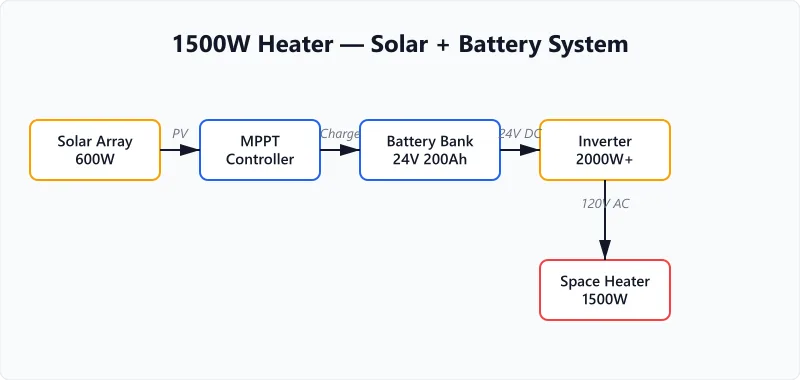
Complete System Sizing for a 1500W Heater
- Calculate daily energy. 1,500W x 6 hours = 9,000Wh per day. Allow 20% for inverter and system losses. The 20% comes off what the system delivers rather than being added to the load, so divide rather than multiply: 9,000 / (1 - 0.20) = 11,250Wh total demand. That is a x1.25 multiplier at 20% losses and x1.33 at 25%.
- Size the inverter. Minimum 2,000W pure sine wave. Modified sine wave inverters can cause resistive heater elements to buzz and reduce their lifespan. Pure sine wave is the safe choice.
- Size the battery bank. For 1 day of autonomy at 80% DoD: 9,000 / 0.80 = 11,250Wh. At 24V: 469Ah. Five 100Ah 12V LiFePO4 batteries in parallel with a series pair (10 batteries total for 24V 500Ah) meets this. A second day of autonomy doubles the battery bank to 20 batteries.
- Size the solar array. 11,250Wh / 4 sun hours = 2,813W of solar panels. Eight 400W panels (3,200W) provide a small buffer.
- Size the charge controller. 3,200W at 24V battery side = 133A. A 150A MPPT controller, or two 80A controllers on separate sub-arrays.
Example: The Winter Heating Reality Check
Here is the honest math for running a 1500W heater 8 hours per night in a northern US location (3 peak sun hours in December).
Daily energy: 1,500 x 8 = 12,000Wh. With 20% losses: 12,000 / (1 - 0.20) = 15,000Wh. Solar needed: 15,000 / 3 = 5,000W, or thirteen 400W panels. Battery bank for 2 cloudy days: 12,000 x 2 / 0.80 = 30,000Wh at 48V = 625Ah. That is 28 batteries (4 series x 7 parallel of 12V 100Ah LiFePO4) at a cost of roughly $7,000 for batteries alone (as of early 2026). Panels add another $3,000-4,000.
This is why most experienced off-grid builders use propane or wood heat instead of electric. A $500 propane heater with a $200 tank covers the entire winter heating season at a fraction of the solar-electric cost. Solar-powered electric heat makes sense in mild climates where you only need 2-3 hours per day, or as a supplement to a primary heat source.
Consider a smaller 750W heater, a 12V diesel heater (200W, far more efficient), or a heat pump (which produces 3W of heat per 1W of electricity) before committing to powering a 1500W resistive heater with solar.
Worked Examples
Sizing a System for Garage Workshop Heating in Colorado
Context
Calculation
Daily energy (per use day) = 1,500W × 4h = 6,000Wh
Loss-adjusted = 6,000 / (1 - 0.20) = 7,500Wh
Solar array = 7,500 / 4.5 = 1,667W → five 400W panels (2,000W)
Battery (1-day autonomy) = 6,000 / 0.80 = 7,500Wh ÷ 24V = 312.5Ah
Battery count = 312.5/100 = 3.1 → 4 parallel strings × 2 series = 8 batteries
Inverter: 2,000W pure sine wave minimum
Interpretation
Five 400W panels and eight 100Ah LiFePO4 batteries handle weekend-only use comfortably. On weekdays, the panels recharge the bank — five sunny weekdays give plenty of time to recover from two days of heavy use.
Takeaway
Weekend-only loads benefit from weekday recovery time, reducing the battery bank compared to daily-use scenarios. Verify the cable between inverter and battery bank handles 63A (1,500W ÷ 24V) safely with our inverter cable size calculator.
Why a Diesel Heater Beats a 1500W Electric Heater Off-Grid
Context
Calculation
Electric heater: 1,500W × 8h = 12,000Wh/day. At 12V: 1,000Ah of battery use per night (before DoD/loss adjustment)
Diesel heater: 25W average × 8h = 200Wh/day. At 12V: 16.7Ah of battery use per night
Electric heater needs 60× more battery capacity than the diesel option for the same runtime.
Interpretation
The diesel heater uses 200Wh vs 12,000Wh — a staggering 60:1 efficiency advantage in electrical terms. The diesel fuel cost for 8 hours is roughly $1-2. The solar system needed for a 1500W heater would cost $8,000+ (as of early 2026). Even a high-end diesel heater ($300-500 installed) saves thousands.
Takeaway
For van and camper heating, diesel or propane heaters are vastly more practical than resistive electric heat. If you're building out a camper electrical system around lighter loads like a diesel heater fan, the camper battery calculator sizes the bank you actually need.
Frequently Asked Questions
Glossary
Continuous Rating
The maximum wattage an inverter can deliver indefinitely without overheating. A 2,000W continuous inverter safely runs a 1,500W heater at 75% load. Running any inverter at 100% continuous load reduces efficiency and shortens its lifespan.
Surge Rating
The peak wattage an inverter can handle for a few seconds during motor startup or inrush current. Resistive heaters have no surge, but motors like compressors and pumps can draw 5-8x their running current at start (NEMA code letters), and generator makers quote 2-3x starting watts for compressor loads. A 2,000W/4,000W inverter handles 2kW continuous and 4kW peak.
Resistive Load
An electrical load that converts all input power directly to heat, like a space heater or toaster. Resistive loads draw constant, predictable power with no startup surge, making them straightforward to size but extremely demanding on battery capacity.
Need the big picture? Our solar panel and battery sizing calculator sizes a complete off-grid system for any combination of loads.
Related calculators
Battery Size for Inverter Calculator
Find the right battery capacity for your inverter. Enter load, runtime, voltage and chemistry: lead-acid banks need more amp-hours than lithium.
Battery
Inverter Cable Size Calculator
Find the right cable gauge for your battery-to-inverter connection. Enter inverter watts, voltage, and distance for safe wire sizing.
Electrical
Off-Grid Load Calculator
Calculate your total daily energy needs for off-grid living. Get recommended battery bank size and solar panel wattage for your system.
Solar
Solar Panel and Battery Sizing Calculator
Size your complete off-grid solar system. Enter daily usage, sun hours, and battery specs to get panel and battery bank recommendations.
Solar
A 1500W heater is a feasible off-grid load, but an expensive one to power with solar. Before committing to a massive panel array and battery bank, consider whether a smaller heater, a diesel heater, or a propane alternative better fits your budget and setup. If solar-electric heating is the goal, this calculator ensures every component — inverter, batteries, panels, and controller — is correctly matched to the demand. For the exact battery count your system needs, the batteries for solar system calculator converts your bank capacity into a purchase list.
More Solar calculators
Browse all solar calculators — Panel output, battery bank sizing, charge time, and system design for off-grid, RV, and residential setups.
Last updated:
Written and maintained by Dan Dadovic, Commercial Director at Ezoic Inc. & PhD Candidate in Information Sciences. He works professionally as Commercial Director at Ezoic Inc., leading revenue strategy across digital publishing.
Disclaimer: Calculator results are estimates based on theoretical formulas. Actual performance varies with temperature, battery age, load patterns, and equipment condition. For critical electrical work, consult a licensed electrician.
Methodology reviewed by Doc. dr. sc. Danijel Jerković-Štil, Assistant Professor, FERIT Osijek.