How Many Autonomy Days Do You Actually Need?
| Use Case | Recommended Autonomy | Reasoning |
|---|---|---|
| Weekend cabin (summer only) | 1 day | Short trips, flexible scheduling, can leave if weather turns bad |
| Full-time RV / van | 2 days | Can drive to better sun. Generator backup is easy to carry. |
| Off-grid home (mild climate) | 2-3 days | Covers typical cloudy stretches. Generator as last resort. |
| Off-grid home (northern/cloudy) | 3-5 days | Pacific Northwest, UK, or Scandinavia see multi-day overcast in winter. |
| Critical loads (medical, comms) | 5-7 days | Life-safety systems need deep reserves. Generator backup essential. |
| Remote telecom / research station | 7-10 days | No quick resupply. Must survive worst-case weather events. |
Each additional autonomy day adds roughly 30-50% to your battery cost. Diminishing returns set in fast — going from 2 to 3 days adds one day of backup, but going from 5 to 10 doubles your battery bank for five extra days you may never use.
LiFePO4 vs Lead-Acid for Solar Battery Banks
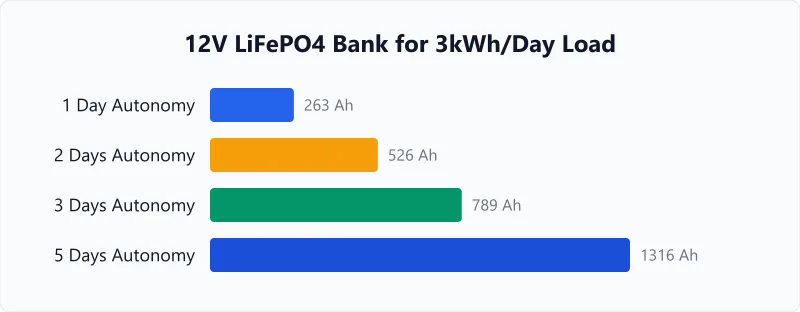
LiFePO4 (lithium iron phosphate) dominates new off-grid builds for good reason. You can use 80-90% of rated capacity per cycle, the batteries last 3,000-5,000 cycles, they weigh a third of equivalent lead-acid, and charge/discharge efficiency sits around 95-98%. A 200Ah LiFePO4 battery gives you 160-180Ah of usable power.
Lead-acid (flooded or AGM) costs less upfront but requires a larger bank because you can only safely use 50% of capacity. Cycle life is 300-500 cycles at 50% DoD. A 200Ah lead-acid battery only delivers 100Ah of usable power — half the usable capacity of the same-rated LiFePO4. Weight is roughly 3x higher per usable kWh.
On a cost-per-usable-kWh-per-cycle basis, LiFePO4 wins convincingly. As of early 2026, a $250 100Ah LiFePO4 battery delivering 80Ah (0.96kWh) over 3,000 cycles costs about $0.09 per usable kWh cycle. A $120 100Ah AGM battery delivering 50Ah (0.6kWh) over 400 cycles costs about $0.50 per usable kWh cycle — nearly six times more expensive over its lifetime. Prices and rates on this page are our own estimates as of the date shown; they change often. Enter your own figures for a current result. Our LiFePO4 vs lead-acid runtime comparison covers the performance differences in more depth.
Example: Sizing a Battery Bank for 5,000Wh/Day
Scenario: an off-grid tiny house using 5,000Wh per day. The owner wants 3 days of autonomy and is choosing between LiFePO4 (80% DoD) and AGM (50% DoD) at 24V.
LiFePO4 at 24V: 5,000Wh x 3 days = 15,000Wh needed. Divide by DoD: 15,000 / 0.80 = 18,750Wh total bank. At 24V: 18,750 / 24 = 781Ah. Sixteen 100Ah 12V LiFePO4 batteries wired as 8 series pairs in parallel (24V, 800Ah) meets this target. Approximate cost as of early 2026: $4,000-4,800.
AGM at 24V: 15,000 / 0.50 = 30,000Wh total bank. At 24V: 30,000 / 24 = 1,250Ah. That is 26 x 100Ah 12V AGM batteries to reach 1,300Ah at 24V. Approximate cost as of early 2026: $2,600-3,900, plus the weight approaches 900kg (nearly a tonne). After 400 cycles (roughly 1 year of daily cycling), the entire bank needs replacing.
The LiFePO4 option costs more upfront, but weighs less, lasts 8-10x longer, and takes up about two thirds of the floor space.
Worked Examples
Battery Bank for a Sailboat Liveaboard
Context
Calculation
Total energy = 2,400Wh × 3 days = 7,200Wh
Adjusted for DoD = 7,200 / 0.80 = 9,000Wh
At 12V: 9,000 / 12 = 750Ah
Interpretation
A 750Ah bank at 12V is substantial for a sailboat. Four 200Ah LiFePO4 batteries (800Ah total) fit the bill and weigh roughly 100 lbs total — significantly less than the 300+ lbs an equivalent AGM bank would add to the boat.
Takeaway
Ocean passages demand generous autonomy because multi-day clouds are common. After sizing the bank, determine recharge speed with our solar battery charge time calculator to verify your panels can recover from deep discharges between port stops.
Minimal Battery Bank for a Garden Shed
Context
Calculation
Daily usage = (60×8) + (50×1) = 480 + 50 = 530Wh
Bank capacity = 530 × 1 day / 0.80 = 662.5Wh
At 12V: 662.5 / 12 = 55.2Ah
Interpretation
A single 100Ah LiFePO4 battery provides nearly double the minimum requirement. This generous margin means cloudy days won't be a problem, and there's room to add a small fan or radio later without resizing.
Takeaway
For small loads like this, one battery and one panel keep things simple. Check how long this single battery lasts under your grow light load with our LiFePO4 battery runtime calculator.
Frequently Asked Questions
Glossary
Autonomy
The number of days a fully charged battery bank can power all connected loads without any recharging from solar, alternator, or grid. More autonomy means a larger (and more expensive) bank, but greater resilience during cloudy weather or equipment failure.
Usable Capacity
The portion of a battery's rated amp-hours that can be safely discharged. A 100Ah battery at 80% DoD provides 80Ah of usable capacity. Discharging beyond the recommended DoD shortens battery lifespan dramatically.
Cycle Life
The number of charge-discharge cycles a battery can perform before its capacity drops to 80% of original. LiFePO4 achieves 3,000-5,000 cycles at 80% DoD, while lead-acid manages 300-500 cycles at 50% DoD.
Parallel Wiring
Connecting batteries positive-to-positive and negative-to-negative to increase total amp-hours while keeping voltage the same. Two 12V 100Ah batteries in parallel become 12V 200Ah.
Need to know how long your sized battery bank will last under load? Run the numbers with our 12V battery runtime calculator.
Related calculators
How Many Batteries for a Solar System?
Figure out how many batteries your solar system needs for reliable off-grid power. Enter daily usage, autonomy, and battery specs.
Solar
Solar Panel and Battery Sizing Calculator
Size your complete off-grid solar system. Enter daily usage, sun hours, and battery specs to get panel and battery bank recommendations.
Solar
Solar Battery Charge Time Calculator
Calculate how long your solar panels take to charge your battery bank. Accounts for sun hours, system voltage, and real-world losses.
Solar
Battery Capacity (Amp Hours) Calculator
Calculate battery capacity in amp-hours from watt-hours and voltage. Convert between Wh, Ah, and watts easily.
Battery
Your battery bank is the foundation of any off-grid system. Undersizing it means nightly brownouts and premature battery death from deep cycling. Use this calculator to find your minimum, then seriously consider adding 20% headroom. Batteries are the most expensive component in an off-grid build — getting the size right the first time saves you from a costly early replacement. For a complete understanding of how discharge depth affects battery life, read our guide on understanding depth of discharge.
More Solar calculators
Browse all solar calculators — Panel output, battery bank sizing, charge time, and system design for off-grid, RV, and residential setups.
Last updated:
Written and maintained by Dan Dadovic, Commercial Director at Ezoic Inc. & PhD Candidate in Information Sciences. He works professionally as Commercial Director at Ezoic Inc., leading revenue strategy across digital publishing.
Disclaimer: Calculator results are estimates based on theoretical formulas. Actual performance varies with temperature, battery age, load patterns, and equipment condition. For critical electrical work, consult a licensed electrician.
Methodology reviewed by Doc. dr. sc. Damir Topić, Assistant Professor, FERIT Osijek.