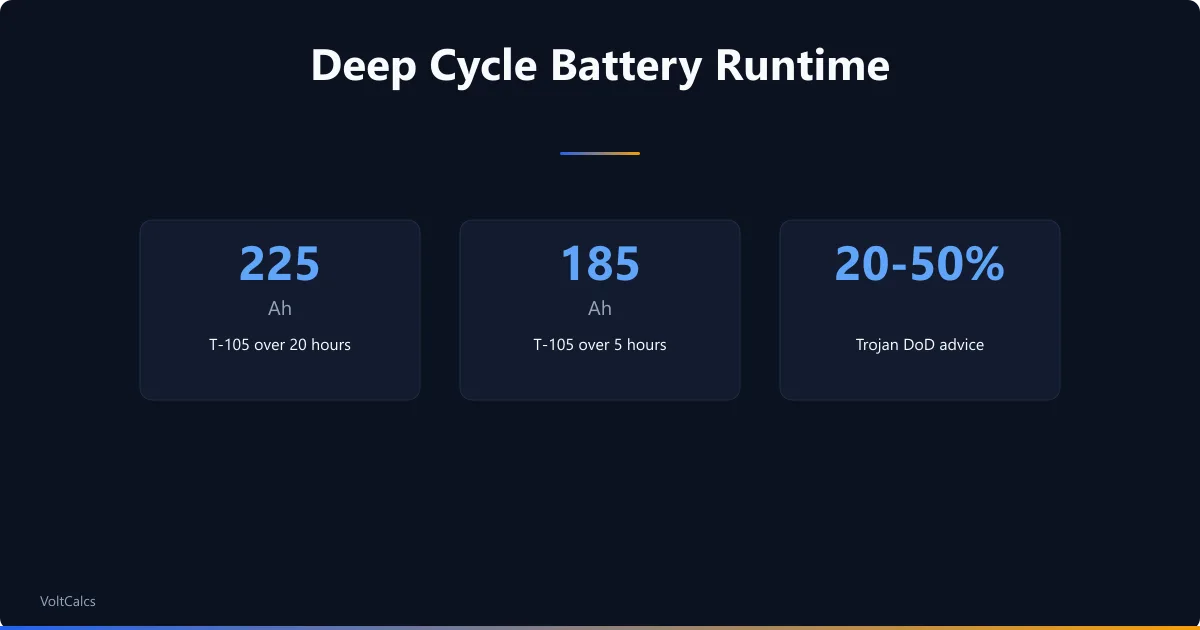
Deep Cycle Battery Types Compared
| Feature | Flooded (Golf Cart) | AGM Deep Cycle | Gel Deep Cycle | LiFePO4 Deep Cycle |
|---|---|---|---|---|
| Maker-printed DoD advice | 20-50% (Trojan) | 50% maximum average (Concorde) | 50% or 80%, with the cycle count printed for each (Victron) | 100% (Battle Born) |
| Printed cycle life | Trojan publishes no single figure for the T-105 | 1,500 cycles at 30% discharge, 600 at 50%, 400 at 80% (Victron AGM Deep Cycle) | 1,800 cycles at 30% discharge, 750 at 50%, 500 at 80% (Victron Gel Deep Cycle) | 3,000-5,000 deep discharge cycles (Battle Born) |
| Rate correction used here | n = 1.15 | n = 1.15 | n = 1.19 | None below 1C |
| Maintenance | Add water monthly | None | None | None |
| Cost per Ah (early 2026) | $0.50-1.00 | $1.50-3.00 | $2.00-3.50 | $3.00-6.00 |
| Weight per Ah | ~0.6 lbs | ~0.6 lbs | ~0.6 lbs | ~0.25 lbs |
One cell in that table is empty on purpose. Trojan publishes depth-of-discharge advice for the T-105 but no cycles-at-a-depth figure for that model, so none is shown; the AGM and gel rows come from Victron's own GEL and AGM datasheet, which prints a three-row cycle design life for each range, and the LiFePO4 row from Battle Born. Read the AGM and gel rows as what they are: one maker's design life for its own cells, not a figure for every battery of that type. Prices and rates on this page are our own estimates as of the date shown; they change often. Enter your own figures for a current result. The weight-per-Ah column is our own estimate; no published source backs those figures. Check your results against your product data or a licensed professional before acting.
Why a Fast Discharge Costs You Amp-Hours
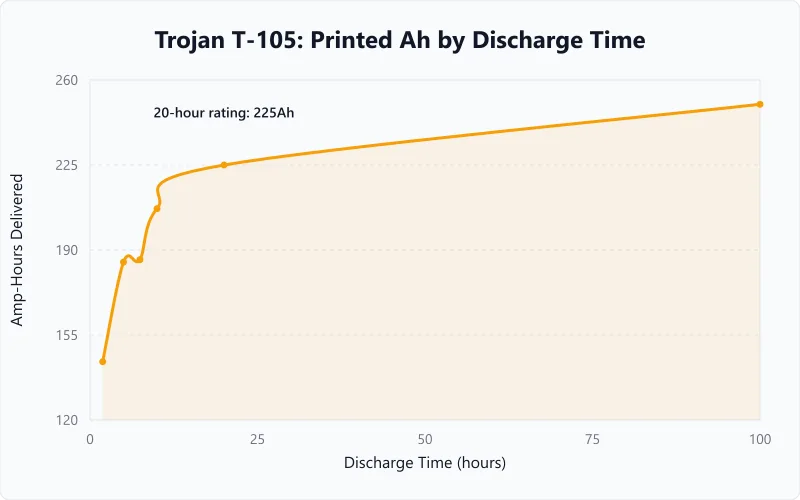
A lead-acid battery gives back less total energy when you pull harder, and its maker measures exactly how much less. Trojan prints four ratings for the same T-105: 250Ah over 100 hours, 225Ah over 20 hours, 207Ah over 10 hours and 185Ah over 5 hours. Against the 20-hour rating most labels quote, the 5-hour figure is 17.8% lower.
This is the Peukert effect, named after the German scientist who quantified it in 1897. High current builds lead sulfate on the plates faster than it dissolves, and the blocked area stops taking part in the reaction.
The calculator above does not ignore this. It applies a rate correction of the form t = a x (I/C20)^-n, with a and n fitted by least squares to constant-current points those makers print: Trojan for flooded, Lifeline and Victron for AGM, Victron for gel. The fitted exponents are 1.15 for flooded, 1.15 for AGM and 1.19 for gel, and the fit reproduces the printed tables to within about 10% for flooded, 6% for AGM and 2% for gel. Lifeline separately prints a recommended Peukert constant of 1.12 for its own line. Outside the range of rates a maker prints, the result carries a live warning rather than a silent extrapolation.
LiFePO4 takes no rate correction here, because Victron measures its own nominal capacity at a 1C discharge already. It does get the nominal voltage right: Victron prints 12.8V and 1280Wh for a 100Ah block, so feeding a flat 12V would understate the pack by 6.25%.
Worked Examples
Runtime from Golf Cart Batteries in an Off-Grid System
Context
You wire four 6V 225Ah golf cart batteries in series for a 24V bank. Your evening loads average 300W and you limit discharge to 50% DoD.
Calculation
Bank: 4 x 6V = 24V, 225Ah (series does not increase Ah)
Current: 300W at 90% efficiency is 333W from the bank, which is 13.9A at 24V, or 0.062C
Runtime to empty at that rate: 14.8 hours; at 50% DoD, 7.4 hours
Interpretation
About 7 hours 24 minutes, enough for an evening with a recharge due by morning. The old identity formula gave 7.65 hours here; the rate correction takes roughly a quarter of an hour off, because 0.062C is a little faster than the 20-hour rate the 225Ah label is measured at.
Takeaway
Golf cart batteries are the cheapest deep-cycle option but require regular watering. For a maintenance-free comparison, check our AGM battery runtime calculator.
Comparing Deep Cycle Types for a Marine Setup
Context
You are choosing between a 105Ah flooded deep-cycle and a 100Ah AGM for powering fish finders, radios, and lights (60W total) on your boat. Both are 12V.
Calculation
Both draw 66.7W from the bank at 90% efficiency, which is 5.6A at 12V
Flooded 105Ah at 0.053C, 50% DoD: 8.8 hours
AGM 100Ah at 0.056C, 50% DoD: 8.7 hours
Interpretation
Seven minutes apart, which is noise. The AGM holds up a shade better because its own fitted exponent is flatter, but at this load neither chemistry is working hard. The AGM costs more and is sealed, vibration-resistant and maintenance-free, which are the real advantages on a boat.
Takeaway
Either battery handles a full day of fishing electronics. For trolling motor loads (much heavier), size a dedicated battery bank using our battery size for inverter calculator with your motor's wattage.
Frequently Asked Questions
Glossary
Peukert Effect
The drop in total delivered capacity as discharge current rises. Trojan prints the same T-105 at 225Ah over 20 hours, 207Ah over 10 hours and 185Ah over 5 hours. LiFePO4 shows almost none of it, which is why Victron measures its own nominal capacity at a 1C discharge.
Deep Cycle Battery
A battery designed to be regularly discharged to 50% or more of its capacity and recharged. Unlike starting batteries (which deliver brief high-current bursts), deep cycle batteries have thicker plates that withstand repeated deep discharges.
Flooded Lead-Acid
The oldest and cheapest deep-cycle battery type. Contains liquid electrolyte that must be periodically topped up with distilled water. Vents hydrogen gas during charging and must be installed upright in a ventilated space.
Sizing a deep cycle bank for solar storage? The solar battery bank size calculator matches your panels to the right battery capacity.
Related calculators
Battery Runtime Calculator
Calculate how long your battery will last under any load. Enter capacity, voltage, and wattage for an instant runtime estimate.
Battery
AGM Battery Runtime Calculator
Estimate AGM battery discharge time with chemistry-specific defaults. Compare AGM vs flooded lead-acid for your use case.
Battery
Marine Battery Runtime Calculator
Estimate trolling motor and boat electronics runtime from your marine battery. Built for anglers and boaters.
Battery
Reserve Capacity to Amp Hours
Convert battery reserve capacity minutes into amp-hours two ways: the exact capacity at the 25 amp test rate and an estimated 20-hour rating.
Battery
Deep cycle batteries vary wildly in quality and real-world performance. The cheapest marine/RV battery at the auto parts store is not in the same class as a Trojan T-105 or a quality LiFePO4 cell. Buy the best you can afford, respect the DoD limits, and your batteries will return the investment many times over. For a detailed look at standard flooded lead-acid chemistry, including the Peukert equation in depth, see the lead-acid runtime calculator. Our LiFePO4 vs lead-acid comparison quantifies the cost-per-cycle advantage of each chemistry.
More Battery calculators
Browse all battery calculators — LiFePO4, lead-acid, AGM, and lithium-ion runtime, charge time, and capacity sizing.
Last updated:
Written and maintained by Dan Dadovic, Commercial Director at Ezoic Inc. & PhD Candidate in Information Sciences. He works professionally as Commercial Director at Ezoic Inc., leading revenue strategy across digital publishing.
Disclaimer: Calculator results are estimates based on theoretical formulas. Actual performance varies with temperature, battery age, load patterns, and equipment condition. For critical electrical work, consult a licensed electrician.
Methodology reviewed by Doc. dr. sc. Damir Topić, Assistant Professor, FERIT Osijek.