How to Find the Numbers You Need
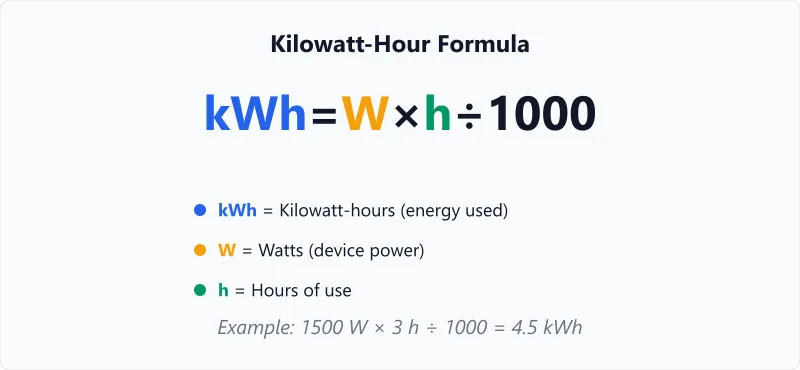
- Find the device wattage. Look on the label on the back or bottom of the device. It might say "1500W" or "120V, 12.5A" — if you only see volts and amps, multiply them to get watts: 120V x 12.5A = 1,500W.
- Estimate daily usage. A space heater might run 8 hours during winter evenings. A refrigerator runs its compressor about 8-12 hours total per day (the motor cycles on and off). A gaming PC running 6 hours a day at 350W costs differently than a laptop at 65W for 10 hours.
- Find your electricity rate. Check your utility bill — look for "price per kWh" or "energy charge." The US average is about 17–20 ¢/kWh (EIA 2024 average 16.5 ¢; BLS early 2026 about 19 ¢), but rates range from $0.10 in Louisiana to $0.35+ in Hawaii and parts of California. Time-of-use rates vary by hour, so use the rate that applies when the device runs. Prices and rates on this page are our own estimates as of the date shown; they change often. Enter your own figures for a current result.
- Set the time period. Use 30 days for monthly cost, 90 for a seasonal estimate, or 365 for annual cost. Seasonal devices like space heaters or pool pumps might only run 90-120 days per year.
What Common Appliances Cost to Run
| Appliance | Watts | Typical Hours/Day | Monthly kWh | Monthly Cost ($0.16) |
|---|---|---|---|---|
| Space heater | 1,500 | 8 | 360 | $57.60 |
| Window A/C (8,000 BTU) | 800 | 10 | 240 | $38.40 |
| Refrigerator | 150 (33% duty) | 8 | 36 | $5.76 |
| Electric oven | 2,500 | 1 | 75 | $12.00 |
| Clothes dryer | 5,000 | 1 | 150 | $24.00 |
| Desktop PC + monitor | 300 | 6 | 54 | $8.64 |
| LED TV (55") | 80 | 5 | 12 | $1.92 |
| LED bulb | 10 | 6 | 1.8 | $0.29 |
| Washing machine | 500 | 1 | 15 | $2.40 |
| EV charger (Level 2) | 7,200 | 4 | 864 | $138.24 |
Typical wattages are our own estimates; check your appliance's nameplate.
The big surprises are usually space heaters, EV chargers, and pool pumps. These high-watt devices running many hours per day dominate your bill. Our electricity cost calculator gives a daily, monthly, and yearly breakdown for any single appliance. A single 1,500W space heater running 8 hours a day can add nearly $60/month.
Practical Ways to Cut kWh and Lower Your Bill
The biggest savings come from the biggest loads. Swapping a space heater for a heat pump saves 50-70% on heating energy because heat pumps move heat instead of generating it. A mini-split heat pump uses about 500W to deliver the same warmth as a 1,500W resistive heater. To project the full bill across all categories — HVAC, water heating, electronics, lighting — our electricity bill estimator builds a category-level total.
Timing matters as much as efficiency. If your electricity costs push you toward going off-grid, our solar and battery sizing calculator designs a complete system around your daily kWh usage. Even on-grid, run your dryer and dishwasher during off-peak hours if your utility offers time-of-use rates. Evening rates can be half of peak afternoon rates. A dryer load that costs $1.20 at 3pm might cost $0.60 at 9pm.
Phantom loads add up quietly. A desktop PC in sleep mode still draws 5-15W. A cable box draws 15-30W even when "off." A TV soundbar pulls 5-10W on standby. Smart power strips that cut power completely when devices are off can save 5-10% on your electronics-related energy use.
If your energy costs are high enough to justify solar panels, our solar panel output calculator shows how much of your daily kWh usage a solar array can offset. Even a modest 4-panel system can wipe out your refrigerator, lighting, and electronics usage.
Worked Examples
What a Big Winter Load Adds to Your Bill
Context
You rely on a 1,500W electric space heater in a home office from November through March. It runs about 8 hours per day, and your electric rate is $0.14/kWh.
Calculation
Daily energy: 1,500 W x 8 hrs = 12,000 Wh = 12 kWh/day
Daily cost: 12 x $0.14 = $1.68/day
Monthly cost (30 days): $1.68 x 30 = $50.40
Five-month winter cost: $50.40 x 5 = $252
Interpretation
A single space heater adds $50/month to your electric bill. Running two heaters doubles it. Over a full winter, the cost rivals a mini-split heat pump, which heats more efficiently. This is a quick illustration of any large winter load; for a full space-heater breakdown by wattage setting and thermostat duty cycle, our dedicated space heater cost calculator is built for exactly this question.
Takeaway
If you are heating an off-grid space with battery power, the load matters even more. Plug 1,500W into our battery runtime calculator to see how fast a heater drains a battery bank — it is surprisingly quick.
Calculating Monthly Cost of a Cryptocurrency Mining Rig
Context
A mining rig draws 1,800W continuously (24/7). Your electricity rate is $0.12/kWh. You want to know the monthly operating cost to compare against mining revenue.
Calculation
Daily energy: 1,800 x 24 = 43,200 Wh = 43.2 kWh
Daily cost: 43.2 x $0.12 = $5.18
Monthly cost: $5.18 x 30 = $155.52
Annual cost: $155.52 x 12 = $1,866.24
Interpretation
At $156/month, electricity is the dominant operating cost. If mining revenue falls below this, the rig loses money every day it runs.
Takeaway
High-wattage continuous loads like miners also stress your home electrical panel. Use our electrical load calculator to verify your panel can handle the added load without exceeding its rating.
Frequently Asked Questions
Glossary
Kilowatt-Hour
A unit of energy equal to 1,000 watts consumed for one hour. This is what your electric utility bills you for — not watts (power) alone, but power multiplied by time.
Electricity Rate
The price per kWh charged by your utility. Rates vary by location, time of day (with time-of-use plans), and usage tier. The US average is roughly $0.16/kWh, but ranges from $0.10 to $0.35+.
Continuous Load
A device that runs at or near its full wattage for extended periods without cycling on and off. Space heaters, mining rigs, and grow lights are continuous. Fridges and AC units cycle, so their effective wattage is lower than the nameplate rating.
Wondering how much battery capacity you need to keep a device running during a power outage? Our UPS battery backup calculator estimates backup time for any load.
Related calculators
Electricity Cost Calculator
See the daily, monthly, and annual electricity bill impact of running any device. Plug in wattage, hours, and your utility rate for a full cost breakdown.
Electrical
Electricity Bill Estimator
Estimate your full monthly electricity bill by category: HVAC, water heating, fridge, lighting, electronics, cooking, laundry, plus fixed delivery charges.
Electrical
Appliance Electricity Cost Calculator
See exactly what each appliance costs to run by day, month, and year. Enter wattage, hours of use, and your rate to rank household energy hogs.
Electrical
Amps Draw Calculator
Calculate current draw in amps from watts and volts for any device. Supports single-phase and three-phase loads with power factor adjustment.
Electrical
Energy awareness is the first step to controlling your electric bill. Once you know which devices cost the most, you can make targeted decisions — upgrade the worst offenders, shift usage to off-peak hours, or estimate the payback period for solar panels to offset your baseline load. The numbers from this calculator are estimates based on the wattage and hours you enter. Actual costs depend on your utility's rate structure, which may include tiered pricing, demand charges, or time-of-use rates.
More Electrical calculators
Browse all electrical calculators — Motor FLA, wire sizing, voltage drop, load calculations, and transformer fusing based on NEC standards.
Last updated:
Written and maintained by Dan Dadovic, Commercial Director at Ezoic Inc. & PhD Candidate in Information Sciences. He works professionally as Commercial Director at Ezoic Inc., leading revenue strategy across digital publishing.
Disclaimer: Calculator results are estimates based on theoretical formulas. Actual performance varies with temperature, battery age, load patterns, and equipment condition. For critical electrical work, consult a licensed electrician.
Methodology reviewed by Doc. dr. sc. Danijel Jerković-Štil, Assistant Professor, FERIT Osijek.