Backup Time by Battery String
Open the case and a UPS is a string of 12V blocks. How long it holds up is set by how many blocks there are, how big each one is, and how many watts each has to push out. Here is what the printed high-rate curve gives at two common loads, with the inverter taking its 80% cut first.
| Battery string | Watts per block at 400W load | Runtime at 200W | Runtime at 400W |
|---|---|---|---|
| 1 x 12V 7Ah | 500W | 8.7 min | 2.6 min* |
| 1 x 12V 9Ah | 500W | 13 min | 4.1 min* |
| 2 x 12V 9Ah (24V) | 250W | 31 min | 13 min |
| 4 x 12V 9Ah (48V) | 125W | 68 min | 31 min |
| 4 x 12V 18Ah (48V) | 125W | 154 min | 68 min |
*Below the shortest row Power-Sonic prints, which is five minutes, so those two cells extend the printed curve rather than read from it. The calculator says so on screen when your own figures land there. Note how the drop is steeper than the load rise: doubling the load from 200W to 400W on a 24V 9Ah string cuts backup time from 31 minutes to 13, a 57% fall rather than a half. That is the shape of the discharge curve, and it is why sizing off a single quoted runtime figure misleads.
Where These Minutes Come From
Battery makers do not publish amp-hours for UPS work. They publish constant-power tables: watts against minutes, measured down to a fixed end voltage. Power-Sonic's PSH-1280 sheet prints 36.0 watts per cell at fifteen minutes to 1.67 volts per cell, which is 216W for the whole six-cell 12V block; CSB's GP1272 sheet prints the same kind of row per battery rather than per cell. This calculator reads those rows directly.
Four steps run behind the Calculate button:
- Divide the string voltage by 12 to get the number of blocks.
- Divide your load by the inverter efficiency, then by the number of blocks, to get the watts one block must deliver.
- Scale the printed curve in proportion to the capacity you entered against the datasheet battery (8.5Ah for the high-rate table, 7.2Ah for the general-purpose one).
- Read the minutes off the scaled curve, interpolating between the two printed rows either side.
Step three is the one assumption, and it holds up under checking. CSB's HR1234W and Power-Sonic's PSH-1280 are high-rate blocks of nearly the same size from different makers, and their printed curves agree within 9% at every shared row from five to ninety minutes. Across the two classes the difference is real but modest: per amp-hour the high-rate block gives about 6% more at the fifteen-minute rate and about 13% less over a twenty-hour discharge.
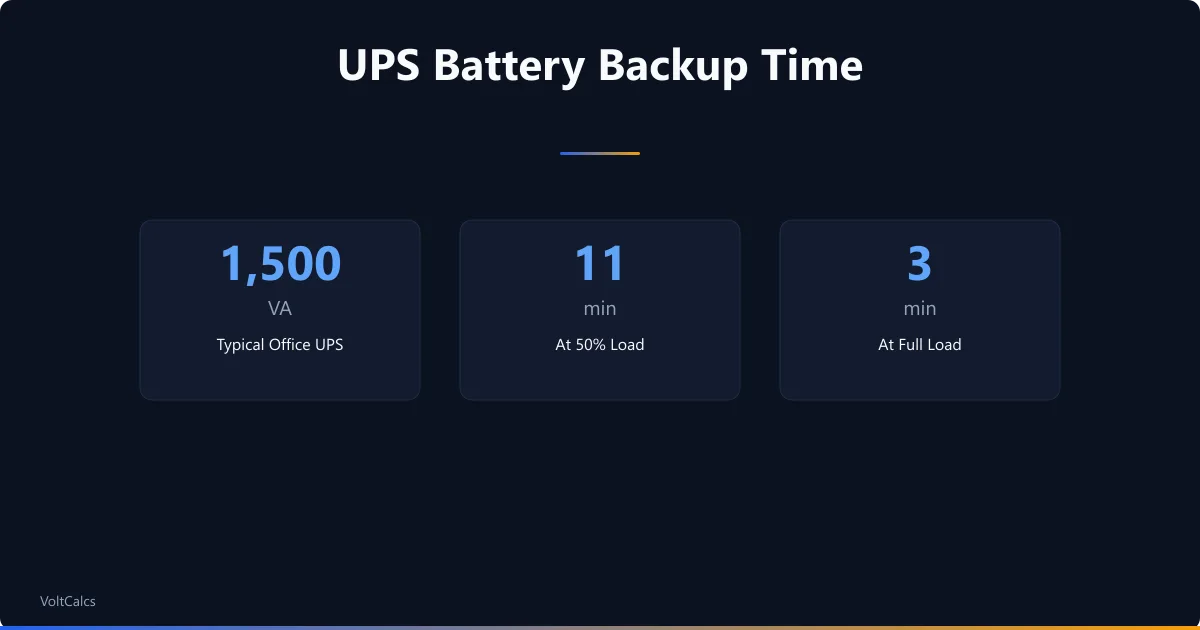
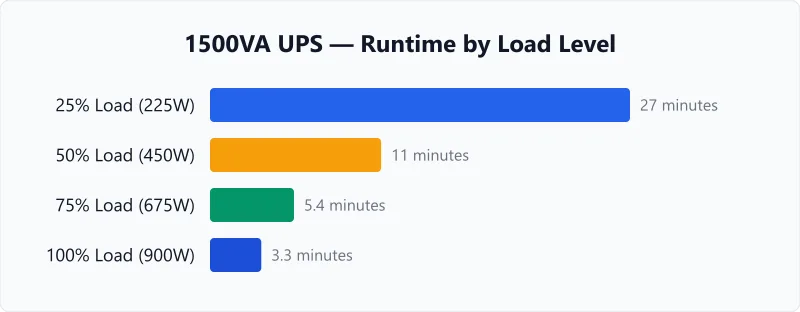
The 80% inverter efficiency is derived, not printed. No UPS maker whose sheets we opened publishes an on-battery efficiency figure, so we worked backwards from one that publishes runtimes instead. CyberPower prints 1,500VA / 900W for the CP1500AVRLCD, a battery of two 12V 9Ah blocks, and runtimes of 12 minutes at half load and 3 minutes at full load. Reproducing 12 minutes at 450W needs 85% efficiency; reproducing 3 minutes at 900W needs 75%. The middle of those two is 80%, which is the default this page ships. Run the calculator at CyberPower's own numbers and it answers 11 minutes and 3.3 minutes against their printed 12 and 3, close enough to be useful and honest about which half of the pair it leans on. If your own unit publishes an efficiency figure, type it in.
Example: Home Office UPS Sizing
You work from home and need UPS backup for your desktop PC, monitor, and internet equipment during brief flickers and short outages, long enough to save and shut down cleanly.
Equipment: desktop PC (250W), 27" monitor (45W), router and modem (20W), USB hub and desk lamp (15W). Total: 330W.
Your UPS holds two 12V 9Ah blocks in series. At 80% efficiency the pair must supply 330 / 0.80 = 413W, so each block carries 206W. On the scaled high-rate curve 206W sits between the fifteen-minute row (229W) and the twenty-minute row (182W), giving about 17 minutes.
That covers a flicker and a tidy shutdown, and not much else. For longer cover, drop the load, since a laptop instead of the desktop saves around 150W, or fit an extended battery module if the unit takes one. When an outage runs into hours and keeping the fridge cold matters more than the desktop, our 12V battery for fridge backup guide moves the planning from minutes of UPS runtime to days of deep-cycle support.
Worked Examples
How Long Will a UPS Keep Your Home Office Running?
Context
Your UPS is a 1500VA unit holding two 12V 9Ah high-rate blocks in series. Your office load is a monitor, desktop and router drawing 350W between them.
Calculation
Watts leaving the battery: 350 / 0.80 inverter efficiency = 437.5W
Split across two 12V blocks: 437.5 / 2 = 218.8W per block
Printed curve scaled from 8.5Ah to 9Ah: 229W at 15 minutes, 182W at 20 minutes
218.8W sits between those rows: about 16 minutes
Interpretation
Sixteen minutes covers saving your work and shutting down properly. It does not cover an outage that outlasts the coffee, and no UPS of this size will.
Takeaway
If you need hours rather than minutes, the answer is a deep-cycle bank, not a bigger UPS. See our deep cycle runtime calculator to size one.
Why the VA Number Does Not Set Your Backup Time
Context
A gaming PC pulls 450W with the GPU working and drops to about 250W sitting idle. The UPS is a 1500VA unit on a 24V string of two 9Ah high-rate blocks.
Calculation
Under load: 450 / 0.80 = 562.5W, split two ways = 281W per block
Scaled printed curve: 296W at 10 minutes, 229W at 15 minutes, so 281W gives about 11 minutes
Idle: 250 / 0.80 / 2 = 156W per block, which reads about 24 minutes off the same curve
The 1500VA figure appears in neither calculation
Interpretation
Eleven minutes under load, twenty-four when the machine is idling: the same UPS, the same battery, two answers. VA sets the most you may plug in, and nothing else. A 2200VA unit on this same 24V 9Ah string would answer 11 minutes too.
Takeaway
Size the VA rating to your peak watts and the battery string to the minutes you need, because they are separate decisions. To put a yearly cost on what that PC draws, try our cost per kWh calculator.
Frequently Asked Questions
Glossary
Volt-Amperes
The apparent power rating of a UPS, combining real power (watts) and reactive power. VA is always equal to or higher than watts. CyberPower prints an output power factor of 0.6 for its CP1500AVRLCD, so that 1500VA label carries a 900W real-power rating.
Transfer Time
The milliseconds between mains power failing and the UPS switching to battery. CyberPower prints a typical transfer time of 4ms for its line-interactive CP1500AVRLCD. Online (double-conversion) units have no transfer time at all, because the load always runs from the inverter.
Battery Runtime
How long a UPS can carry the connected load from its internal blocks, read off the battery maker's constant-power discharge table. It follows the string and the watts, never the VA label: a 24V 9Ah string runs 31 minutes at 200W and 13 minutes at 400W.
Calculating your home office energy costs? The kWh calculator estimates monthly electricity usage and cost.
Related calculators
Laptop Battery Runtime Calculator
Estimate your laptop battery life based on battery Wh rating and actual power consumption by usage mode.
Battery
Battery Runtime Calculator
Calculate how long your battery will last under any load. Enter capacity, voltage, and wattage for an instant runtime estimate.
Battery
Propane Generator Run Time Calculator
Calculate how long a propane generator runs on a given tank size. Enter tank weight, load, and generator efficiency.
Battery
Watt Hours to Amp Hours Calculator
Convert watt-hours to amp-hours at any voltage. Use this to compare batteries rated in different units.
Battery
Everything above assumes a battery in good health at room temperature, which is what the datasheet curves are measured on. An older block gives back less, and no calculator can tell you how much less without measuring your own. So treat the number here as the ceiling for your string: replace blocks on schedule, and check the real figure once a year by pulling the plug and timing it, rather than finding out during the next storm.
More Battery calculators
Browse all battery calculators — LiFePO4, lead-acid, AGM, and lithium-ion runtime, charge time, and capacity sizing.
Last updated:
Written and maintained by Dan Dadovic, Commercial Director at Ezoic Inc. & PhD Candidate in Information Sciences. He works professionally as Commercial Director at Ezoic Inc., leading revenue strategy across digital publishing.
Disclaimer: Calculator results are estimates based on theoretical formulas. Actual performance varies with temperature, battery age, load patterns, and equipment condition. For critical electrical work, consult a licensed electrician.
Methodology reviewed by Doc. dr. sc. Damir Topić, Assistant Professor, FERIT Osijek.