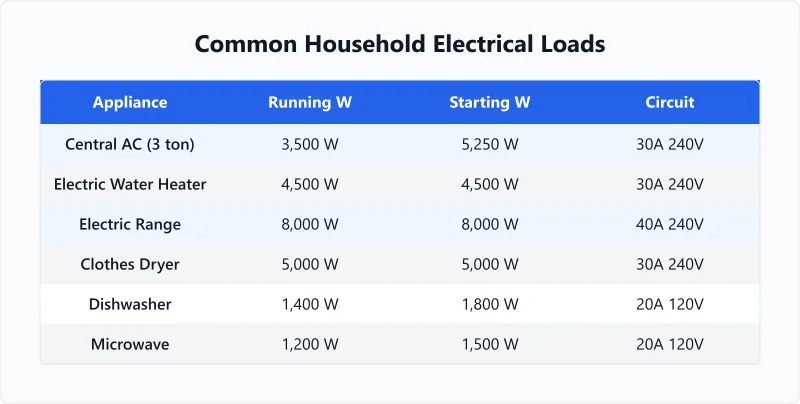
Typical Dwelling Load Wattages
| Appliance / Load | Typical Watts | Notes |
|---|---|---|
| Electric range/oven | 8,000-12,000 | Table 220.55 allows a demand value below nameplate |
| Electric clothes dryer | 4,500-5,500 | Use nameplate; commonly about 5,000 VA |
| Central A/C (3 ton) | 3,500 | Use locked rotor amps for starting surge |
| Electric water heater | 4,500 | Continuous load — apply 125% for circuit sizing |
| Dishwasher | 1,200-1,800 | Check nameplate — newer models use less |
| Washing machine | 500-800 | Motor load, brief surge on start |
| Refrigerator | 100-400 | Running watts, not starting surge |
| Microwave | 1,000-1,500 | Input watts, not cooking watts |
| General lighting + receptacles | 3 VA per sq ft | NEC 220.41 minimum for dwelling units (2023; Table 220.12 in 2020) |
These are starting points. Always check the nameplate on the actual equipment. A "1500W space heater" might actually draw 1,440W, close enough for estimation, but the nameplate is the legal number for code calculations. To translate those nameplate watts into a monthly utility cost per appliance, our appliance electricity cost guide ranks the typical household energy hogs by annual spend.
Two NEC Ways to Size a Dwelling
The National Electrical Code gives you two legitimate ways to size a dwelling service, and they routinely land on different numbers. The standard method (Article 220, Part III) factors each load category on its own. The optional method (NEC 220.82) is the shortcut this calculator uses. Here is how each one treats the same dwelling loads.
| Load | Standard method (Art. 220, Part III) | Optional method (220.82) |
|---|---|---|
| Who can use it | Any dwelling, feeder, or service | Dwelling on a single 100 A or larger, 3-wire 120/240 V service |
| General lighting | 3 VA/sq ft, then Table 220.45 (100% / 35% / 25%) | 3 VA/sq ft, added to the general-load total |
| Electric range | Table 220.55 (8 kW for one range up to 12 kW) | Full nameplate, added to the general-load total |
| Other fixed appliances | 75% for four or more (220.53) | Full nameplate, added to the general-load total |
| General-load factor | applied per category above | first 10 kVA at 100%, remainder at 40% (220.82(B)) |
| Heating vs A/C | larger of the two only (220.60) | largest of the 220.82(C) options |
| Typical outcome | more steps, usually the higher number | fewer steps, usually the lower number |
Neither method is "more correct." The optional method is usually lower for an all-electric home and is faster to run, which is why electricians reach for it on service upgrades. The standard method is what you fall back on when a dwelling sits outside the 220.82 eligibility window, such as a service below 100 A. For a permit, your local jurisdiction decides which calculation it wants to see.
The Standard Method, Step by Step
The standard method walks each load category through its own demand factor. Here is the dwelling sequence, with the 2023 section numbers and the 2020 numbers where Article 220 was renumbered.
- Add the general lighting and receptacle load. Multiply the living area by 3 VA per sq ft (NEC 220.41, Table 220.12 in 2020), then add 1,500 VA for each small-appliance and laundry circuit (220.52).
- Apply the lighting demand factor. Table 220.45 (Table 220.42 in 2020) takes the first 3,000 VA at 100%, the portion from 3,001 to 120,000 VA at 35%, and anything above 120,000 VA at 25%.
- Size the electric range. A single range up to 12 kW counts as 8 kW under Table 220.55, Column C. Ranges above 12 kW add 5% to that 8 kW for each kW over 12.
- Apply the fixed-appliance demand factor. Four or more fastened-in-place appliances (water heater, dishwasher, disposal, and the like, but not the range, dryer, heat, or A/C) get a 75% factor under 220.53.
- Count heating or cooling, not both. Heating and A/C rarely run together, so 220.60 lets you drop the smaller of the two. Fixed electric heat counts at 100% (220.51); the larger figure is the one you keep.
- Total and convert. Add the demand-adjusted categories, divide by 240 V for amps, and round up to the next standard service size.
Cited to NEC Table 220.45, Table 220.55 and 220.51. The code text itself is not freely available to link; confirm the figure against the current edition or your authority having jurisdiction before acting.
This calculator does not run those category steps. It applies the NEC 220.82 optional method instead: the first 10 kW of your total at 100% and the rest at 40%. That is a recognized code calculation for dwellings on a 100 A or larger service, not a rough shortcut. For an exact optional-method result the heating and A/C load is handled separately under 220.82(C); the tool folds everything into the one factor, so it slightly overstates an all-electric home with large electric heat. For a permit, a licensed electrician runs the full Article 220 numbers for your jurisdiction.
What Size Service Do I Need?
Once you have a demand figure, the service size is mostly arithmetic: divide demand by 240 V and round up to the next standard rating. The table below is engineering guidance from that arithmetic plus the standard ratings in NEC 240.6(A), not a code table you read a required size straight out of. A one-family dwelling can never go below 100 A (NEC 230.79(C)).
| Service size | Max load at 240 V | Typical dwelling it covers |
|---|---|---|
| 100 A | ~24 kVA | Small home or condo, gas heat and range, no EV |
| 125 A | ~30 kVA | Mid-size home, gas heat, modest electric loads |
| 150 A | ~36 kVA | Larger home, or modest all-electric without an EV |
| 200 A | ~48 kVA | Most new homes; all-electric or one EV charger |
| 400 A | ~96 kVA | Large all-electric home with EVs, heat pump, and a shop |
Leave headroom. A panel running near its calculated limit has no room for the next upgrade, and an electric vehicle charger or heat pump can erase a comfortable margin fast. If you are planning battery backup for these loads during an outage, the UPS battery backup calculator shows how long a bank would carry the demand.
Worked Examples
Same House, Two Methods: Standard vs Optional
Context
A 2,400 sq ft all-electric dwelling has these loads: general lighting 7,200 VA (2,400 x 3 VA/sq ft), two small-appliance circuits and one laundry circuit at 1,500 VA each (4,500 VA), a 12 kW range, a 5,000 VA dryer, a 4,500 VA water heater, a 1,500 VA dishwasher, a 900 VA disposal, a 1,500 VA microwave, 5,000 VA of central A/C, and 10,000 VA of electric heat. What service does it need?
Calculation
Standard method (Article 220, Part III):
Lighting + small-appliance + laundry = 7,200 + 3,000 + 1,500 = 11,700 VA. Apply Table 220.45: first 3,000 at 100% (3,000) + remaining 8,700 at 35% (3,045) = 6,045 VA.
Range: 8,000 VA (Table 220.55, one range up to 12 kW). Dryer: 5,000 VA at 100%. Four fixed appliances (water heater, dishwasher, disposal, microwave) = 8,400 VA x 75% = 6,300 VA (220.53). Heat 10,000 VA beats A/C 5,000 VA, so keep 10,000 VA only (220.60).
Total = 6,045 + 8,000 + 5,000 + 6,300 + 10,000 = 35,345 VA. At 240 V that is 147 A, so a 150 A service.
Optional method (220.82):
General loads at nameplate = 7,200 + 4,500 + 12,000 + 5,000 + 4,500 + 1,500 + 900 + 1,500 = 37,100 VA. Apply 220.82(B): first 10,000 at 100% (10,000) + remaining 27,100 at 40% (10,840) = 20,840 VA. HVAC under 220.82(C): the larger of heat 10,000 x 65% (6,500) and A/C 5,000 x 100% (5,000) is 6,500 VA. Total = 20,840 + 6,500 = 27,340 VA. At 240 V that is 114 A, so a 125 A service.
Interpretation
Same house, two legal answers: 150 A by the standard method, 125 A by the optional method. The optional method comes out lower here because it never breaks the range and appliances out to their own factors; it just runs the whole pile through 10 kVA at 100% then 40%. Most electricians would still install 200 A for an all-electric home this size to leave room for an EV charger.
Takeaway
Pick the method your jurisdiction accepts, then size the service above the result. Once the service size is set, the feeder or service-entrance conductors have to carry it over the run length; our wire distance calculator sizes the cable so voltage drop stays in spec.
Checking if a 200A Panel Handles a New EV Charger
Context
Your home's existing loads total 18 kW connected. You want to add a Level 2 EV charger rated at 7.2 kW (240V, 30A). The panel is rated 200A at 240V.
Calculation
Existing connected: 18,000 W
New EV charger: 7,200 W
Total connected: 25,200 W
NEC demand (first 10 kVA at 100%, remainder at 40%): 10,000 + (15,200 x 0.40) = 10,000 + 6,080 = 16,080 W
Demand amps: 16,080 / 240 = 67 A
Interpretation
At 67A demand, you are well within the 200A panel capacity. The NEC demand factor method shows the panel can handle the charger even though connected load is 25 kW.
Takeaway
An EV charger is a continuous load (NEC 625.42), so its circuit is sized at 125% of the charger's rated current (625.41), and the 2023 code adds a dedicated EVSE load rule at 220.57. Cited to NEC 220.57. The code text itself is not freely available to link; confirm the figure against the current edition or your authority having jurisdiction before acting. Before you commit to a charging schedule, estimate the running cost with our kWh calculator.
Frequently Asked Questions
Glossary
Connected Load
The total wattage of all electrical devices that could potentially run at the same time on a circuit or panel. This is always higher than the actual demand load because not everything runs simultaneously.
Demand Factor
The ratio of actual expected load to total connected load, expressed as a percentage. NEC provides standard demand factors for residential calculations — typically 100% for the first 10 kVA, then 40% for the remainder.
Continuous Load
Any load expected to run for 3 hours or more without interruption. NEC requires continuous loads to be sized at 125% of their rated current, which affects breaker and conductor sizing. To size the breaker for a single branch circuit, see what size breaker a load needs.
Noncoincident Loads
Two loads that are unlikely to run at the same time, such as electric heat and air-conditioning. NEC 220.60 lets you count only the larger of the pair in a service calculation and drop the smaller. It is the reason a standard-method dwelling calculation keeps the larger of the heating or cooling load, never the sum of both.
Sizing a solar system to offset your electrical load? Our solar panel and battery sizing calculator designs a complete off-grid system based on your daily usage.
Related calculators
Amps Draw Calculator
Calculate current draw in amps from watts and volts for any device. Supports single-phase and three-phase loads with power factor adjustment.
Electrical
Generator Sizing Calculator
Find the right generator size for your loads. Enter running watts, motor surge, and power factor for an instant recommendation with safety margin.
Electrical
Off-Grid Load Calculator
Calculate your total daily energy needs for off-grid living. Get recommended battery bank size and solar panel wattage for your system.
Solar
Kilowatt-Hour (kWh) Calculator
Calculate kilowatt-hours and energy cost for any appliance or device. Enter watts, hours of use, and your electricity rate for instant results.
Electrical
This calculator gives you a quick optional-method demand figure for planning. If you want to size an off-grid system around these loads, start from the demand figure rather than connected load; it is far closer to how the house actually draws power. Adding a big new branch, an EV charger above all, can push an existing 100 A or 150 A panel close to its limit; our EV charging cost calculator covers the energy side once the panel question is settled. The full Article 220 calculation for a permit applies more specific factors per appliance category, and your jurisdiction may amend it, so a licensed electrician should run the official numbers for new construction or a panel upgrade. Results here are estimates: actual demand varies with usage patterns and equipment.
More Electrical calculators
Browse all electrical calculators — Motor FLA, wire sizing, voltage drop, load calculations, and transformer fusing based on NEC standards.
Last updated:
Written and maintained by Dan Dadovic, Commercial Director at Ezoic Inc. & PhD Candidate in Information Sciences. He works professionally as Commercial Director at Ezoic Inc., leading revenue strategy across digital publishing.
Disclaimer: Calculator results are estimates based on theoretical formulas. Actual performance varies with temperature, battery age, load patterns, and equipment condition. For critical electrical work, consult a licensed electrician.
Methodology reviewed by Doc. dr. sc. Danijel Jerković-Štil, Assistant Professor, FERIT Osijek.