Three Ways to Find an Appliance’s Wattage
- Check the nameplate. Most appliances list watts directly. If only volts and amps are listed, multiply them: a 120V × 12A microwave is 1,440W.
- Use the manufacturer’s spec sheet. Search the model number online for documented running watts. This is more accurate than the label, which often shows peak draw.
- Measure with a plug-in meter. A $20-30 Kill A Watt meter shows real-time watts and accumulates kWh over time. This is the gold standard for variable-load devices like fridges and PCs.
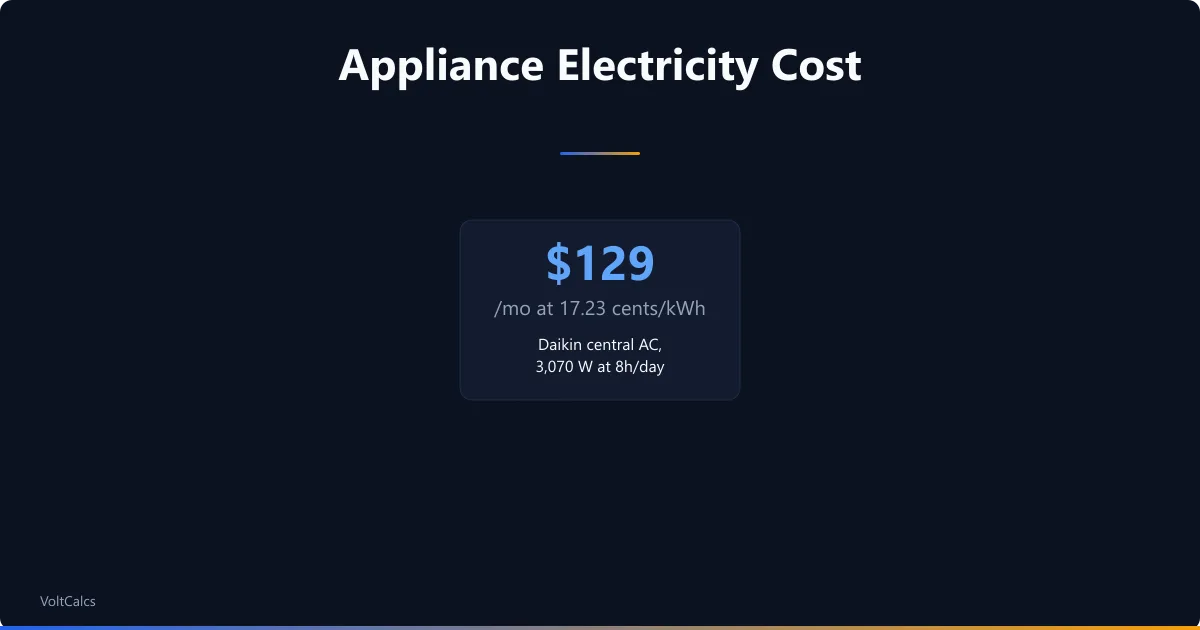
Once you have a wattage, plug it in above with your daily usage and rate. The calculator returns the cost for your period and, beside it, a month of use for five named appliances.
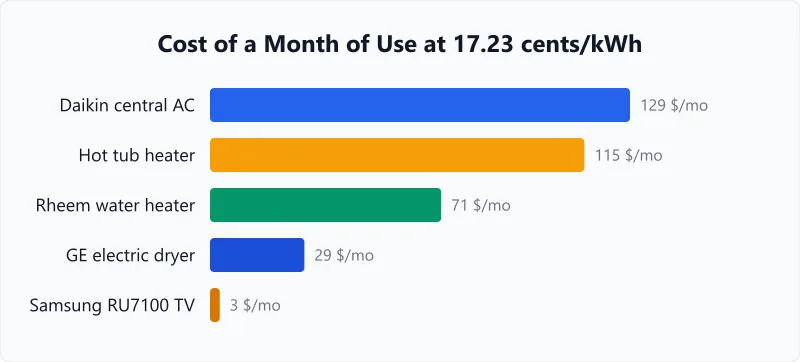
What Named Appliances Cost to Run
| Appliance | Watts (maker's print) | Hours/Day | Days | Cost* |
|---|---|---|---|---|
| Rheem XE50T06ST45U1 water heater, 4,500 W element | 4,500 | 3 | 365 | $849.01 a year |
| Daikin DC3SEN3610A 3-ton central air conditioner, 95 F outdoors | 3,070 | 8 | a month of use (365 / 12) | $128.71 a month |
| GE AGV10AB 10,000 Btu window unit | 1,020 | 8 | a month of use (365 / 12) | $42.76 a month |
| Lasko space heater on high | 1,500 | 8 | a month of use (365 / 12) | $62.89 a month |
| GE electric dryer | 5,600 | 1 | 365 | $352.18 a year |
| Samsung 65-inch RU7100 TV | 122 | 5 | 365 | $38.36 a year |
Each watts figure is the maker's own print: Rheem's "Dual 3000W or 4500W copper heating elements"; Daikin's expanded cooling data, 3.07 kW total system power at 95 F outdoors (70 F indoor dry bulb, 67 F wet bulb); GE's "1,020 Watts / 9.2 Amps"; Lasko's 900 W to 1500 W; GE's 5,600W for its electric dryers; Samsung's "Power Consumption (Typical) W 122". The hours and days are usage: enter your own. No maker prints the season of a cooling or heating load, so those rows show a month of use (365 / 12 days) and no year. A pool pump, a desktop computer and an LED bulb are not in the table: no maker's page on file prints their watts. A refrigerator is rated in kWh a year on its label, not in watts: see the refrigerator question below.
*At 17.23 cents per kWh, the page's default rate (EIA's 2025 annual U.S. residential average). Enter your own rate for a current result. Your own bill shows your home's total kWh for the month: set each row beside it. A load that draws many watts for many hours moves the bill most.
Where the Real Savings Live
The math says: cost is watts times hours times your rate, so the loads that draw the most watts for the most hours are where the savings live. A heat pump moves heat rather than making it in a resistance element, so it uses less electricity for the same warmth; our space heater electricity cost calculator breaks down that resistance-heat baseline by wattage and run time. A heat pump water heater does the same for hot water against a tank with resistance elements. A central AC with a higher SEER rating uses less electricity for the same cooling, and the air conditioner running cost calculator shows that monthly figure from the unit BTU and SEER rating. Enter each option's own watts and hours above to see what it saves at your rate.
Small habit changes on small loads move the bill less. An LED bulb draws fewer watts than an incandescent for the same light, and a charger left plugged in draws few watts: run each through the calculator to see its figure for your home. Spend the effort where the dollars are.
Bill estimation works the other way: instead of summing every appliance, our electricity bill estimator takes category totals (HVAC, water heating, refrigeration) and projects the full bill, which is closer to how utilities actually bill you. For sizing solar to offset specific loads, our solar ROI calculator shows the payback period.
Worked Examples
Pool Pump Running All Summer
Context
You have a single-speed 1HP pool pump rated at 1,000W and run it 8 hours per day from May through September (about 150 days). Your electricity rate is $0.16/kWh. What does the pump cost over the swimming season?
Calculation
Daily energy: 1,000 W × 8 hours = 8,000 Wh = 8 kWh
Daily cost: 8 kWh × $0.16 = $1.28
Seasonal cost (150 days): $1.28 × 150 = $192
Interpretation
That is $192.00 for the swimming season at 8 hours a day. The pump runs a fixed schedule, so the cost moves only if you change the runtime or the pump. A variable-speed pump run at a low setting for most of the day draws fewer watts: enter its own watts and hours above to compare.
Takeaway
A pool pump runs for hours every day of the season, so the hours you set matter as much as its watts. For backup-power planning around a pool, our battery runtime calculator shows how long a battery bank holds the pump load if power goes out.
GE Electric Dryer for a Year
Context
GE's own page prints 5,600W for its electric dryers. You run yours 1 hour a day, every day of the year: the hours are your own usage, so enter your own. Your electricity rate is $0.16/kWh. What does the dryer cost to run for a year?
Calculation
Daily energy: 5,600 W × 1 hour = 5,600 Wh = 5.6 kWh
Energy for the year: 5.6 kWh × 365 days = 2,044 kWh
Cost for the year: 2,044 kWh × $0.16 = $327.04
Interpretation
That is $327.04 for a year of drying at 1 hour a day. The cost moves with the hours: half an hour a day is half the cost, and two hours a day is twice the cost.
Takeaway
A refrigerator is not worked this way: its yellow EnergyGuide label rates it in kWh a year. Midea's product page for one of its refrigerators prints 207 kWh/yr, which is $35.67 a year at the page's default 17.23 cents per kWh. To plan a complete electrical-load picture for a kitchen renovation, our electrical load calculator totals all branch-circuit demand by NEC method.
Frequently Asked Questions
Glossary
Running Watts
The continuous power draw of an appliance under normal operation. Different from peak watts (the brief surge when motors start). For cost calculations, running watts is what matters because it represents the steady consumption over time. Resistive loads like heaters have running watts equal to their rated wattage; motor-driven loads like fridges average much less than peak draw.
Duty Cycle
The fraction of time an appliance actively draws full power. A compressor that runs a quarter of the time has a duty cycle of 0.25, and its average draw is a quarter of its running watts. For a refrigerator, use the kWh a year on its label instead of watts and hours.
Energy Star Rating
A US EPA certification that an appliance meets efficiency standards stricter than federal minimums. ENERGY STAR's criteria for certified refrigerators are 10% less measured energy use than the minimum federal efficiency standards. The yellow EnergyGuide label shows the estimated annual cost in dollars.
For deeper background on how rate, demand, and delivery charges combine into the bill total, see our guide to understanding electricity costs.
Related calculators
Electricity Bill Estimator
Estimate a monthly electricity bill from four categories (HVAC, water heating, refrigeration, other) and your all-in rate, with defaults from RECS 2020.
Electrical
Electricity Cost Calculator
See the daily, monthly, and annual electricity bill impact of running any device. Plug in wattage, hours, and your utility rate for a full cost breakdown.
Electrical
Kilowatt-Hour (kWh) Calculator
Calculate kilowatt-hours and energy cost for any appliance or device. Enter watts, hours of use, and your electricity rate for instant results.
Electrical
Water Heater Electricity Cost Calculator
Compare tank, tankless, and heat pump water heater operating costs with DOE UEF math. Inputs: gallons/day, set temp, inlet temp, and rate.
Electrical
One last note: every appliance cost figure is only as good as the wattage and rate you enter. Wattage labels often show maximum draw, not average. For a refrigerator, use the kWh a year on its yellow EnergyGuide label instead. Daily kWh from a Kill A Watt meter is far more accurate than label math. For your rate, divide the bill total by total kWh used to get the all-in number, including delivery and taxes. Our electricity cost calculator uses the same math but is designed for single-device estimation rather than ranking. For the full audit method (the 30-minute diagnostic that finds your top three loads before you start measuring), read our guide to what appliances actually cost to run.
More Electrical calculators
Browse all electrical calculators: Motor FLA, wire sizing, voltage drop, load calculations, and transformer fusing based on NEC standards.
Last updated:
Written and maintained by Dan Dadovic, Commercial Director at Ezoic Inc. & PhD Candidate in Information Sciences. On the energy side, Dan has hands-on experience with residential solar panel installation, DIY battery bank construction, off-grid power systems, wind power, and EV ownership/driving, all from building, maintaining, and operating his own systems.
Disclaimer: Calculator results are estimates based on theoretical formulas. Actual performance varies with temperature, battery age, load patterns, and equipment condition. For critical electrical work, consult a licensed electrician.
Methodology reviewed by Doc. dr. sc. Danijel Jerković-Štil, Assistant Professor, FERIT Osijek.