Why Use Categories Instead of Adding Up Every Appliance?
Because that is how the survey behind the defaults breaks it down. RECS 2020 table CE4.1 prints household electricity in five columns: space heating, water heating, air conditioning, refrigerators and other. This estimator uses them as four inputs, with space heating and air conditioning together as HVAC. Trying to itemize every appliance introduces error in two directions: you forget loads (standby draw, modems, network gear) and you double-count loads (a dehumidifier overlaps with HVAC). Category totals smooth those errors out.
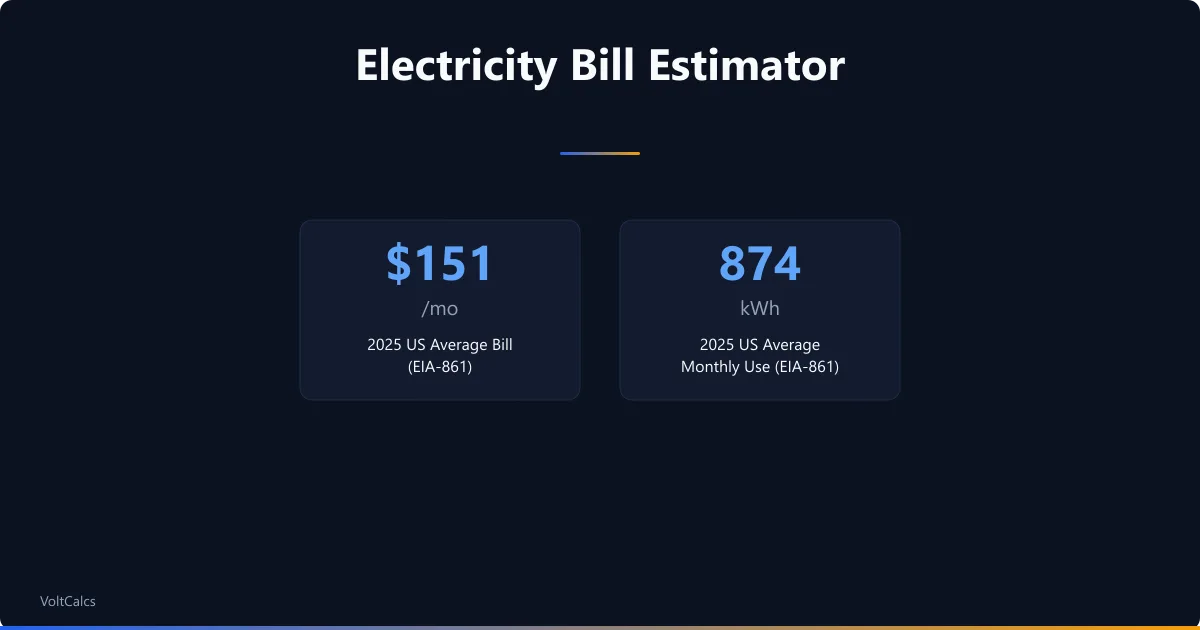
The defaults are RECS 2020's all-homes figures per home per month and sum to 880 kWh, a bill of $151.62 at the default rate with no fixed charge. EIA-861 (Historical State Data, 2025) gives a 2025 U.S. average of 874 kWh a month and an average bill of $150.68; those figures come from another survey and are not part of the defaults. Usage varies by climate, household and home: enter the kWh from your own bill for your own result.
Where Each Category’s kWh Comes From
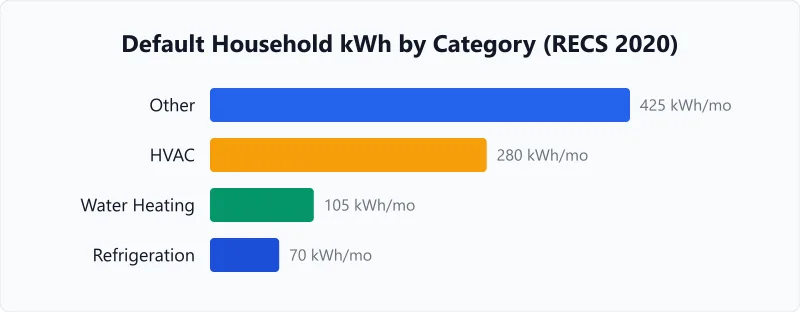
Every default comes from one table and one year: RECS 2020 table CE4.1, the electricity columns, all homes. The table prints 1,305 billion kWh for 123.53 million homes; per home per month that is 1,305 billion / 123.53 million / 12 = 880.35 kWh. Each category is divided the same way and rounded to the nearest 5 kWh, the step of the HVAC, water heating and refrigeration inputs.
HVAC is space heating (161 billion kWh: 108.61 a month) plus air conditioning (254 billion kWh: 171.35 a month): 279.96 kWh, entered as 280.
Water heating is 156 billion kWh: 105.24 kWh a month, entered as 105.
Refrigeration is the table's refrigerators column, 103 billion kWh: 69.48 kWh a month, entered as 70.
Other is every end use the table does not print on its own, lighting, electronics, cooking and laundry among them: 880.35 - 108.61 - 171.35 - 105.24 - 69.48 = 425.67 kWh, entered as 425. The table's own Other column, 631 billion kWh, gives the same 425.67. To estimate any single device, our kWh calculator handles the math.
The presets are the table's housing-unit-type rows, divided the same way: single-family detached (77.07 million homes, 1,035 kWh as entered), single-family attached (7.45 million, 705), apartments in buildings with 2-4 units (9.34 million, 555), apartments in buildings with 5 or more units (22.84 million, 510) and mobile homes (6.83 million, 1,035). Each preset uses the default rate, EIA's 2025 U.S. average of 17.23 cents per kWh, and no fixed charge.
Where to Cut First
Look at the breakdown table from this calculator: it ranks the categories by kWh. At the defaults the largest is Other (425 kWh), then HVAC (280) and water heating (105). HVAC and water heating together are 43.8 percent of the 880 kWh. A water heater cost calculator can show whether a heat pump unit pays back its installed-cost premium for your specific usage profile.
Other holds lighting, electronics, cooking and laundry together. To identify single-device offenders inside it before you start swapping equipment, our step-by-step appliance cost audit walks through the 30-minute diagnostic that finds your top three loads from the bill alone.
Worked Examples
EIA 2025 Average U.S. Residential Bill
Context
EIA-861 (Historical State Data, 2025) prints the 2025 U.S. residential row: revenue, sales, customers and an average price of 17.23 cents per kWh. From that row, the average monthly bill is residential revenue divided by residential customers, over twelve months: $150.68; the average monthly use is residential sales divided by residential customers, over twelve months: 874 kWh. The data print no split by end use, so the 874 kWh goes in as one figure (Other), with HVAC, water heating and refrigeration at 0. What does the estimator give for that row?
Calculation
Total kWh = 0 + 0 + 0 + 874 = 874 kWh
Variable cost = 874 × $0.1723 = $150.59
Total bill = $150.59 + $0 fixed = $150.59/month
Annual: $150.59 × 12 = $1,807
Interpretation
The estimator gives $150.59 for the row whose bill the same data put at $150.68; the 9 cents between them come from rounding the row's kWh and price to 874 and 17.23. The price is revenue over sales, so on that row the kWh times the price is the bill, and no fixed charge is added on top: the rate is all-in. The defaults above come from another survey, RECS 2020, and sum to 880 kWh; EIA-861's 874 kWh is the 2025 average and is not part of their derivation.
Takeaway
If your own rate is far from 17.23 cents, enter it: EIA-861 (Historical State Data, 2025) prints 2025 residential averages of 31.35 cents per kWh for California and 40.40 for Hawaii. To estimate what solar would offset, our solar panel and battery sizing calculator takes monthly kWh as input.
Heat Pump Retrofit Savings
Context
A household on an energy-only rate of $0.17/kWh with a $12 monthly fixed charge uses 400 kWh of HVAC, 350 of water heating, 80 of refrigeration and 270 of everything else (Other) a month: 1,100 kWh and a $199 bill. It replaces the resistance-heat HVAC with a heat pump (HVAC kWh drops from 400 to 180) and the tank electric water heater with a heat pump unit (water heating kWh drops from 350 to 120). Other categories unchanged. New bill?
Calculation
New total kWh = 180 + 120 + 80 + 270 = 650 kWh
Variable cost = 650 × $0.17 = $110.50
Total bill = $110.50 + $12 = $122.50/month
Annual savings: ($199 - $122.50) × 12 = $918
Interpretation
$918/year in savings. The federal 25C credit ended for property placed in service after 2025. To judge the payback, divide the installed cost quoted for your home, after any rebates, by the $918 a year, and compare the years with the equipment life the quote states.
Takeaway
Whether a heat pump pays back depends on your installed cost, your climate and your rate: run your own categories before and after. To size solar for the post-retrofit bill, our solar panel size estimator takes your monthly kWh, peak sun hours, panel wattage and system losses and returns the panel count, the system size in kW and the share of the bill it offsets; it does not check roof space or orientation.
Frequently Asked Questions
Glossary
Variable Charges
The portion of the electricity bill that scales with kWh consumed: generation cost, transmission, distribution, and any per-kWh riders. This is the main lever a household can pull to lower the bill. On your own bill, the variable part is the total minus the fixed charge.
Fixed Charges
Monthly fees that do not change with usage: customer charge, service charge, connection fee, sometimes basic metering. Your bill states the amount. Fixed charges become a higher percentage of the bill for very low-usage households (vacation cabins, energy-efficient apartments).
Demand Charge
A surcharge based on the highest 15-minute power draw (kW) during the billing period, common on commercial bills and increasingly on residential time-of-use plans. Running a dryer, oven, and AC simultaneously creates a demand spike that triggers this charge. Demand charges are not captured in a simple kWh × rate calculation.
Sizing solar to offset your bill? Our solar ROI calculator estimates the payback period from your system cost, the system's annual production in kWh and your electricity rate.
Related calculators
Electricity Cost Calculator
See the daily, monthly, and annual electricity bill impact of running any device. Plug in wattage, hours, and your utility rate for a full cost breakdown.
Electrical
Appliance Electricity Cost Calculator
See what an appliance costs per day and over the days you enter, with the annual figure at 365 days. Enter its wattage, daily hours, days and your rate.
Electrical
EV Charging Cost Calculator
Calculate the true cost of charging an electric car at home or on the road. Side-by-side Level 1 vs Level 2 vs DC Fast comparison with cost per mile.
Electrical
Water Heater Electricity Cost Calculator
Compare tank, tankless, and heat pump water heater operating costs with DOE UEF math. Inputs: gallons/day, set temp, inlet temp, and rate.
Electrical
A few cautions when comparing this estimate to a real bill. First, enter the rate as the bill pairs it: an all-in rate (the bill total over its kWh) already holds taxes, riders, fuel adjustments and the fixed charge, so Fixed Charges stays at 0; an energy-only rate does not, so add the fixed charge and expect the bill's other items on top. Second, time-of-use rates change effective cost based on when you run loads, which a single rate input cannot represent. Third, the estimator takes the kWh you enter as one month and applies no day count; your bill's own period sets how many days its kWh cover. For more precision, divide your last bill’s total by total kWh used to get your true all-in rate, then enter that here. Our guide to understanding electricity costs walks through a real bill line by line.
More Electrical calculators
Browse all electrical calculators: Motor FLA, wire sizing, voltage drop, load calculations, and transformer fusing based on NEC standards.
Last updated:
Written and maintained by Dan Dadovic, Commercial Director at Ezoic Inc. & PhD Candidate in Information Sciences. On the energy side, Dan has hands-on experience with residential solar panel installation, DIY battery bank construction, off-grid power systems, wind power, and EV ownership/driving, all from building, maintaining, and operating his own systems.
Disclaimer: Calculator results are estimates based on theoretical formulas. Actual performance varies with temperature, battery age, load patterns, and equipment condition. For critical electrical work, consult a licensed electrician.
Methodology reviewed by Doc. dr. sc. Danijel Jerković-Štil, Assistant Professor, FERIT Osijek.