The Relationship Between Watts, Volts, and Amps
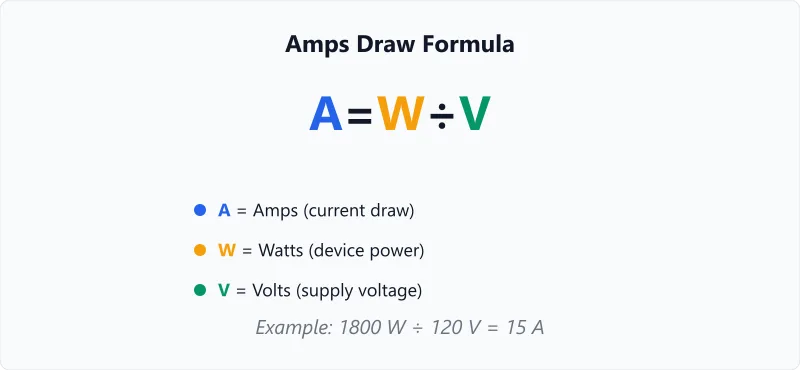
Three quantities define every electrical circuit: voltage (V), current (A), and power (W). They are linked by a simple formula:
Amps = Watts / Volts
A 1,800W hair dryer at 120V draws 15A. That same hair dryer on a 240V circuit (common in Europe and Australia) would draw only 7.5A. The device does the same amount of work either way — higher voltage simply means less current is needed to deliver the same power.
This formula assumes a power factor of 1.0, which is true for purely resistive loads: heaters, incandescent lights, toasters, and hair dryers. These devices convert all their electrical energy directly to heat or light.
Motors, fluorescent ballasts, and power supplies have a power factor below 1.0, typically between 0.75 and 0.95. They draw more current than the simple formula predicts because some of that current oscillates back and forth without doing useful work. For a 1,000W motor with a 0.80 power factor at 120V, the actual current is 1,000 / (120 x 0.80) = 10.4A instead of the 8.3A you would expect from watts and volts alone.
For three-phase systems, the formula becomes: Amps = Watts / (Volts x 1.732 x Power Factor). The 1.732 factor accounts for the three-phase voltage relationship. Three-phase loads draw less current per conductor than single-phase loads of the same power — one reason commercial and industrial buildings use three-phase power.
Amp Draw of Common Household Devices
| Device | Watts | Voltage | Amps |
|---|---|---|---|
| Hair dryer (high) | 1,800 | 120 | 15.0 |
| Microwave | 1,500 | 120 | 12.5 |
| Space heater | 1,500 | 120 | 12.5 |
| Toaster | 1,200 | 120 | 10.0 |
| Vacuum cleaner | 1,000 | 120 | 8.3 |
| Coffee maker | 900 | 120 | 7.5 |
| Window A/C (8k BTU) | 800 | 120 | 6.7 |
| Refrigerator (running) | 150 | 120 | 1.3 |
| LED TV (55") | 80 | 120 | 0.7 |
| LED bulb | 10 | 120 | 0.08 |
| EV charger (Level 2) | 7,200 | 240 | 30.0 |
| Electric dryer | 5,000 | 240 | 20.8 |
| Electric oven | 4,000 | 240 | 16.7 |
Devices over 1,800W at 120V need a dedicated circuit. If you plan to run any of these from a battery-based inverter, our battery size for inverter calculator shows how much capacity you need. A standard 15A kitchen outlet already maxes out with a single hair dryer. Plug in a microwave at the same time and the breaker trips instantly — that is not a faulty breaker, it is your wiring doing its job.
Example: How Many Devices Can Share One Circuit?
A standard US bedroom circuit is 15A at 120V. NEC says you should load it to no more than 80% for continuous use — that is 12A or 1,440W.
Say you plug in a desktop PC (300W), a monitor (50W), a desk lamp (10W LED), and a phone charger (20W). That totals 380W, or about 3.2A. You are at 21% of the circuit's safe capacity, with plenty of room for an additional device like a laser printer (600W at peak).
Now try a different room. A space heater (1,500W / 12.5A) on a 15A circuit uses 83% of the safe capacity by itself. Add a table lamp and phone charger and you are fine. Add a vacuum cleaner and the breaker trips. This is why kitchens and bathrooms have 20A circuits — high-draw appliances need the extra headroom. On long wire runs, the current you calculate here also determines the voltage drop in the circuit.
If you are adding up multiple loads to size a backup power source, our generator sizing calculator factors in running watts and motor starting surges to recommend the right unit.
Worked Examples
Can a 15A Kitchen Circuit Handle a Microwave and Toaster?
Context
Your kitchen has a single 15A, 120V circuit. You want to run a 1,200W microwave and an 800W toaster at the same time.
Calculation
Microwave: 1,200 / 120 = 10.0 A
Toaster: 800 / 120 = 6.7 A
Combined: 10.0 + 6.7 = 16.7 A
Interpretation
16.7A exceeds the 15A breaker rating. Running both simultaneously will trip the breaker. NEC also limits continuous loading to 80% of breaker capacity (12A), so even the microwave alone pushes the limit.
Takeaway
If your kitchen trips breakers regularly, you likely need a dedicated 20A circuit. Use our electrical load calculator to add up all the appliances on that circuit and see the total draw.
Three-Phase Current for an Industrial Heater Bank
Context
A factory has a 15 kW resistance heater bank on a 480V three-phase circuit with a power factor of 1.0 (purely resistive load).
Calculation
I = 15,000 / (480 x 1.732 x 1.0)
= 15,000 / 831.4
= 18.0 A per phase
Interpretation
At 18A, this load fits on a 30A three-phase breaker with room to spare. The unity power factor makes this straightforward — motors with lower power factor would draw more current for the same kilowattage.
Takeaway
For motor loads on this same panel, the power factor drops below 1.0 and current increases. Use our motor FLA calculator to get accurate current draw for each motor.
Frequently Asked Questions
Glossary
Current Draw
The amount of electric current (in amps) a device pulls from the circuit. Higher wattage devices draw more current at the same voltage. Exceeding a circuit's current capacity trips breakers or blows fuses.
Power Factor
For resistive loads like heaters and incandescent bulbs, power factor is 1.0. For motor and electronic loads, it drops below 1.0, meaning the device draws more current than a simple wattage-to-amps conversion would suggest.
Circuit Capacity
The maximum continuous current a circuit can safely carry, determined by the wire gauge and breaker rating. NEC limits continuous loads to 80% of the breaker rating to prevent overheating.
Running these devices from a battery system? Our battery runtime calculator shows how long a given battery bank lasts under any load.
Related calculators
Electrical Load Calculator
Calculate your home's electrical load and NEC 220 demand for panel and service sizing. Enter loads and quantities for connected and demand estimates.
Electrical
Voltage Drop Calculator
Calculate voltage drop in any wire run. Enter wire gauge, distance, current, and voltage to check if your wiring meets NEC standards.
Electrical
Wire Distance Calculator
Calculate voltage drop and recommended wire gauge for any distance. Enter amps, distance, voltage, and target drop percentage.
Electrical
Motor FLA Calculator
Calculate motor full load amps for single-phase and three-phase motors. Enter HP, voltage, efficiency, and power factor for instant FLA results.
Electrical
Knowing the amp draw of your devices is the foundation of safe electrical practice. To see what those amps cost you in electricity, enter the wattage and hours in our electricity cost calculator. Before plugging in a new high-draw appliance, check the circuit breaker rating and add up what else is on that circuit. Overloaded circuits are the most common cause of tripped breakers and one of the leading causes of residential electrical fires. The values from this calculator are theoretical — always check the device nameplate for the manufacturer's rated current draw.
More Electrical calculators
Browse all electrical calculators — Motor FLA, wire sizing, voltage drop, load calculations, and transformer fusing based on NEC standards.
Last updated:
Written and maintained by Dan Dadovic, Commercial Director at Ezoic Inc. & PhD Candidate in Information Sciences. He works professionally as Commercial Director at Ezoic Inc., leading revenue strategy across digital publishing.
Disclaimer: Calculator results are estimates based on theoretical formulas. Actual performance varies with temperature, battery age, load patterns, and equipment condition. For critical electrical work, consult a licensed electrician.
Methodology reviewed by Doc. dr. sc. Danijel Jerković-Štil, Assistant Professor, FERIT Osijek.