Trolling Motor Power Draw by Thrust
Minn Kota publishes a maximum amp draw for every motor it sells, in the sizing table it uses to specify wire gauge and circuit breakers. Those figures are the starting point for any runtime estimate, and they are the only draw figures Minn Kota publishes.
| Motor Thrust | System Voltage | Max Amp Draw | Watts at That Voltage |
|---|---|---|---|
| 30 lb | 12V | 30A | 360W |
| 40-45 lb | 12V | 42A | 504W |
| 50-55 lb | 12V | 50A | 600W |
| 70 lb | 24V | 42A | 1,008W |
| 80 lb | 24V | 56A | 1,344W |
| 101 lb | 36V | 46A | 1,656W |
| 112 lb | 36V | 52A | 1,872W |
The amp column is Minn Kota's own; the watt column is that figure multiplied by the row's voltage, which is all watts are. A 70lb motor on 24V draws fewer amps than a 55lb motor on 12V and still does more work, which is the whole reason bigger motors move to 24V and 36V.
There is no speed column here because Minn Kota will not publish one, and it states the reason in its own words: wind, waves, current and battery condition vary so much that it will not put a number on draw at any setting below full power. Minn Kota also warns that its maximum figures "only occur intermittently" and should not be treated as a continuous load. Enter the maximum if that is all you know, read the answer as the shortest run you will get, and clamp a meter on your own motor if you want a truer figure. For a bank that also runs a fridge or lights overnight at the dock, the deep cycle battery runtime calculator covers appliance-level loads.
What the Makers' Own Run-Time Method Leaves Out
Newport Vessels and Discover Battery both publish the same one-line method: amp-hours divided by amp draw equals run time. Newport works it through for its own motor: 624 watts on a 12V battery is 52 amps, and 50Ah divided by 52 amps gives 0.96 hours. It is a fine first pass and it is always optimistic, for two reasons this calculator makes explicit.
The first is depth of discharge. That method spends the whole battery. Concorde prints 50% as the deepest its Lifeline AGM batteries should routinely go, so half the printed answer is off the table before you start.
The second is discharge rate, and it is the one most calculators skip. A battery's amp-hour rating is measured over 20 hours. Pull harder and you get less: Trojan prints 225Ah at the 20-hour rate for its T-105, and 115 minutes at 75 amps, which is 144Ah, or 36% less capacity out of the same battery. A trolling motor is squarely in that territory, drawing a third to half the pack every hour. This page runs your numbers through a curve fitted to discharge tables Trojan, Lifeline and Victron print, so that loss is in the answer rather than in a footnote.
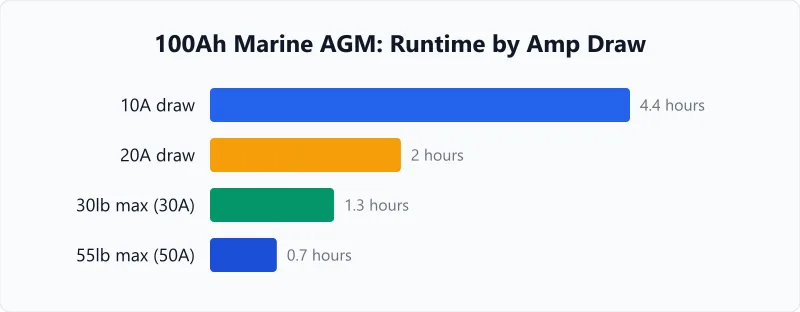
Put together on the default vector: 100Ah divided by 50 amps is 2 hours by the makers' method, 1 hour once you stop at 50% depth of discharge, and about 42 minutes once the rate correction is applied. If you want the deeper discharge without the penalty, set the chemistry above to LiFePO4 and the same load runs on lithium, where the rating already assumes a 1C discharge.
Worked Examples
One Group 31 AGM Behind a 55lb Motor
Context
A single 105Ah AGM Group 31, the standard marine deep-cycle, behind a 55lb transom motor. Minn Kota prints 50 amps as that motor's maximum draw on 12V, which is 600W. Concorde puts the depth limit for its Lifeline AGM line at 50%.
Calculation
Draw: 50A on a 105Ah battery is a 0.48C discharge, roughly twice the rate the printed AGM tables cover.
Full discharge at that rate, from the fitted curve: 1.48 hours. Stopping at 50% depth of discharge: 0.74 hours.
Runtime: about 44 minutes at full throttle, with 630Wh still held in reserve.
Interpretation
Forty-four minutes sounds alarming until you remember nobody trolls flat out. This is the floor, not the forecast: it is what one battery gives if you pin the throttle and leave it there. At a third of that draw the same battery runs about 2.6 hours. The simple amp-hour division most guides print would have promised 2.1 hours here.
Takeaway
If you need full-throttle capability for real stretches, two batteries are the answer, not a bigger single one. Get the wiring right first with our battery pack calculator.
Stepping Up to an 80lb 24V Motor
Context
Two 100Ah 12V AGM batteries in series give 24V at 100Ah. Minn Kota prints 56 amps as the 80lb motor's maximum draw on 24V, which is 1,344W.
Calculation
Draw: 56A on a 100Ah bank is a 0.56C discharge.
Full discharge at that rate, from the fitted curve: 1.23 hours. At the 50% AGM limit: 0.61 hours.
Runtime: about 37 minutes, with 1,200Wh in reserve.
Interpretation
Series wiring doubles the voltage but not the amp-hours, so the bigger motor eats the bank faster even though it draws its amps at 24V. Going from the 55lb example above to this one costs seven minutes for a lot more push.
Takeaway
Anglers who want a tournament day out of an 80lb motor either carry a third battery or switch chemistry, where 80% depth is routine rather than punishing. Our LiFePO4 versus lead-acid comparison puts numbers on both sides.
Frequently Asked Questions
Glossary
Thrust Rating
A trolling motor's power measured in pounds of force. Higher thrust moves larger boats or handles stronger currents. Thrust does not directly equal amp draw — efficiency varies by motor design and speed setting.
Speed Setting vs Amp Draw
Trolling motors have 5-speed or variable controls, and draw climbs steeply as you move up them. Minn Kota publishes no figure for any setting below full power and states that wind, waves, current and battery condition make it impossible to specify one. The maximum draw in the table above is its only published number, and your real draw sits below it.
Series Wiring
Connecting batteries positive-to-negative to add their voltages while keeping amp-hours the same. Two 12V 100Ah batteries in series = 24V 100Ah. Required for 24V and 36V trolling motor systems.
Planning to add solar charging to your boat? The solar panel output calculator estimates how much a panel on your bow recovers during the day.
Related calculators
RV Battery Runtime Calculator
Calculate how long your RV battery bank powers your camper. Enter your loads, battery size, and get real runtime.
Battery
Deep Cycle Battery Runtime Calculator
Estimate deep cycle battery runtime for marine, RV, and off-grid use. Accounts for depth of discharge and system efficiency.
Battery
Reserve Capacity to Amp Hours
Convert battery reserve capacity minutes into amp-hours two ways: the exact capacity at the 25 amp test rate and an estimated 20-hour rating.
Battery
Off-Grid Load Calculator
Calculate your total daily energy needs for off-grid living. Get recommended battery bank size and solar panel wattage for your system.
Solar
Marine runtime moves around more than any other application on this site, because the water changes under you. Size for the worst day you fish regularly rather than the average one, and treat every figure here as the shortest answer rather than the likely one when you enter a maximum draw from Minn Kota's table. Coming back to the dock with 30% left is a good trip. Coming back under tow is not. If the same bank also runs cabin loads overnight, the RV battery runtime calculator handles appliance-level budgeting, and if you want the AGM side on its own, the AGM runtime calculator goes deeper on that chemistry.
More Battery calculators
Browse all battery calculators — LiFePO4, lead-acid, AGM, and lithium-ion runtime, charge time, and capacity sizing.
Last updated:
Written and maintained by Dan Dadovic, Commercial Director at Ezoic Inc. & PhD Candidate in Information Sciences. He works professionally as Commercial Director at Ezoic Inc., leading revenue strategy across digital publishing.
Disclaimer: Calculator results are estimates based on theoretical formulas. Actual performance varies with temperature, battery age, load patterns, and equipment condition. For critical electrical work, consult a licensed electrician.
Methodology reviewed by Doc. dr. sc. Damir Topić, Assistant Professor, FERIT Osijek.