How to Calculate Battery Runtime
Last updated:
8 min read
The battery runtime formula tells you how many hours a battery will power your devices before it needs recharging. It works for any battery — lithium, lead-acid, AGM, even a laptop battery — and uses five inputs you can find on any spec sheet.
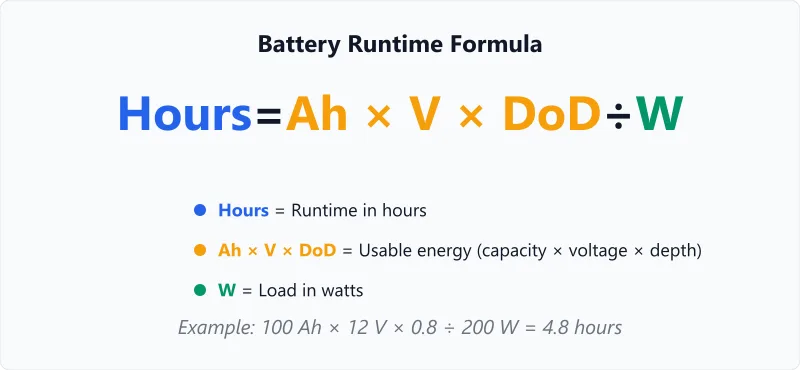
Runtime (hours) = (Capacity × Voltage × DoD × Efficiency) / Load
That is the entire formula. The rest of this guide explains each variable, walks through three real scenarios, and flags the mistakes that cause the biggest errors in practice.
The Formula Broken Down
Each variable in the runtime formula represents a real physical property of your battery and system. Understanding what each one does helps you make better estimates and spot when a result does not look right.
Capacity (Ah) — the total charge a fully charged battery can deliver, measured in amp-hours. A 100Ah battery can theoretically supply 1 amp for 100 hours, or 10 amps for 10 hours. In practice, higher discharge rates slightly reduce effective capacity due to the Peukert effect (more significant in lead-acid than lithium).
Voltage (V) — the battery's nominal voltage. Common values: 3.7V (single lithium cell), 6V, 12V, 24V, 48V. Multiply Ah by V to get watt-hours (Wh) — the true measure of stored energy. The Wh-to-Ah converter handles this conversion instantly for any voltage. A 50Ah 24V battery stores the same energy as a 100Ah 12V battery: both are 1,200Wh.
Depth of Discharge (DoD) — the fraction of total capacity you can safely use. For LiFePO4: 0.80-1.00. For lead-acid and AGM: 0.50. This is not optional — exceeding recommended DoD dramatically shortens battery lifespan. See our depth of discharge guide for chemistry-specific recommendations.
Efficiency — accounts for energy lost as heat in wiring, connections, and the inverter (if used). Pure DC systems with short cable runs: 0.95-0.98. Systems with an inverter: 0.85-0.92. The inverter is usually the largest efficiency loss. Pure sine wave inverters are slightly more efficient than modified sine wave, but both lose 8-15% of throughput as heat.
Load (W) — the total power draw of all connected devices, in watts. For constant loads (a light, a heater), this is the nameplate wattage. For cycling loads (a fridge, an air compressor), use the average power draw over a full cycle — not the peak draw when the compressor is running.
Walking Through the Variables Step by Step
Gather these five inputs and plug them into the formula to get your runtime estimate.
- Read the battery label. Find capacity (Ah) and voltage (V). If the battery lists Wh instead (common on laptop batteries and power banks), divide by voltage to get Ah. A 72Wh laptop battery at 11.1V is 72 / 11.1 = 6.5Ah. Use the battery capacity calculator for conversions.
- Determine your DoD. LiFePO4: use 0.80 for daily cycling, 1.00 for emergency/portable use. Lead-acid/AGM: use 0.50 (non-negotiable for longevity). Lithium-ion: use 0.80. If you do not know the chemistry, default to 0.50 to be safe.
- Estimate system efficiency. Direct 12V DC loads with short cables: use 0.95. Running AC loads through an inverter: use 0.85 for a good-quality pure sine wave inverter, 0.80 for a basic modified sine wave unit. Longer cable runs (over 6 feet from battery to inverter): drop efficiency by 2-3% to account for cable losses.
- Measure or look up your load. Check the device label for wattage. If only amps are listed, multiply by voltage: a 12V fridge drawing 3.5A uses 42W. If only volts and amps are listed on an AC device, multiply them for apparent power (VA), then multiply by power factor (0.6-0.9 for most electronics) to get true watts.
- Divide and get your answer. Plug everything into the formula or use the battery runtime calculator for instant results.
Three Worked Examples
Example 1: Camping LED lights on a portable battery
Battery: 100Ah 12V LiFePO4. Load: five 10W LED string lights (50W total). No inverter — lights run directly on 12V DC.
Runtime = (100 × 12 × 0.80 × 0.95) / 50
= (960 × 0.95) / 50
= 912 / 50
= 18.2 hours
Three full evenings of campsite lighting from a single charge. The 0.95 efficiency factor is generous for a direct DC connection with short cables — actual runtime may even exceed this estimate. A LiFePO4 battery delivers more usable runtime than lead-acid from the same Ah rating — our LiFePO4 vs lead-acid comparison explains why.
Example 2: RV refrigerator on a battery bank
Battery: two 100Ah 12V AGM batteries in parallel (200Ah total). Load: a 12V compressor fridge averaging 45W (cycles between 0W off and 150W running). No inverter.
Runtime = (200 × 12 × 0.50 × 0.95) / 45
= (1,200 × 0.95) / 45
= 1,140 / 45
= 25.3 hours
Just over a full day. If Marcus from our solar battery bank sizing guide arrives at his campsite Friday at 6 PM, the fridge runs until Saturday evening — but only if he limits other loads. Add lights, phone charging, and a water pump, and the battery bank might last 16-18 hours total.
Example 3: Home UPS running a computer and monitor
Battery: internal 12V 9Ah sealed lead-acid (typical in consumer UPS units). Load: desktop computer (200W) + monitor (40W) + router (12W) = 252W total through the UPS inverter.
Runtime = (9 × 12 × 0.50 × 0.85) / 252
= (54 × 0.85) / 252
= 45.9 / 252
= 0.18 hours (about 11 minutes)
This is why consumer UPS units are designed for graceful shutdown, not extended operation. The small internal battery provides just enough time to save your work and shut down. For longer backup runtime, external battery packs or a dedicated UPS battery backup system with larger batteries is necessary.
Common Calculation Mistakes
Using Ah as if it were Wh. A 100Ah battery does not store 100 watt-hours — it stores 100Ah × voltage. At 12V, that is 1,200Wh. At 24V, it is 2,400Wh. Always multiply Ah by voltage before comparing batteries or calculating runtime. Two batteries with the same Ah but different voltages store very different amounts of energy.
Ignoring DoD. Treating a 100Ah lead-acid battery as if you can use all 100Ah is the most common mistake in online calculator discussions. At 50% DoD, you have 50Ah. Period. Using more will work in the short term but kill the battery in months.
Ignoring the inverter. Every watt of AC load costs you 1.10-1.18 watts from the battery due to inverter losses. A 1,000W AC load draws about 1,100-1,180W from the battery. Forget this factor and your runtime estimate will be 10-15% too optimistic.
Using peak watts instead of average watts. A refrigerator nameplate says 150W, but it only draws 150W while the compressor runs (about 30-40% of the time). Average draw is 45-60W. Using 150W in your calculation gives you a runtime 60-70% shorter than reality. Check for "average consumption" in the device manual, or measure with a kilowatt-hour meter.
Forgetting temperature effects. Cold batteries deliver less capacity. A lead-acid battery at 32°F has roughly 70% of its rated capacity. At 0°F, it drops to about 50%. If you are running a battery system in an unheated space during winter, reduce your capacity estimate accordingly.
When the Simple Formula Falls Short
The runtime formula assumes a constant load and a linear discharge curve. Real-world systems deviate from both assumptions, and understanding when the formula breaks down helps you plan for the gap.
The Peukert effect. Lead-acid batteries deliver less total energy at higher discharge rates. A 100Ah lead-acid battery rated at the 20-hour rate (5A continuous) might deliver only 85Ah at a 10-hour rate (8.5A) and 70Ah at a 5-hour rate (14A). This is the Peukert effect — internal resistance and chemical kinetics limit how quickly lead-acid can release energy.
LiFePO4 batteries are far less affected: a 100Ah LiFePO4 battery delivers close to 100Ah whether you draw 5A or 50A. If you are running high-current loads (inverters above 1,000W) on lead-acid, reduce your capacity estimate by 10-20% to account for Peukert losses.
Non-linear and intermittent loads. The formula works cleanly for constant loads like lights or heaters. For intermittent loads — refrigerators, air compressors, pumps — the compressor cycling pattern means your battery alternates between heavy draw and zero draw.
The average power determines total runtime, but the peak current during compressor-on periods causes greater instantaneous voltage sag and wiring losses than the average would suggest. For mixed loads where some devices cycle while others run continuously, calculate runtime based on the combined average draw, then subtract 5-10% as a real-world safety margin.
Quick Reference Table
| Battery | 50W Load | 100W Load | 200W Load | 500W Load |
|---|---|---|---|---|
| 100Ah 12V LiFePO4 (80% DoD, 90% eff) | 17h 16m | 8h 38m | 4h 19m | 1h 44m |
| 100Ah 12V Lead-Acid (50% DoD, 90% eff) | 10h 48m | 5h 24m | 2h 42m | 1h 5m |
| 200Ah 12V LiFePO4 (80% DoD, 90% eff) | 34h 34m | 17h 16m | 8h 38m | 3h 27m |
| 200Ah 12V Lead-Acid (50% DoD, 90% eff) | 21h 36m | 10h 48m | 5h 24m | 2h 10m |
| 50Ah 24V LiFePO4 (80% DoD, 90% eff) | 17h 16m | 8h 38m | 4h 19m | 1h 44m |
Runtimes assume system efficiency of 90% (typical with inverter). For direct DC loads, add roughly 5-8% to these numbers. For exact runtime with your specific setup, use the 12V battery runtime calculator.
Frequently Asked Questions
Written and maintained by Dan Dadovic, Commercial Director at Ezoic Inc. & PhD Candidate in Information Sciences. He works professionally as Commercial Director at Ezoic Inc., leading revenue strategy across digital publishing.
Disclaimer: Calculator results are estimates based on theoretical formulas. Actual performance varies with temperature, battery age, load patterns, and equipment condition. For critical electrical work, consult a licensed electrician.
Methodology reviewed by Doc. dr. sc. Damir Topić, Assistant Professor, FERIT Osijek.