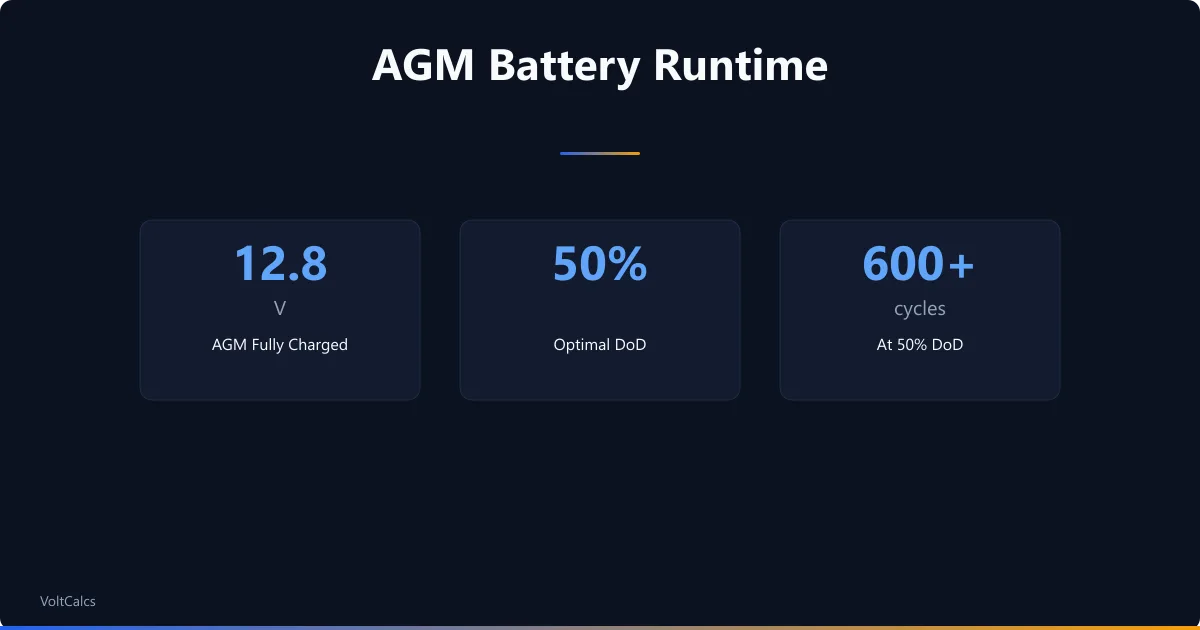
AGM vs Standard Flooded Lead-Acid
| Characteristic | AGM | Flooded Lead-Acid |
|---|---|---|
| Internal resistance | Lower — better high-current delivery | Higher — more voltage sag under load |
| Charge speed | Accepts higher charge rates (up to 0.3C) | Slower charge acceptance (0.1-0.2C) |
| Vibration tolerance | Excellent — glass mat holds plates firmly | Poor — plates can shed in rough conditions |
| Self-discharge | 1-3% per month | 5-15% per month |
| Cycle life at 50% DoD | 400-800 cycles | 600-1,000 cycles |
| Maintenance | None — sealed | Monthly water checks |
| Cost per 100Ah | $150-300 | $80-150 |
| Weight | Similar to flooded | Similar to AGM |
AGM batteries last fewer cycles than premium flooded batteries but make up for it with zero maintenance, better cold-weather starting, and faster recharging. This is our own estimate; no published source backs these figures. Check your results against your product data or a licensed professional before acting. Prices and rates on this page are our own estimates as of the date shown; they change often. Enter your own figures for a current result. For vehicles, boats, and applications with vibration, AGM is the safer choice.
When AGM Makes the Most Sense
AGM batteries excel in applications where three conditions meet: moderate cycling (not daily deep discharge), enclosed installation (no ventilation for hydrogen gas), and vibration or movement (boats, vehicles, portable setups).
Specific scenarios where AGM outperforms alternatives: dual-purpose marine batteries (starting plus trolling), RV house batteries where you cannot maintain flooded cells, UPS backup systems in office environments, and overland vehicle auxiliary batteries mounted under seats or in tight spaces.
Where AGM falls short: daily-cycle solar storage (LiFePO4 wins on cost-per-cycle) and budget stationary applications (flooded wins on upfront cost). If you cycle your battery bank daily, AGM batteries will need replacement every 1-2 years at 80% DoD, making them more expensive than LiFePO4 over 5-10 years.
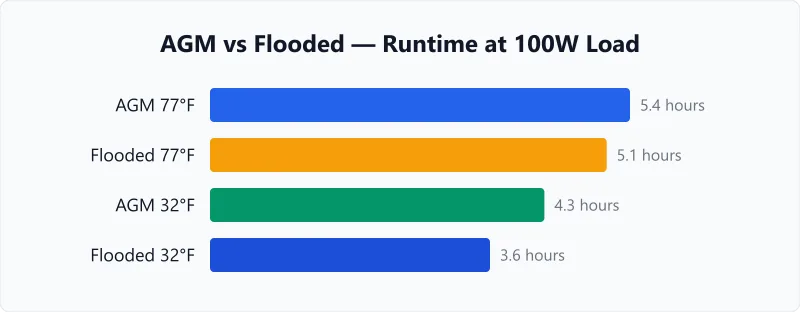
One underrated AGM advantage: cold cranking performance. AGM batteries deliver 10-15% more starting current than equivalent flooded batteries in cold weather because their lower internal resistance allows more current to flow. This is why many modern vehicles with stop-start systems use AGM from the factory.
Worked Examples
AGM vs Flooded for a Marine House Battery
Context
You are choosing a 100Ah house battery for your boat. An AGM costs $280, a flooded costs $150. Both are 12V. Your loads are 80W (fish finder, radio, lights) for 6-hour trips.
Calculation
AGM (88% eff, 50% DoD): 100 x 12 x 0.50 x 0.88 = 528 Wh → 528/80 = 6.6 hours
Flooded (85% eff, 50% DoD): 100 x 12 x 0.50 x 0.85 = 510 Wh → 510/80 = 6.4 hours
Interpretation
Nearly identical runtime. The AGM advantage is not capacity — it is zero maintenance, spill-proof mounting at any angle, better vibration resistance, and lower self-discharge. On a boat where the battery is in a hard-to-reach compartment, those factors justify the price premium.
Takeaway
If you also need trolling motor power, you will want a separate starting battery. Check your motor's runtime needs with our marine battery runtime calculator.
Will an AGM Battery Handle an RV Inverter?
Context
Your RV has two 100Ah AGM batteries (200Ah parallel) and a 1,000W inverter. Evening loads average 400W for 4 hours.
Calculation
Energy needed: 400 x 4 = 1,600 Wh
Delivered: 200 x 12 x 0.50 x 0.88 = 1,056 Wh
1,056 < 1,600 — the bank falls short by 544 Wh
Interpretation
Your AGM bank cannot sustain 4 hours at 400W. You would deplete below 50% DoD in about 2.6 hours, which accelerates AGM degradation. You need either a larger bank or to reduce loads.
Takeaway
Upgrading to LiFePO4 at 80% DoD lifts usable energy 1.6x from the same Ah. Size the right battery bank for your RV with our RV battery runtime calculator.
Frequently Asked Questions
Glossary
Absorbed Glass Mat
A sealed lead-acid battery where the electrolyte is held in fiberglass mats between the plates. AGM batteries are maintenance-free, spill-proof, mount in any position, and handle vibration better than flooded batteries. They cost 50-80% more per Ah.
Self-Discharge Rate
The rate at which a battery loses charge while sitting idle. Flooded lead-acid loses 5-15% per month. AGM loses 1-3% per month. LiFePO4 loses under 2% per month. High self-discharge means more frequent maintenance charging.
Gel vs AGM
Both are sealed lead-acid, but gel batteries use silica-thickened electrolyte while AGM uses glass mat separators. AGM handles higher discharge rates and is more common. Gel is more sensitive to overcharging but better at very slow, deep discharges.
Sizing an AGM bank for solar? The solar battery bank size calculator helps you match panels to AGM storage capacity.
Related calculators
Lead-Acid Battery Runtime Calculator
Work out flooded, AGM or gel runtime using a rate correction fitted to maker discharge tables, and see how lithium compares on the same load.
Battery
LiFePO4 Battery Runtime Calculator
Estimate LiFePO4 battery runtime with accurate DoD and efficiency defaults. Compare lithium iron phosphate vs lead-acid.
Battery
Deep Cycle Battery Runtime Calculator
Estimate deep cycle battery runtime for marine, RV, and off-grid use. Accounts for depth of discharge and system efficiency.
Battery
Marine Battery Runtime Calculator
Estimate trolling motor and boat electronics runtime from your marine battery. Built for anglers and boaters.
Battery
AGM is the practical middle ground — more capable than flooded, more affordable than LiFePO4. If you cycle your batteries daily, LiFePO4 wins on long-term cost. If you rarely cycle and want maintenance-free reliability, AGM delivers solid value. Choose based on how you actually use the battery, not just the price tag. Our LiFePO4 vs lead-acid comparison breaks down the cost-per-cycle math in detail. For heavy-duty cycling applications, the deep cycle runtime calculator includes Peukert-effect adjustments that affect AGM at high loads.
More Battery calculators
Browse all battery calculators — LiFePO4, lead-acid, AGM, and lithium-ion runtime, charge time, and capacity sizing.
Last updated:
Written and maintained by Dan Dadovic, Commercial Director at Ezoic Inc. & PhD Candidate in Information Sciences. He works professionally as Commercial Director at Ezoic Inc., leading revenue strategy across digital publishing.
Disclaimer: Calculator results are estimates based on theoretical formulas. Actual performance varies with temperature, battery age, load patterns, and equipment condition. For critical electrical work, consult a licensed electrician.
Methodology reviewed by Doc. dr. sc. Damir Topić, Assistant Professor, FERIT Osijek.