CPAP Wattage Varies Dramatically by Mode
The single biggest factor in CPAP battery life is whether you run the heated humidifier and heated tube, and ResMed publishes the numbers for its own machines. An AirSense 10 with SlimLine tubing and no humidifier draws 0.93 A at 12 V at a pressure of 10 cmH₂O. Turn the humidifier to 8 and the same machine at the same pressure draws 3.66 A. Multiply by 12 V and that is 11.2 W against 43.9 W — close to four times the draw, not the doubling most guides quote.
On a 12 V 100 Ah LiFePO4 pack discharged to 80%, that gap is 91.4 hours against 23.3 hours: eleven nights of therapy or three. If you are camping and battery life matters more than comfort, switching off heated humidification is the single most effective change you can make. Measure your own draw with a watt meter in the mode you plan to use, or read the current your maker prints for your pressure.
Power Draw by CPAP Brand and Model
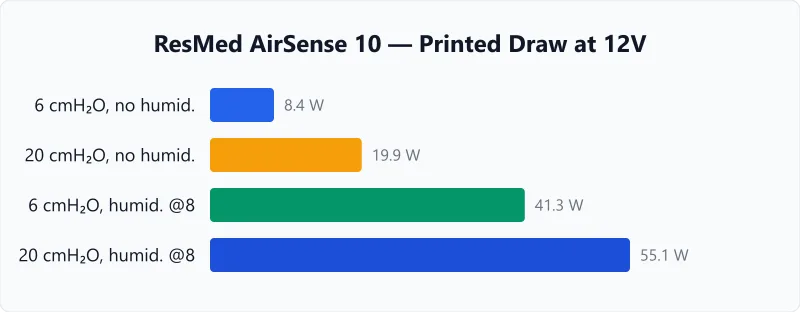
ResMed publishes a battery guide with the current each of its machines draws at 12 V, by pressure and humidifier setting, and the deep-cycle battery size it recommends for one night. Every wattage below is that printed current multiplied by 12 V.
| ResMed machine and setting | Pressure | Printed draw @12V | Watts | ResMed battery size |
|---|---|---|---|---|
| AirSense 10 + SlimLine, no humidifier | 6 cmH₂O | 0.70 A | 8.4W | 9 Ah |
| AirSense 10 + SlimLine, no humidifier | 10 cmH₂O | 0.93 A | 11.2W | 12 Ah |
| AirSense 10 + SlimLine, no humidifier | 20 cmH₂O | 1.66 A | 19.9W | 20 Ah |
| AirSense 10 + SlimLine, humidifier @8 | 10 cmH₂O | 3.66 A | 43.9W | 44 Ah |
| AirSense 10 + ClimateLine Air @30°C, humidifier @8 | 20 cmH₂O | 5.61 A | 67.3W | 68 Ah |
| AirMini | 10 cmH₂O | 0.45 A | 5.4W | 5 Ah |
| S9 AutoSet, DC-to-DC converter | 10 cmH₂O | 0.55 A | 6.6W | 7 Ah |
| S9 AutoSet, DC-to-AC inverter | 10 cmH₂O | 1.02 A | 12.2W | 12 Ah |
The battery-size column is ResMed's own, and the guide states the basis plainly: All battery sizes are based on 8-hour usage and include a 50% safety margin.
That works out as current at 12 V × 8 hours × 1.5, which is why the calculator above prints ResMed's figure beside your own result. Ours rounds up to the next whole amp-hour, which reproduces ResMed's own column on 25 of its 30 printed rows, reads 1 Ah above it on four, and 1 Ah below it on one: the S9 on a converter at 20 cmH₂O, where ResMed prints 1.00 A and a 13 Ah battery. ResMed worked its column from unrounded currents while printing the amps to two decimals, which is why that row does not come back exactly, and it is one more reason to check the number against your own machine's guide. The last two rows are the same machine at the same pressure through ResMed's two published paths: its DC-to-DC converter needs 0.55 A, a DC-to-AC inverter needs 1.02 A. An inverter costs 85% more current here, not the 10-15% a general efficiency figure suggests.
For machines other makers build, use the label. Philips' DreamStation 2 manual publishes only an AC input envelope (100-240 VAC, 2.0-1.0 A) and no wattage, so there is nothing to copy — read the rating plate on your own machine or its power supply and enter that. ResMed's AirSense 11 user guide does publish a machine-level figure, Typical power consumption 56.1W
, with a peak of 73.2 W; that is an AC-side figure for the whole unit, which is why it sits above the 12 V draws in the table. Pressure and mask leak both move the number, so measure before you buy.
Flying with a CPAP Battery: FAA Rules
Lithium batteries for CPAP machines are permitted on aircraft, but the FAA sets strict size limits. Batteries rated under 100 watt-hours (Wh) can go in carry-on luggage with no restrictions. Most dedicated CPAP batteries like the Medistrom Pilot-24 Lite, which its maker rates at 95Wh, are built to sit under this threshold.
Batteries between 100Wh and 160Wh require airline approval before boarding. You must contact the airline in advance, and you are limited to two spare batteries in this range. Batteries over 160Wh are prohibited on passenger aircraft entirely.
To calculate your battery's watt-hour rating: multiply voltage by amp-hours. Chemistry matters here, because a "12V" LiFePO4 is really 12.8V nominal: a 20Ah pack is 256Wh, well over the carry-on limit, and even an 8Ah pack is 102Wh — over it. Drop to 7.5Ah and you are at 96Wh, just under. The same 8Ah in a 12.0V lead-acid pack is 96Wh and would pass, which is exactly why you check the watt-hour figure printed on the battery rather than working it out from the label voltage. If you fly frequently with your CPAP, choose a purpose-built CPAP battery that stays under 100Wh. For longer trips, bring two sub-100Wh batteries rather than one large one. Our camper battery sizing guide can help you plan how many batteries to bring on a camping trip.
Worked Examples
Three Nights Off-Grid with the Humidifier Running
Context
You are camping for three nights with a 200Ah LiFePO4 bank sold as 12V, which Victron prints at 12.8V nominal, discharged to 80%. Your ResMed AirSense 10 runs at 10 cmH₂O with the heated humidifier at 8, and ResMed publishes 3.66 A at 12 V for exactly that setting — 43.9W. That current is drawn from the battery through ResMed's converter, so there is no separate efficiency to subtract.
Calculation
Usable energy = 200 Ah x 12.8 V nominal x 0.80 DoD = 2,048 Wh
Runtime = 2,048 Wh / 43.9 W = 46.6 hours
Nights = 46.6 / 8 = 5.8 nights
Interpretation
Five nights on the arithmetic, and the calculator flags it: ResMed's own table asks for 44 Ah per night at this setting, so five nights is 220 Ah against the 200 Ah you packed. The three nights you planned are comfortable; the fifth is the one ResMed's margin does not cover. Switch the humidifier off and its printed figure for the same machine at the same pressure drops to 0.93 A, or 11.2W — the same bank then runs 182.8 hours, 22.8 nights.
Takeaway
Humidification, not pressure, sets the size of the bank you carry. If you want to recharge mid-trip with a portable panel, our solar panel sizing calculator helps you pick the wattage for daily top-offs.
Air Travel on an FAA-Legal 96Wh Pack
Context
You fly to a conference with a 12V 7.5Ah lithium pack, which is 96Wh at its 12.8V nominal and so sits just under the FAA's 100Wh carry-on line. Your ResMed AirMini runs at 20 cmH₂O, and ResMed publishes 0.76 A at 12 V for that setting: 9.1W. It is a dedicated CPAP pack, so you discharge it fully.
Calculation
Usable energy = 7.5 Ah x 12.8 V nominal x 1.00 DoD = 96 Wh
Runtime = 96 Wh / 9.1 W = 10.5 hours
Nights = 10.5 / 8 = 1.3 nights
Interpretation
One night, not two, and the calculator says why: it sizes this night at 10 Ah, rounding up from the 9 Ah ResMed prints for this machine at this pressure, and you are carrying 7.5 Ah. ResMed's figure carries a 50% safety margin that yours does not, so the hour and a half past the first night is the part to leave out of the plan.
Takeaway
For a second night in the air you need a second sub-100Wh pack, not a bigger one — anything over 100Wh needs airline approval. A portable power bank sized the same way covers the phone and laptop separately.
Frequently Asked Questions
Glossary
CPAP Pressure Setting
The air pressure your CPAP delivers, measured in centimeters of water (cmH₂O). ResMed's own battery tables run from 6 to 20 cmH₂O. Across that span an AirSense 10 with no humidifier goes from 0.70 A to 1.66 A at 12 V — 8.4W to 19.9W, an increase of 11.5W. With the humidifier at 8 the same span adds 13.8W. Auto-CPAP machines vary pressure throughout the night, so power draw fluctuates too.
Heated Humidifier
A heated water chamber attached to the CPAP that warms and moistens the air before delivery. ResMed's printed currents put the cost of the element directly: at 6 cmH₂O an AirSense 10 goes from 0.70 A to 3.44 A when the humidifier is set to 8, which is 32.9W added; at 20 cmH₂O the same change adds 35.2W. Turning it off is the most effective way to reduce CPAP power consumption for battery use.
Watt-Hour Rating
The total energy stored in a battery, calculated as voltage × amp-hours. A 100Ah battery sold as "12V" stores 1,200Wh if it is lead-acid, but 1,280Wh if it is LiFePO4 — Victron prints 12.8V nominal and 1,280Wh for its 100Ah lithium unit. Use the watt-hour figure the maker prints rather than working it out from the label voltage. The FAA uses watt-hour ratings to classify lithium batteries for air travel: under 100Wh is unrestricted carry-on, 100-160Wh requires airline approval, over 160Wh is prohibited.
Recharging your CPAP battery with solar panels? Our solar battery charge time calculator tells you how many sun-hours you need.
Related calculators
Portable Power Bank Runtime Calculator
Find how long your portable power bank charges your phone, tablet, or laptop. Enter mAh, voltage, and device wattage.
Battery
Laptop Battery Runtime Calculator
Estimate your laptop battery life based on battery Wh rating and actual power consumption by usage mode.
Battery
Watt Hours to Amp Hours Calculator
Convert watt-hours to amp-hours at any voltage. Use this to compare batteries rated in different units.
Battery
UPS Battery Backup Time Calculator
Work out how long your UPS runs on battery from the string inside it, the load you plug in, and the battery class it uses.
Battery
A CPAP battery buys independence from wall outlets — but always bring a backup plan. Pack a 12V car adapter, a shore power extension cord, or a second smaller battery for emergencies. Batteries degrade in extreme cold and lose capacity with age, so the runtime you calculated above is your best-case starting point. Test your actual setup at home before relying on it in the field. For the full setup process including battery chemistry selection, FAA travel rules, and multi-night planning, read our guide to powering a CPAP off-grid.
More Battery calculators
Browse all battery calculators — LiFePO4, lead-acid, AGM, and lithium-ion runtime, charge time, and capacity sizing.
Last updated:
Written and maintained by Dan Dadovic, Commercial Director at Ezoic Inc. & PhD Candidate in Information Sciences. He works professionally as Commercial Director at Ezoic Inc., leading revenue strategy across digital publishing.
Disclaimer: Calculator results are estimates based on theoretical formulas. Actual performance varies with temperature, battery age, load patterns, and equipment condition. For critical electrical work, consult a licensed electrician.
Methodology reviewed by Doc. dr. sc. Damir Topić, Assistant Professor, FERIT Osijek.