How to Read Your Battery Label
- Find the capacity rating. Look for "Ah" (amp-hours), "Wh" (watt-hours), or "mAh" (milliamp-hours) on the label. Larger batteries usually list Ah. Power banks and laptops list mAh or Wh.
- Find the voltage. Look for "V" (volts) — this is the nominal voltage. A "12V" battery actually operates between 10.5V (empty) and 14.4V (charging), but 12V is the nominal used for calculations. LiFePO4 "12V" batteries are actually 12.8V nominal.
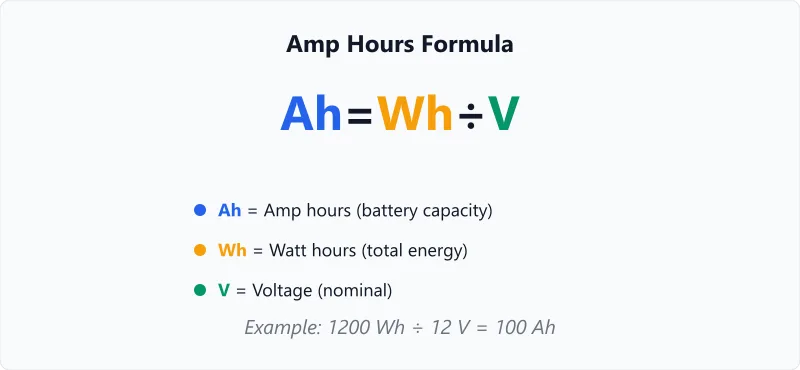
- Convert if needed. Ah to Wh: multiply Ah by voltage. Wh to Ah: divide Wh by voltage. mAh to Ah: divide by 1,000. Examples: 100Ah at 12V = 1,200Wh. 20,000mAh at 3.7V = 74Wh = 20Ah.
- Compare fairly. A 50Ah 24V battery stores the same energy as a 100Ah 12V battery — both are 1,200Wh. Always convert to watt-hours for apples-to-apples comparison across different voltages.
Quick Amp-Hour Conversion Table
| Watt-Hours | At 2V (Ah) | At 6V (Ah) | At 12V (Ah) | At 24V (Ah) | At 48V (Ah) |
|---|---|---|---|---|---|
| 600 Wh | 300 Ah | 100 Ah | 50 Ah | 25 Ah | 12.5 Ah |
| 1,200 Wh | 600 Ah | 200 Ah | 100 Ah | 50 Ah | 25 Ah |
| 2,400 Wh | 1,200 Ah | 400 Ah | 200 Ah | 100 Ah | 50 Ah |
| 4,800 Wh | 2,400 Ah | 800 Ah | 400 Ah | 200 Ah | 100 Ah |
| 9,600 Wh | 4,800 Ah | 1,600 Ah | 800 Ah | 400 Ah | 200 Ah |
| 14,400 Wh | 7,200 Ah | 2,400 Ah | 1,200 Ah | 600 Ah | 300 Ah |
The pattern holds across the range: doubling the voltage halves the amp-hours for the same energy. That is why 2V cells show up in large stationary and forklift banks, 6V cells in golf-cart and RV setups, and 48V in whole-home systems. Higher voltage carries the same power at lower current, which means thinner, cheaper cables.
Combining batteries shifts the totals in a predictable way. Wiring two identical batteries in parallel doubles the amp-hours and keeps the voltage the same; wiring them in series doubles the voltage and keeps the amp-hours the same. Either way the watt-hours add up, so a pair of 12V 100Ah batteries stores 2,400 Wh whether you wire it for 12V 200Ah or 24V 100Ah.
C-Rate and Rated vs Usable Capacity
A battery's amp-hour rating is not a single fixed number; it depends on how fast you pull the current. Engineers describe discharge speed as a C-rate: a 1C rate empties a fully charged battery in one hour, 0.5C (also written C/2) takes two hours, and 0.2C (C/5) takes five hours. Battery University notes that flooded and lead-acid batteries are rated at a gentle 0.05C, the 20-hour rate, because a slow discharge returns the highest figure for the label.
Draw current faster than that and the battery gives back fewer amp-hours. This is the Peukert effect, and the Peukert exponent puts a number on it: an ideal battery would sit at exactly 1.0, where capacity is independent of the discharge rate. Real batteries run higher, and manufacturers publish their own measured exponents rather than one industry-wide number: Concorde/Lifeline lists a recommended Peukert constant of 1.12 for its AGM batteries, and Rolls Battery Engineering rates its S6 L16-HC flooded model at 1.19 — real printed examples, not averages for the whole battery type. We could not find a gel-specific figure from a manufacturer or standards body, so gel is left out of the table below. Lithium (LiFePO4) sits much closer to the ideal; Victron, whose battery monitors apply this correction, notes lead-acid is more affected by the Peukert effect than lithium, so a LiFePO4 pack returns nearly its full rated capacity regardless of discharge rate.
| Battery type | Peukert exponent | Usable vs rated at high draw |
|---|---|---|
| Ideal (theoretical) | 1.0 | No change with rate |
| LiFePO4 / lithium | near 1.0 | Nearly flat |
| AGM (Concorde/Lifeline) | 1.12 | Small drop |
| Flooded (Rolls S6 L16-HC) | 1.19 | Larger drop |
What does that mean in amp-hours? Take a 100Ah flooded battery rated at the 20-hour rate (a 5A draw). Run it instead at a 4-hour rate (25A) and the Peukert formula, using Rolls Battery Engineering's printed exponent of 1.19 for its S6 L16-HC flooded model, predicts only about 74Ah of usable capacity before the voltage sags. A LiFePO4 battery of the same rating would still deliver close to its full 100Ah at that load. The rule for sizing: trust the label for lithium, but derate lead-acid for anything heavier than a slow, steady draw. Our lead-acid battery runtime calculator works the full Peukert equation into a runtime estimate.
Worked Examples
Converting a 100Ah Battery Back to Watt-Hours and mAh
Context
You have a 100Ah 12V LiFePO4 battery and want two other figures: its watt-hours (for airline rules and cross-voltage comparison) and its milliamp-hours (to compare against a power bank).
Calculation
Watt-hours: 100 Ah x 12 V = 1,200 Wh
Milliamp-hours: 100 Ah x 1,000 = 100,000 mAh
Interpretation
The same battery is 1,200 Wh and 100,000 mAh: identical capacity expressed in three different units. At 1,200 Wh it is twelve times the 100Wh airline carry-on limit, so it cannot fly in a carry-on without special approval.
Takeaway
If your battery is labeled only with a reserve-capacity rating in minutes instead of amp-hours, our reserve capacity to Ah converter turns that figure into Ah.
Converting an E-Bike Battery Spec to Ah
Context
Your e-bike battery is rated 720Wh at 48V. You want to know the amp-hour capacity to compare it against replacement options listed in Ah.
Calculation
Ah = 720 Wh / 48 V = 15 Ah
Interpretation
The battery is 15Ah. A replacement rated at 20Ah would be 960Wh — 33% more range per charge, assuming the same motor efficiency. To see how that translates to real-world distance, plug those numbers into the e-bike battery range calculator.
Takeaway
For power banks and smaller batteries rated in mAh, remember that 1 Ah = 1,000 mAh. A 20,000mAh bank at 3.7V is 74 Wh. See our power bank runtime calculator for more detail.
Frequently Asked Questions
Glossary
Ampere-Hours
A measure of electric charge capacity. One amp-hour means the battery can deliver 1 amp for 1 hour, or 2 amps for 30 minutes. Ah only tells you capacity at a specific voltage — you need both Ah and voltage to calculate total energy.
Watt-Hours
A measure of total energy. Wh = Ah x V. Unlike amp-hours, watt-hours let you compare batteries of different voltages directly. A 50Ah 24V battery (1,200 Wh) stores the same energy as a 100Ah 12V battery (1,200 Wh).
Nominal Voltage
The average voltage a battery delivers during normal use. A "12V" lead-acid actually ranges from 10.5V to 12.7V. A "12V" LiFePO4 ranges from 10V to 14.6V. The nominal value is used for capacity calculations.
Sizing a solar system? The solar battery bank size calculator uses amp-hour figures to match storage to your panels.
Related calculators
Watt Hours to Amp Hours Calculator
Convert watt-hours to amp-hours at any voltage. Use this to compare batteries rated in different units.
Battery
Reserve Capacity to Amp Hours
Convert battery reserve capacity minutes into amp-hours two ways: the exact capacity at the 25 amp test rate and an estimated 20-hour rating.
Battery
How Many Watts in a 12V Battery?
Calculate total watt-hours stored in any 12V battery from its amp-hour rating. Includes common 12V battery examples.
Battery
Battery Pack Calculator
Size a custom battery pack using series and parallel cell configurations. Enter target voltage, capacity, and cell specs.
Battery
Converting between amp-hours and watt-hours is the foundation of every battery sizing calculation. Get this step right — and always compare at the same voltage — and the rest of your system design falls into place. Our battery runtime guide walks through how amp-hours translate into real-world runtime across different battery chemistries and load scenarios.
More Battery calculators
Browse all battery calculators — LiFePO4, lead-acid, AGM, and lithium-ion runtime, charge time, and capacity sizing.
Last updated:
Written and maintained by Dan Dadovic, Commercial Director at Ezoic Inc. & PhD Candidate in Information Sciences. He works professionally as Commercial Director at Ezoic Inc., leading revenue strategy across digital publishing.
Disclaimer: Calculator results are estimates based on theoretical formulas. Actual performance varies with temperature, battery age, load patterns, and equipment condition. For critical electrical work, consult a licensed electrician.
Methodology reviewed by Doc. dr. sc. Damir Topić, Assistant Professor, FERIT Osijek.