How Long Will a 12V Battery Last? Runtime by Chemistry and Load
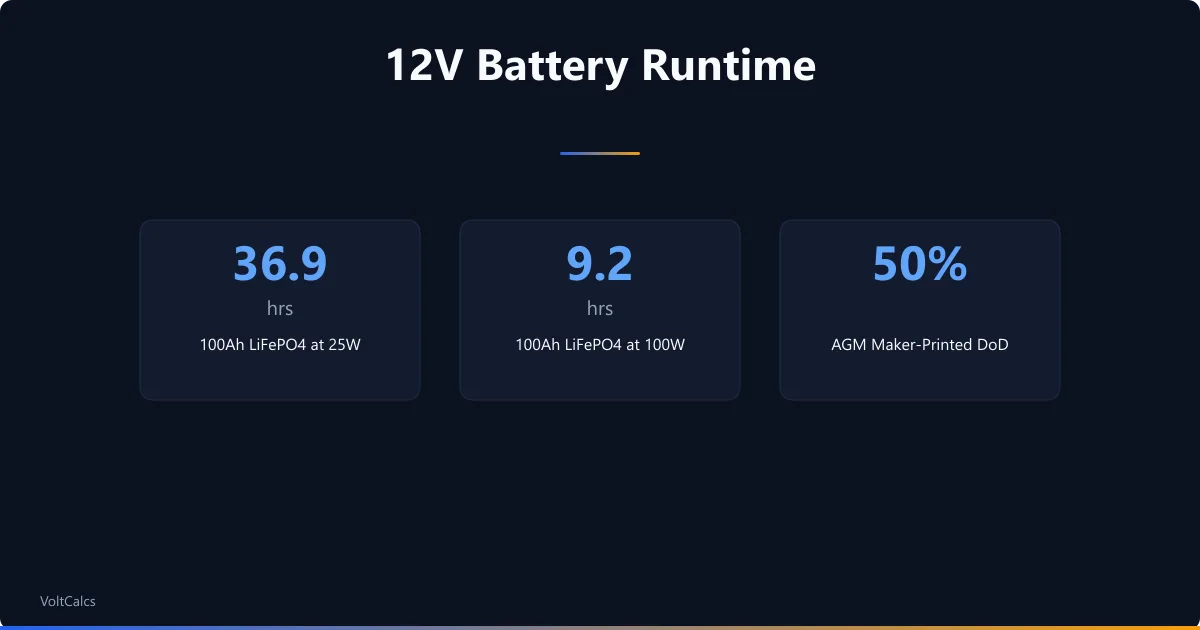
Chemistry moves this answer more than anything else on the page. A flooded, AGM or gel battery hands back less of its label capacity the harder you pull, so a 100Ah battery is only a 100Ah battery at the 20-hour rate its label was measured at. A LiFePO4 battery holds its rating up to a 1C draw and sits at 12.8V nominal rather than 12V. This chart runs a 100Ah 12V battery at each chemistry's maker-printed depth of discharge and 90% system efficiency:
| Load | Flooded, 50% DoD | AGM, 50% DoD | Gel, 50% DoD | LiFePO4, 80% DoD |
|---|---|---|---|---|
| 25W | 22.9 hours | 23.8 hours | 24.8 hours | 36.9 hours |
| 50W | 10.3 hours | 10.7 hours | 10.8 hours | 18.4 hours |
| 100W | 4.6 hours | 4.8 hours | 4.7 hours | 9.2 hours |
| 300W | 1.3 hours | 1.4 hours | 1.3 hours | 3.1 hours |
| 500W | 43 min | 46 min | 42 min | 1.8 hours |
Battery size still scales the answer, but not the way most charts imply. LiFePO4 scales straight: at 100W, 50Ah gives 4.6 hours, 100Ah gives 9.2 and 200Ah gives 18.4. AGM does better than straight, because a bigger battery is also a gentler draw per amp-hour: at the same 100W, 50Ah gives 2.2 hours, 100Ah gives 4.8 and 200Ah gives 10.7, so doubling capacity multiplies runtime by about 2.2 rather than 2. If your bank is AGM rather than lithium, our AGM runtime calculator starts from AGM defaults instead.
The cells at the far corners of the chart sit outside the range of discharge points the correction was fitted to: the 25W and 50W AGM and gel figures are lighter than the 20-hour rate the printed tables begin at, and every 500W figure is heavier than they end at. The calculator says so on screen when your own numbers land there. Running loads on 12V DC without an inverter removes the conversion stage entirely, which leaves only wiring loss and stretches every figure above.
What Can a 12V Battery Power?
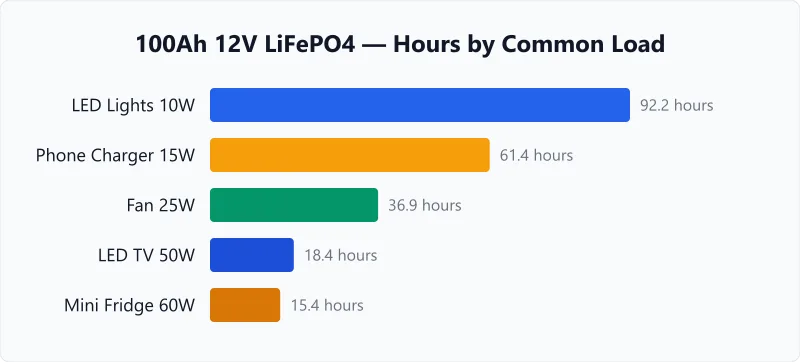
| Device | Typical Watts | Runtime on 100Ah LiFePO4 (80% DoD) |
|---|---|---|
| LED light strip (1m) | 5-15W | 61-184 hours |
| Phone charger | 10-18W | 51-92 hours |
| Laptop charger | 45-65W | 14-20 hours |
| 12V compressor fridge | 30-60W avg | 15-30 hours |
| CPAP machine | 30-60W | 15-30 hours |
| Portable fan | 15-40W | 23-61 hours |
| Water pump (RV) | 40-100W | 9-23 hours |
| Inverter + TV (32") | 50-80W | 11-18 hours |
Typical wattages are our own estimates; check your appliance's nameplate.
Runtimes above are for a 100Ah 12V LiFePO4 battery at 80% DoD and 90% system efficiency, which delivers 922Wh. The same 100Ah label in AGM at 50% DoD delivers a little over half as long at these loads, and every figure falls further in the cold.
Example: Weekend Camping with a 12V Battery
Scenario: you are car camping for two nights with a 100Ah LiFePO4 battery. Two days of loads look like this:
- LED lights — 10W for 5 hours a night = 100Wh over two nights
- Phone charging (2 phones) — 20W for 3 hours a night = 120Wh
- 12V fridge — 40W average, running 48 hours = 1,920Wh
- Portable speaker — 5W for 6 hours a night = 60Wh
Total weekend energy: 100 + 120 + 1,920 + 60 = 2,200Wh. Your 100Ah 12V LiFePO4 battery stores 1,280Wh, 1,024Wh of that at 80% DoD, and 922Wh after the 90% system efficiency the calculator applies. That leaves you 1,278Wh short, and the fridge is almost all of it.
Check any remedy against that number rather than against instinct. A second identical battery at 80% DoD brings you to 1,843Wh, which is still 357Wh short. Battle Born prints 100% depth of discharge for its LiFePO4, and two batteries taken to full depth deliver 2,304Wh, which covers the weekend with about 100Wh spare. The cheaper fix is the fridge: at the 40% duty cycle our worked example below uses, a 50W compressor averages 20W, the fridge drops from 1,920Wh to 960Wh, and two batteries at 80% DoD cover the weekend with 600Wh to spare. A portable solar panel helps as well, though how much it makes in a day depends on the panel, the season and the sky.
Worked Examples
Running a 12V Compressor Fridge While Camping
Context
Your 12V compressor fridge draws 50W when the compressor runs and cycles about 40% of the time (effective 20W average). You have a 100Ah 12V battery and want at least 24 hours before needing a recharge.
Calculation
Usable at DoD = 100 x 12.8 x 0.80 = 1,024 Wh; delivered = 1,024 x 0.95 = 972.8 Wh
Runtime at 20W average = 972.8 / 20 = 48.6 hours
Interpretation
At 20W average draw, you get two full days from a single 100Ah battery. Even at the full 50W continuous, you still get more than 19 hours. The 12.8V nominal Victron prints for LiFePO4 is worth 6% of that on its own.
Takeaway
Duty cycle makes all the difference for fridges. For a more detailed refrigerator-specific analysis, use our 12V fridge runtime calculator which accounts for duty cycle directly.
Powering a Portable Ham Radio Station
Context
You operate a portable HF radio that draws 120W on transmit and 20W on receive. During a field day event, you estimate 30% transmit time (effective average ~50W). You have a 100Ah AGM at the 50% DoD Concorde recommends.
Calculation
Current drawn = 50W / 0.95 / 12V = 4.39A, which is 0.044C against the 100Ah 20-hour rating
AGM rate correction: a full discharge at 0.044C = 22.9 hours; at 50% DoD that is 11.4 hours
Interpretation
11 hours covers a typical field day event. If you transmit more heavily, runtime drops faster than the wattage rises: at a full 120W continuous transmit the battery lasts 4.2 hours, not the 4.8 that a flat energy sum would predict.
Takeaway
For multi-day events, bring solar to recharge between sessions. Figure out what size panel you need with our solar panel size calculator.
Frequently Asked Questions
Glossary
Duty Cycle
The percentage of time a device actually runs during its operating period. A fridge compressor with a 40% duty cycle runs 24 minutes per hour. Effective power draw equals rated wattage multiplied by the duty cycle.
DC Efficiency
Running 12V devices straight from a 12V battery skips the inverter, so there is no conversion stage to lose anything in and only wiring resistance remains. Through an inverter you keep most of the energy and lose the rest: Victron prints a maximum of 87-92% for its small Phoenix inverters, so about 8-13% goes as heat at best. At light load it is far worse, and Victron's own measured curve for a 3kVA unit reads 71% at 50W.
Nominal Voltage
The standard voltage used to name a battery system rather than a voltage you will read at the terminals. Power-Sonic calls its PDC-121000 a 12.0 volt battery of six cells, then prints discharge end points that fall as the rate rises: 10.8 volts at the 20-hour rate, 10.2 at the 5-hour rate and 9.6 at the 1-hour rate. LiFePO4 is named differently again, because Victron prints "Nominal voltage 12,8 V" and 1,280Wh of nominal energy for a 100Ah cell block, so this calculator uses 12.8V when you pick LiFePO4 and 12V for the three lead-acid chemistries.
Discharge Rate (C-rate)
The current you are drawing expressed as a fraction of the 20-hour rating. A 100Ah battery supplying 5A is at 0.05C, the rate its label was measured at; 50A is 0.5C. Lead-acid capacity falls as C-rate rises, which is why this calculator shows the C-rate beside the result and says so when your figure runs past the range the printed tables cover.
Recharging with solar? Our solar battery charge time calculator shows how long your panels take to refill a 12V battery.
Related calculators
Battery Runtime Calculator
Calculate how long your battery will last under any load. Enter capacity, voltage, and wattage for an instant runtime estimate.
Battery
How Many Watts in a 12V Battery?
Calculate total watt-hours stored in any 12V battery from its amp-hour rating. Includes common 12V battery examples.
Battery
How Long Will a 12V Battery Run a Refrigerator?
Calculate how long a 12V battery powers your refrigerator. Works for power outages, camping, and off-grid setups.
Battery
LiFePO4 Battery Runtime Calculator
Estimate LiFePO4 battery runtime with accurate DoD and efficiency defaults. Compare lithium iron phosphate vs lead-acid.
Battery
A 12V system is the simplest and most versatile battery setup for portable and mobile use. Match your battery capacity to your actual load — not your worst-case fantasy load — and you will avoid both overspending and running out of power at 2 AM. When the goal shifts from camping to keeping a household fridge running through a grid-down event, our 12V battery for fridge during power outage guide applies the same Wh math to an extended-outage scenario. For non-12V portable devices, we also have dedicated calculators for drone flight time and e-bike battery range.
More Battery calculators
Browse all battery calculators — LiFePO4, lead-acid, AGM, and lithium-ion runtime, charge time, and capacity sizing.
Last updated:
Written and maintained by Dan Dadovic, Commercial Director at Ezoic Inc. & PhD Candidate in Information Sciences. He works professionally as Commercial Director at Ezoic Inc., leading revenue strategy across digital publishing.
Disclaimer: Calculator results are estimates based on theoretical formulas. Actual performance varies with temperature, battery age, load patterns, and equipment condition. For critical electrical work, consult a licensed electrician.
Methodology reviewed by Doc. dr. sc. Damir Topić, Assistant Professor, FERIT Osijek.