How to Find Your E-Bike Battery Specs
- Check the battery label. Most e-bike batteries have a sticker showing voltage (V) and amp-hours (Ah). Common combinations: 36V 10Ah, 48V 14Ah, 52V 17.5Ah. Some labels show watt-hours (Wh) instead — divide Wh by voltage to get Ah.
- Check the charger. The charger output voltage tells you your battery voltage. A charger rated at 42V output charges a 36V battery (10 cells × 4.2V max). This is our own estimate; no published source backs these figures. Check your results against your product data or a licensed professional before acting. A 54.6V charger means a 48V battery (13 cells × 4.2V).
- Look up your bike model. If both the battery and charger labels are worn, search your bike manufacturer's spec sheet. Battery capacity is always listed in the original specs, and you can use our battery capacity calculator if the spec lists watt-hours only.
- Multiply for watt-hours. Once you have V and Ah, multiply them: 48V × 14Ah = 672Wh. Watt-hours are the universal measure for comparing e-bike batteries, regardless of voltage.
Assist Level Is the Biggest Range Lever
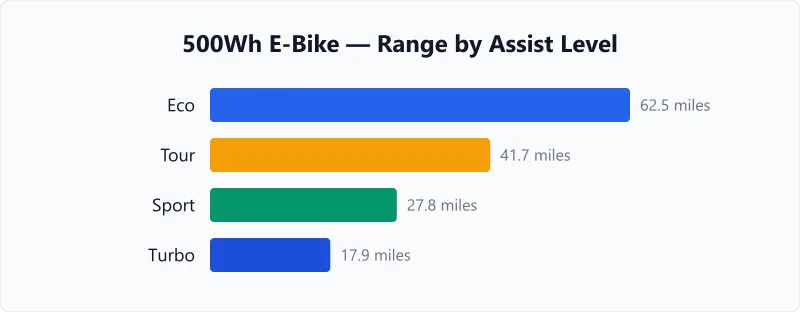
Switching from High to Eco assist can nearly double your range on the same battery. In High mode, the motor delivers maximum torque at every pedal stroke, consuming 30-50 Wh per mile on flat ground. In Eco mode, the motor provides gentle assistance only when you pedal firmly, dropping consumption to 12-20 Wh per mile.
Most e-bike displays show real-time power draw in watts. Watch it during a ride to understand your actual consumption pattern. Flat ground at 15 mph on Eco might show 80-120W. The same speed on High assist jumps to 200-350W. Hills can push High mode above 500W momentarily. That real-time feedback is the most accurate way to calibrate this calculator's results to your specific bike and riding style.
A practical strategy: use Eco mode on flat sections and Normal or High only for steep climbs. This "selective assist" approach typically extends range by 30-40% compared to riding in a single high mode the entire trip. For general battery pack design including series-parallel cell configurations, the same voltage and capacity math applies.
Typical Energy Consumption by E-Bike Type
| Bike Type | Typical Wh/mile | Typical Range (500Wh battery) | Notes |
|---|---|---|---|
| City commuter (250W) | 12-18 | 28-42 miles | Flat roads, moderate assist, paved surfaces |
| Hybrid / touring | 18-25 | 20-28 miles | Mixed terrain, moderate cargo |
| Mountain e-bike (250W EU) | 22-35 | 14-23 miles | Elevation gain is the dominant factor |
| Fat tire / beach cruiser | 25-40 | 13-20 miles | Wide tires increase rolling resistance by 10-20% |
| Cargo e-bike | 25-40 | 13-20 miles | Heavy loads (kids, groceries) increase consumption |
| Folding commuter | 15-22 | 23-33 miles | Smaller wheels less efficient, but lighter overall weight |
These numbers assume a 165 lb rider on normal assist. Heavier riders add about 18% consumption per 30 lbs above baseline. Cold weather (below 40°F / 5°C) can reduce battery capacity by 10-20%, further shrinking range. Our solar panel calculator can help you size a panel for mid-trip recharging if you carry a portable panel. The same Wh-based formula drives our drone battery flight time calculator — useful if you fly a drone on bike tours.
Worked Examples
Daily Commute on a 48V 14Ah E-Bike
Context
You commute 12 miles round trip on flat city roads with a 48V 14Ah battery (672Wh). You ride on normal assist, the road is flat, and you weigh 170 lbs. Your e-bike consumes about 20 Wh per mile on this route.
Calculation
Battery energy = 48V x 14Ah = 672 Wh
Adjusted consumption = 20 Wh/mi x 1.0 (normal assist) x 1.0 (flat) = 20 Wh/mi
Weight factor = 170 / 165 = 1.030
Effective consumption = 20 x 1.030 = 20.6 Wh/mi
Range = 672 / 20.6 = 32.6 miles
Interpretation
33 miles of range covers your 12-mile round-trip commute nearly three times. You could commute for 2-3 days on a single charge, depending on how aggressively you use the motor. Even in winter with 15% capacity loss, you still get nearly 28 miles.
Takeaway
A 48V 14Ah battery is well-sized for a short urban commute. If your battery label shows watt-hours instead of amp-hours, divide Wh by voltage — or check our watts in a battery guide for the full explanation.
Weekend Mountain Trail Ride
Context
You plan a 15-mile mountain trail ride with a 48V 20Ah battery (960Wh). The trail is hilly, you ride on high assist for the climbs, and you weigh 200 lbs. Mountain riding consumes about 25 Wh per mile on average.
Calculation
Battery energy = 48V x 20Ah = 960 Wh
Adjusted consumption = 25 Wh/mi x 1.5 (high assist) x 1.5 (hilly) = 56.25 Wh/mi
Weight factor = 200 / 165 = 1.212
Effective consumption = 56.25 x 1.212 = 68.2 Wh/mi
Range = 960 / 68.2 = 14.1 miles
Interpretation
14.1 miles falls just short of your planned 15-mile ride. If the trail is steeper than expected or you hit a headwind, you finish the last stretch on pedal power alone. This is a case where switching to Eco on flatter sections makes a real difference.
Takeaway
Mountain riding on high assist drains batteries fast. Using "selective assist" — Eco on flats, High on climbs only — could stretch this to 20+ miles. For charge time planning between rides, check our battery charge time calculator.
Frequently Asked Questions
Glossary
Pedal Assist System
The sensor and controller that detect your pedaling and activate the motor. Cadence sensors detect whether you are pedaling; torque sensors detect how hard you are pedaling. Torque-based PAS is more efficient because it matches motor output to your effort, reducing battery consumption by 10-20% compared to cadence-only systems.
Watt-Hours per Mile
A measure of energy efficiency for e-bikes, analogous to miles per gallon for cars. Lower numbers mean greater efficiency. City commuters typically average 15-20 Wh/mi, mountain bikes 25-40 Wh/mi. This metric accounts for speed, terrain, rider weight, and assist level in a single number.
Regenerative Braking
A system that converts braking energy back into electrical energy stored in the battery. Common on hub-motor e-bikes but rare on mid-drive bikes. Regenerative braking recovers 5-10% of energy in hilly terrain — meaningful over a long ride but not a major factor. It adds drag when coasting, which some riders dislike.
Charging your e-bike from solar panels on a bike tour? Our solar battery charge time calculator shows how long a portable panel takes to top off your battery.
Related calculators
Electric Scooter Battery Range Calculator
Calculate your electric scooter range from battery voltage, capacity, speed mode, terrain, and rider weight. Free, instant results.
Battery
Drone Battery Flight Time Calculator
Calculate drone flight time from battery mAh, voltage and average power draw. Presets carry DJI printed pack energy and hover times.
Battery
Battery Pack Calculator
Size a custom battery pack using series and parallel cell configurations. Enter target voltage, capacity, and cell specs.
Battery
Watt Hours to Amp Hours Calculator
Convert watt-hours to amp-hours at any voltage. Use this to compare batteries rated in different units.
Battery
Range estimates are starting points, not guarantees. Real-world range varies with wind, tire pressure, road surface, temperature, and how much you pedal versus relying on the motor. Ride your usual route once with the display showing watt-hours consumed, then use that measured consumption rate in this calculator for a far more accurate prediction than any default value. Our e-bike battery range guide covers everything that affects range and how to maximize miles per charge. If you also ride an electric scooter, the scooter range calculator handles the higher consumption rates and different speed modes.
More Battery calculators
Browse all battery calculators — LiFePO4, lead-acid, AGM, and lithium-ion runtime, charge time, and capacity sizing.
Last updated:
Written and maintained by Dan Dadovic, Commercial Director at Ezoic Inc. & PhD Candidate in Information Sciences. He works professionally as Commercial Director at Ezoic Inc., leading revenue strategy across digital publishing.
Disclaimer: Calculator results are estimates based on theoretical formulas. Actual performance varies with temperature, battery age, load patterns, and equipment condition. For critical electrical work, consult a licensed electrician.
Methodology reviewed by Doc. dr. sc. Damir Topić, Assistant Professor, FERIT Osijek.