Depth of Discharge: How Deep Can You Drain Your Battery?
Last updated:
7 min read
Depth of discharge (DoD) is the single most important number for predicting how long your battery will survive, yet most product listings barely mention it. A 100Ah battery at 50% DoD and the same battery at 80% DoD behave like two completely different products in terms of usable energy, lifespan, and real-world cost.
This guide explains what DoD actually measures, how it varies across battery chemistries, and how to pick the right DoD setting for your system.
What Depth of Discharge Actually Means
Depth of discharge is simply the percentage of a battery's total capacity that has been used. A 100Ah battery discharged by 30Ah is at 30% DoD (or equivalently, 70% state of charge). Discharge it by 80Ah and you are at 80% DoD.
The confusing part: DoD and State of Charge (SOC) are mirror images. 80% DoD = 20% SOC. 50% DoD = 50% SOC. Most battery monitors display SOC, but most specification sheets reference DoD when talking about cycle life. When a manufacturer says "3,000 cycles at 80% DoD," they mean the battery will last 3,000 discharge cycles if you never drain it below 20% remaining capacity.
DoD matters because batteries do not degrade linearly. Shallow cycling causes minimal wear. Deep cycling accelerates chemical degradation — but by how much depends entirely on the chemistry inside the battery. If you want the full runtime formula that uses DoD as a key variable, our battery runtime calculation guide walks through every step.
Recommended DoD by Battery Chemistry
| Battery Type | Max Recommended DoD | Usable Ah from 100Ah | Typical Cycle Life at Rated DoD |
|---|---|---|---|
| Flooded lead-acid | 50% | 50Ah | 300-800 cycles |
| AGM (Absorbed Glass Mat) | 50% | 50Ah | 300-500 cycles |
| Gel | 50% | 50Ah | 500-800 cycles |
| LiFePO4 (Lithium Iron Phosphate) | 80-100% | 80-100Ah | 2,000-5,000 cycles |
| Lithium-ion (NMC/NCA) | 80% | 80Ah | 500-1,500 cycles |
The gap between lead-acid and LiFePO4 is striking. Lead-acid batteries give you half their rated capacity in practice. LiFePO4 gives you 80-100%. This means a single 100Ah LiFePO4 battery replaces a 200Ah lead-acid bank in terms of usable energy — at roughly a third of the weight. Run a direct comparison with the battery runtime calculator by adjusting the DoD percentage to see how runtime changes.
How DoD Affects Cycle Life
Cycle life is the number of charge-discharge cycles a battery delivers before its capacity degrades to 80% of original (the industry standard end-of-life threshold). The relationship between DoD and cycle life is exponential, not linear.
For flooded lead-acid batteries, Battery University data shows:
- At 30% DoD: approximately 1,200 cycles
- At 50% DoD: approximately 500 cycles
- At 80% DoD: approximately 200 cycles
- At 100% DoD: approximately 100 cycles (severe damage with each cycle)
Going from 50% to 80% DoD does not simply reduce cycle life by 37%. It cuts it by 60%. The damage accelerates because deep discharge converts lead sulfate into large, hard crystals that resist reconversion during charging. This process — sulfation — is irreversible once the crystals grow past a certain size.
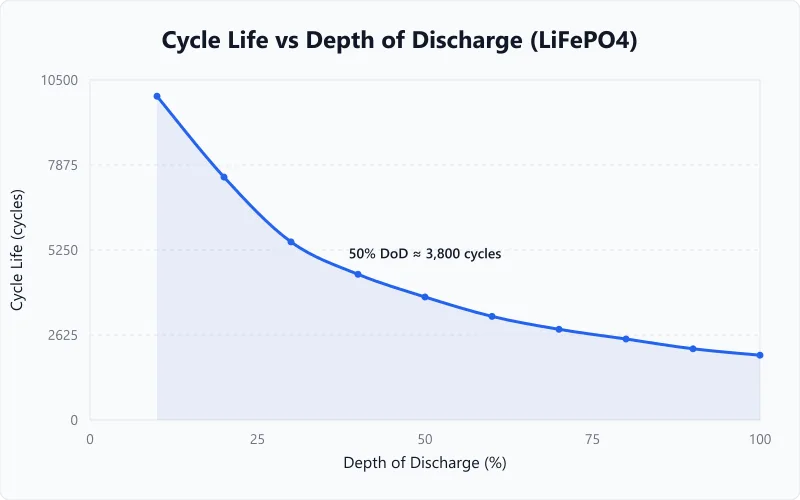
LiFePO4 batteries tell a different story. Their cycle life degrades much more gradually with deeper discharge:
- At 50% DoD: approximately 5,000-7,000 cycles
- At 80% DoD: approximately 3,000-5,000 cycles
- At 100% DoD: approximately 2,000-3,000 cycles
Going from 50% to 100% DoD on LiFePO4 reduces cycle life by roughly 50-60% — significant, but far less punishing than lead-acid. The lithium iron phosphate crystal structure is inherently more stable during deep intercalation/deintercalation of lithium ions. Combined with a BMS that prevents over-discharge below safe cell voltages, LiFePO4 batteries tolerate deep cycling without the catastrophic failure modes that plague lead-acid.
Finding the Right DoD for Your Battery
Lead-acid and AGM
Stick to 50% DoD as your daily limit. This is the universal recommendation from battery manufacturers, solar installers, and independent testing labs. Occasional deeper discharges during emergencies will not kill the battery immediately, but repeated cycling below 50% SOC shortens lifespan rapidly.
Set your battery monitor's low-voltage cutoff to trigger at 50% SOC (approximately 12.0V resting for a 12V lead-acid battery). This protects the battery from accidental deep discharge overnight or during cloudy weather.
For lead-acid batteries in solar systems, the charge controller handles this automatically if configured correctly. Most MPPT controllers have a "low voltage disconnect" setting — set it to 11.8-12.0V under load (which corresponds roughly to 50% SOC when accounting for voltage sag during discharge). Check your battery bank sizing to confirm the bank is large enough that daily cycling stays above 50% SOC.
LiFePO4
80% DoD is the standard recommendation for daily cycling. You get a large usable capacity while preserving the longest possible cycle life. At 80% DoD, a quality LiFePO4 battery lasts 3,000-5,000 cycles — meaning daily cycling for 8-14 years.
Running at 100% DoD is safe for the battery chemistry, but reduces cycle life to 2,000-3,000 cycles. For applications where you need every last watt-hour (portable power, weight-sensitive installations, emergency backup), 100% DoD is a valid choice. The BMS will shut off output before the cells reach a damaging voltage, so there is no risk of irreversible damage like there is with lead-acid.
For seasonal or low-cycle applications (emergency home backup, a boat used 20 weekends per year), even 100% DoD is fine because you will never approach 2,000 cycles. Size for convenience, not cycle life. For a practical example of how DoD affects real battery sizing decisions, our RV battery sizing guide shows the math for both weekend and full-time use cases.
Warranty terms tie directly to DoD. Most LiFePO4 manufacturers warrant their batteries for a specific cycle count at a specific DoD — typically 2,000-3,000 cycles at 80% DoD, or 4,000-5,000 cycles at 50% DoD. If you regularly discharge below the warranted DoD and the battery fails prematurely, the manufacturer can deny the claim.
Before choosing a DoD strategy, read your battery's warranty document and note the exact DoD percentage it references. A warranty that claims "5,000 cycles" might specify 50% DoD in the fine print — giving you far less usable energy per cycle than you expected.
Lithium-ion (NMC/NCA)
These are the chemistries in laptops, phones, and Tesla Powerwalls. The recommended DoD is 80% (or equivalently, do not charge above 80% and do not discharge below 20% for maximum longevity). Phone manufacturers and EV makers bake this into their battery management software — when your phone shows "100%," the actual cell is at roughly 95-97% SOC, and "0%" is really 3-5% SOC.
For home energy storage using NMC batteries (like the Tesla Powerwall), the inverter firmware manages DoD automatically. You typically cannot and should not override these limits.
DoD and System Sizing
DoD directly determines how much battery capacity you need to buy. For a system that needs 1,000 Wh of usable energy per day:
- Lead-acid at 50% DoD: 1,000 Wh / 0.50 = 2,000 Wh of rated capacity needed (167Ah at 12V)
- LiFePO4 at 80% DoD: 1,000 Wh / 0.80 = 1,250 Wh of rated capacity needed (104Ah at 12V)
- LiFePO4 at 100% DoD: 1,000 Wh / 1.00 = 1,000 Wh of rated capacity needed (83Ah at 12V)
The lead-acid option requires 60% more rated capacity to deliver the same usable energy as LiFePO4 at 80% DoD. When you factor in weight (lead-acid is 3-4x heavier per kWh) and the cost of replacing lead-acid batteries 4-10x more often, the total ownership cost picture shifts dramatically toward lithium. For the full comparison with battery-life and weight numbers, see our LiFePO4 vs lead-acid runtime comparison.
Whichever chemistry you choose, your deep cycle battery runtime depends on getting DoD right. Build it into your calculations from the start — not as an afterthought. If you are planning a battery backup for a specific appliance like a refrigerator, our 12V fridge backup guide shows how DoD translates into real-world hours of runtime.
Frequently Asked Questions
Written and maintained by Dan Dadovic, Commercial Director at Ezoic Inc. & PhD Candidate in Information Sciences. He works professionally as Commercial Director at Ezoic Inc., leading revenue strategy across digital publishing.
Disclaimer: Calculator results are estimates based on theoretical formulas. Actual performance varies with temperature, battery age, load patterns, and equipment condition. For critical electrical work, consult a licensed electrician.
Methodology reviewed by Doc. dr. sc. Damir Topić, Assistant Professor, FERIT Osijek.