PWM vs MPPT: How Your Charge Controller Affects Charge Time
Your charge controller is the gatekeeper between panels and batteries, and the type you use changes real-world charge speed dramatically.
PWM (Pulse Width Modulation) controllers are simple and cheap. They connect panels directly to batteries, which means panel voltage gets dragged down to battery voltage. A 20V panel charging a 12V battery wastes roughly 40% of the available power as heat. PWM works acceptably only when panel voltage closely matches battery voltage.
MPPT (Maximum Power Point Tracking) controllers convert the higher panel voltage down to battery voltage while boosting current. They capture 15-30% more energy than PWM controllers in most conditions, and the advantage grows wider in cold weather (when panel voltage rises) and when panel voltage is much higher than battery voltage. For any system over 200W, MPPT pays for itself in faster charging and better energy harvest.
This calculator assumes MPPT-level efficiency. If you are using a PWM controller, increase the system loss percentage by 15-20% to get a more realistic charge time.
Example: Charging a 200Ah 12V LiFePO4 Bank
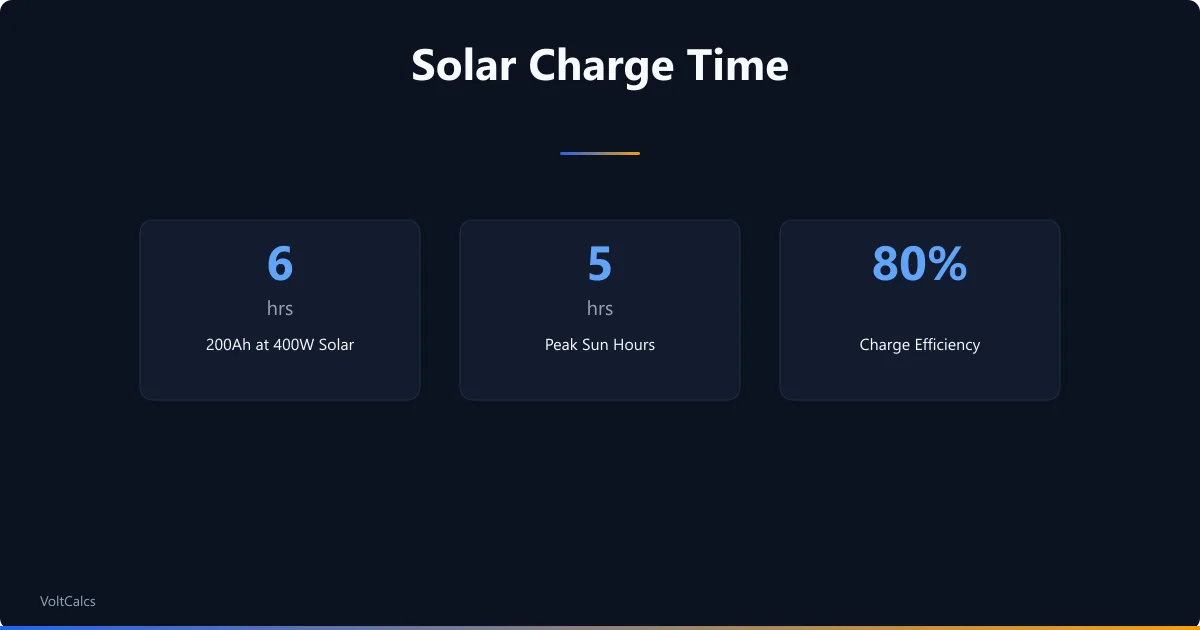
Setup: 400W of solar panels, 5 peak sun hours per day, 200Ah 12V LiFePO4 battery bank drained to 20% state of charge (80% DoD), 14% system losses (the PVWatts default).
Energy needed to refill: 200Ah x 0.80 = 160Ah. At 12V, that is 1,920Wh.
Effective solar input per day: 400W x 5 hours x 0.86 (14% losses) = 1,720Wh per day.
Charge time: 1,920 / 1,720 = 1.12 days. Just over one full day of sun to go from 20% back to 100%.
In practice, the last 10-15% of charge takes longer because the charge controller enters absorption phase, reducing current as the battery approaches full. A LiFePO4 battery accepts charge at a flatter rate than lead-acid, so this effect is less pronounced — but still adds 1-2 hours to the final charge.
Charge Times by Panel and Battery Combination
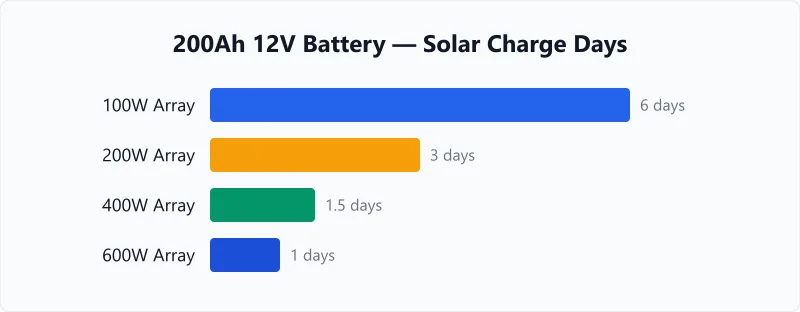
| Solar Array | Battery Bank | Sun Hours | Approx. Charge Time (from 20%) |
|---|---|---|---|
| 200W | 100Ah 12V | 5h | ~1.1 days |
| 400W | 200Ah 12V | 5h | ~1.1 days |
| 600W | 200Ah 12V | 5h | ~0.74 days |
| 400W | 400Ah 12V | 4h | ~2.8 days |
| 800W | 400Ah 12V | 5h | ~1.1 days |
| 2000W | 400Ah 48V | 4h | ~2.2 days |
All figures assume MPPT controller and 14% system losses (the PVWatts default), and every row is the calculator's own output. Lead-acid batteries will take 10-20% longer due to the extended absorption phase needed to reach full charge. To convert these wattages to the amps your charge controller must handle, use the solar watts to amps calculator.
Worked Examples
Recharging a Depleted RV Battery Bank After a Weekend Trip
Context
Calculation
Energy to replenish = 300Ah × 0.70 × 12V = 2,520Wh
Effective solar per day = 600W × 6h × 0.86 = 3,096Wh/day
Charge time = 2,520 / 3,096 = 0.81 days (about 5 of the 6 peak sun hours)
Interpretation
With 6 PSH, the 600W array can replenish the bank in under a full day of sun. The owner can expect to be back to 100% by late afternoon if parking starts by 9 AM. The last 10% may trickle in slowly during absorption phase.
Takeaway
If you regularly drain to 30% SoC on weekend trips, 600W of panels is well-matched for recovery. To verify your battery bank is large enough for the loads you're running, try our RV battery runtime calculator.
Slow-Charging a Large Off-Grid Bank During Winter
Context
Calculation
Bank fully depleted to 80% DoD: 600Ah × 0.80 × 48V = 23,040Wh to refill
Effective solar per day = 2,000W × 2.5h × 0.80 = 4,000Wh/day
Charge time = 23,040 / 4,000 = 5.76 days
Interpretation
Nearly 6 days to recharge from deep discharge in winter. This is a common trap for northern off-grid systems — the battery bank takes longer to recharge than the time between cloudy stretches. The system would benefit from more panels or a backup generator.
Takeaway
Winter recharge math exposes undersized arrays. If your charge time exceeds your average sunny stretch, you need more panels or a generator. Use the solar panel and battery sizing calculator to re-evaluate your array for winter conditions.
Frequently Asked Questions
Glossary
Absorption Phase
The second stage of battery charging where voltage is held constant while current tapers. This phase tops off the last 15-20% of capacity and can take 1-4 hours depending on battery chemistry and charge controller settings.
Bulk Charging
The first stage of battery charging where the controller delivers maximum available current. This phase handles the first 80-85% of charge quickly and efficiently before transitioning to absorption.
Charge Acceptance Rate
How much current a battery can safely absorb at a given state of charge. LiFePO4 batteries maintain high acceptance rates (0.5C or higher) until near full, while lead-acid acceptance drops sharply above 80% SoC.
Wondering how long your charged battery will last? Plug your load into the battery runtime calculator for an instant estimate.
Related calculators
Solar Battery Bank Size Calculator
Calculate the battery bank capacity your off-grid solar system needs. Enter daily usage, autonomy days, and system voltage.
Solar
Battery Charge Time Calculator
Calculate how long a battery takes to charge from capacity, charger amps, and chemistry. Returns the bulk stage and the absorption stage separately.
Battery
Solar Panel Output Calculator
Calculate daily and monthly energy output from your solar panels. Enter wattage, sun hours, and panel count for instant results.
Solar
How Long to Charge a 100Ah Battery?
Calculate charge time for a 100Ah battery from solar, a mains charger, or a DC-DC charger. Lead-acid and LiFePO4 compared, stage by stage.
Battery
Solar charge times are estimates based on average conditions. Clouds, partial shade, and the natural taper of charge controllers all extend real-world charging beyond the calculated minimum. Build your system with enough panel headroom to reach full charge even on mediocre sun days — a 30% buffer over the minimum solar wattage goes a long way toward consistent battery health. For details on how charge time feeds into long-term battery care, read how to calculate battery runtime.
More Solar calculators
Browse all solar calculators — Panel output, battery bank sizing, charge time, and system design for off-grid, RV, and residential setups.
Last updated:
Written and maintained by Dan Dadovic, Commercial Director at Ezoic Inc. & PhD Candidate in Information Sciences. He works professionally as Commercial Director at Ezoic Inc., leading revenue strategy across digital publishing.
Disclaimer: Calculator results are estimates based on theoretical formulas. Actual performance varies with temperature, battery age, load patterns, and equipment condition. For critical electrical work, consult a licensed electrician.
Methodology reviewed by Doc. dr. sc. Damir Topić, Assistant Professor, FERIT Osijek.