Why Panel Tilt Affects Output So Much
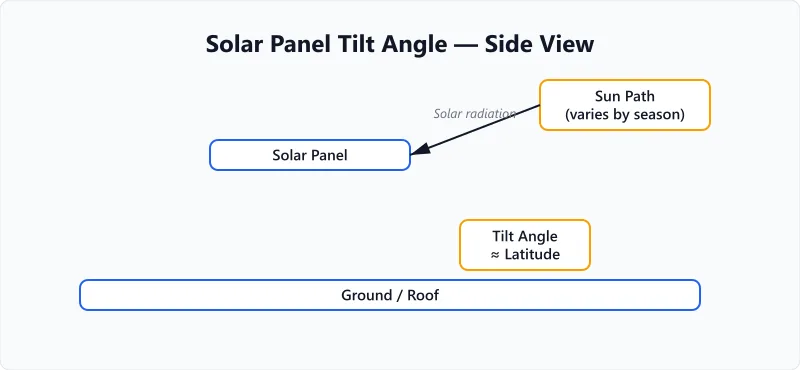
Solar panels produce maximum power when sunlight hits them at a 90-degree angle (perpendicular to the surface). As the sun moves across the sky and shifts seasonally, the angle between the panel and the sun changes constantly. A fixed panel can only be optimised for one position, so the goal is to find the tilt that captures the most total energy across the period you care about — full year, specific season, or a particular month.
At the equator (0° latitude), the sun passes nearly straight overhead, so panels produce best when nearly flat. At 45°N (Minneapolis, Montreal, Milan), the sun is much lower in the sky, especially in winter when it peaks at only 21° above the horizon at the solstice. A flat panel there receives sunlight at such a shallow angle that output drops by 25-30% compared to a properly tilted one. Use our solar panel output calculator to see how this difference translates into real kWh for your specific panel setup.
The general rule: set your annual tilt angle equal to your latitude. The US Department of Energy Federal Energy Management Program states that the optimal tilt angle for solar exposure equals the local latitude, and the PVWatts documentation calls that setting a common rule of thumb for fixed arrays. The rule balances summer (when the sun is high and panels should be flatter) against winter (when the sun is low and panels should be steeper). NASA POWER's modelled optimal tilt angles, from its 2001-2020 climatology, sit lower: Seattle 31.5°, New York 31.0°, Albuquerque 31.5°. This calculator prints the latitude rule and does not apply NASA's model, so the Seattle preset (47.6°N) returns 47.6° and the New York preset (40.7°N) returns 40.7°, roughly 16° and 10° steeper than those modelled figures. Seasonal adjustments of ±15° from your latitude can boost output by 10-15% in the adjusted season, which matters for off-grid systems that struggle in winter. The ±15° offsets and the 10-15% gain are our own estimate; no published source backs them. Check your results against your product data or a licensed professional before acting.
Optimal Tilt Angles by Latitude and Season
| Latitude | Annual Optimal | Summer Tilt | Winter Tilt | Spring/Fall Tilt |
|---|---|---|---|---|
| 25° (Miami, Key West) | 25° | 10° | 40° | 25° |
| 30° (Houston, Jacksonville) | 30° | 15° | 45° | 30° |
| 35° (Los Angeles, Charlotte) | 35° | 20° | 50° | 35° |
| 40° (New York, Denver) | 40° | 25° | 55° | 40° |
| 45° (Minneapolis, Portland OR) | 45° | 30° | 60° | 45° |
| 50° (Vancouver, London) | 50° | 35° | 65° | 50° |
These angles are measured from horizontal (0° = flat, 90° = vertical). The summer tilt is approximately latitude minus 15°, and the winter tilt is approximately latitude plus 15°. These rules of thumb come from DOE solar design guidelines and work well for most residential installations. Fine-tuning beyond these values yields diminishing returns — the difference between 40° and 42° is less than 0.5% annual output.
Fixed Tilt vs Adjustable vs Tracking Mounts
Fixed-tilt mounts are the standard for residential rooftop installations. The panels stay at one angle year-round, typically matching the roof pitch. Cost: $0 extra beyond standard racking. Output penalty: 0-10% compared to seasonally adjusted, depending on how close your roof pitch is to optimal. Most homeowners accept this tradeoff because the simplicity and lower maintenance outweigh the modest output loss.
Seasonally adjustable mounts let you change the tilt 2-4 times per year. Ground-mount systems use these more often than rooftop installations because roof access for seasonal adjustments is impractical and potentially dangerous. Cost: $200-500 extra per array. Prices and rates on this page are our own estimates as of the date shown; they change often. Enter your own figures for a current result. Output gain: 5-15% annually compared to fixed, with the biggest gains in winter when every extra kWh matters for off-grid systems. Use the solar panel and battery sizing calculator to spec the full ground-mount system once you decide on adjustable mounts.
Single-axis trackers follow the sun from east to west throughout the day. They boost output 20-35% compared to fixed-tilt and are common on commercial solar farms. Cost: $1,000-3,000 per tracker. For residential use, the math rarely works — the extra cost buys more output than simply adding another panel or two, but the mechanical complexity adds maintenance and failure points. Dual-axis trackers add north-south seasonal tracking and gain another 5-10%, but at $3,000-6,000 per tracker they are strictly commercial-scale equipment.
Worked Examples
Optimizing a Rooftop Array in Denver
Context
A homeowner in Denver, CO (latitude 39.7°N) is installing a south-facing ground-mount array and wants to know the best fixed tilt angle for maximum annual output. The roof is not an option due to shading from a large tree on the south side.
Calculation
Annual optimal tilt = latitude = 39.7°
Summer optimal = 39.7° − 15° = 24.7°
Winter optimal = 39.7° + 15° = 54.7°
For a fixed mount, 39.7° (a 40° bracket setting) captures the best year-round balance
Interpretation
A 39.7° fixed tilt (set the bracket to 40°) in Denver captures within 1-2% of the maximum possible annual energy. Denver's 300 days of sunshine make it one of the best solar locations in the US despite being at a relatively high latitude. The difference between a 35° roof pitch and the optimal 39.7° is only about 1% annual output — well within the noise of weather variation. Use the solar panel size calculator to determine the right array wattage for Denver's excellent sun hours.
Takeaway
Denver homeowners with a south-facing roof pitched between 30° and 45° can flush-mount panels with confidence. The output difference is negligible compared to the cost and complexity of tilt brackets.
Seasonal Adjustment in Seattle
Context
An off-grid cabin owner near Seattle, WA (latitude 47.6°N) has adjustable ground-mount panels. Winter is the bottleneck — the system barely keeps the batteries charged from November through February. They want to know how much winter output improves with seasonal tilt adjustment.
Calculation
Annual optimal = latitude = 47.6°
Summer tilt = 47.6° − 15° = 32.6°
Winter tilt = 47.6° + 15° = 62.6°
Difference in winter energy capture: panels at 62.6° vs fixed 47.6° captures approximately 10-12% more energy in December-February
Interpretation
Tilting to 62.6° in winter aims the panels directly at Seattle's low winter sun, which peaks at only 19° above the horizon at the solstice. That 10-12% winter gain is significant for an off-grid system where winter is already the weakest production period. Across the full year, seasonal adjustment (4 changes) adds about 8% total output compared to a fixed mount. Check how many batteries your solar system needs to store the extra winter energy from properly tilted panels.
Takeaway
For off-grid systems at high latitudes, seasonal tilt adjustment is one of the easiest ways to improve winter performance without buying more panels. Set a calendar reminder to adjust in March, June, September, and December.
Frequently Asked Questions
Glossary
Azimuth Angle
The compass direction a solar panel faces, measured in degrees from true north (0° = north, 180° = south in the northern hemisphere). Due south (180°) is optimal in the northern hemisphere. Panels facing southeast or southwest (150°-210°) lose only 3-5% of annual output compared to due south.
Peak Sun Hours
The equivalent number of hours per day when solar intensity reaches the standard 1,000 W/m² used to rate panels. A location with 5 peak sun hours receives the same total energy as 5 hours of maximum-rated sunshine, even though actual daylight may last much longer at lower intensities.
Solar Irradiance
The power density of sunlight striking a surface, measured in watts per square meter (W/m²). Clear midday sun at sea level delivers about 1,000 W/m². Irradiance drops with cloud cover, atmospheric haze, and lower sun angles. The total daily irradiance determines how much energy a solar panel can produce.
After finding your optimal angle, figure out how many panels you need with our solar panel size estimator based on your daily energy use and local sun hours.
Related calculators
Solar Time Calculator
Calculate apparent solar time and solar noon for any location. Enter longitude and date to find when the sun is highest.
Solar
Solar Panel Output Calculator
Calculate daily and monthly energy output from your solar panels. Enter wattage, sun hours, and panel count for instant results.
Solar
Solar Panel Roof Area Calculator
Calculate how many solar panels fit on your roof and the total output potential. Enter roof dimensions and panel specs.
Solar
Solar Panel Calculator
Free solar panel calculator: enter your daily energy use and sun hours to get the panel wattage and number of panels for a home, RV, or off-grid setup.
Solar
Getting your panel angle right is one of the cheapest ways to squeeze more energy from the hardware you already own. For most homeowners, the roof pitch is close enough. For ground-mount and off-grid systems, seasonal adjustment is worth the effort — especially if winter output determines whether your batteries stay charged. Our solar panel angle guide covers optimal tilt by latitude, seasonal adjustment strategy, and fixed vs tracking mount comparisons.
More Solar calculators
Browse all solar calculators — Panel output, battery bank sizing, charge time, and system design for off-grid, RV, and residential setups.
Last updated:
Written and maintained by Dan Dadovic, Commercial Director at Ezoic Inc. & PhD Candidate in Information Sciences. He works professionally as Commercial Director at Ezoic Inc., leading revenue strategy across digital publishing.
Disclaimer: Calculator results are estimates based on theoretical formulas. Actual performance varies with temperature, battery age, load patterns, and equipment condition. For critical electrical work, consult a licensed electrician.
Methodology reviewed by Doc. dr. sc. Damir Topić, Assistant Professor, FERIT Osijek.