Solar Panel Output Explained
Last updated:
7 min read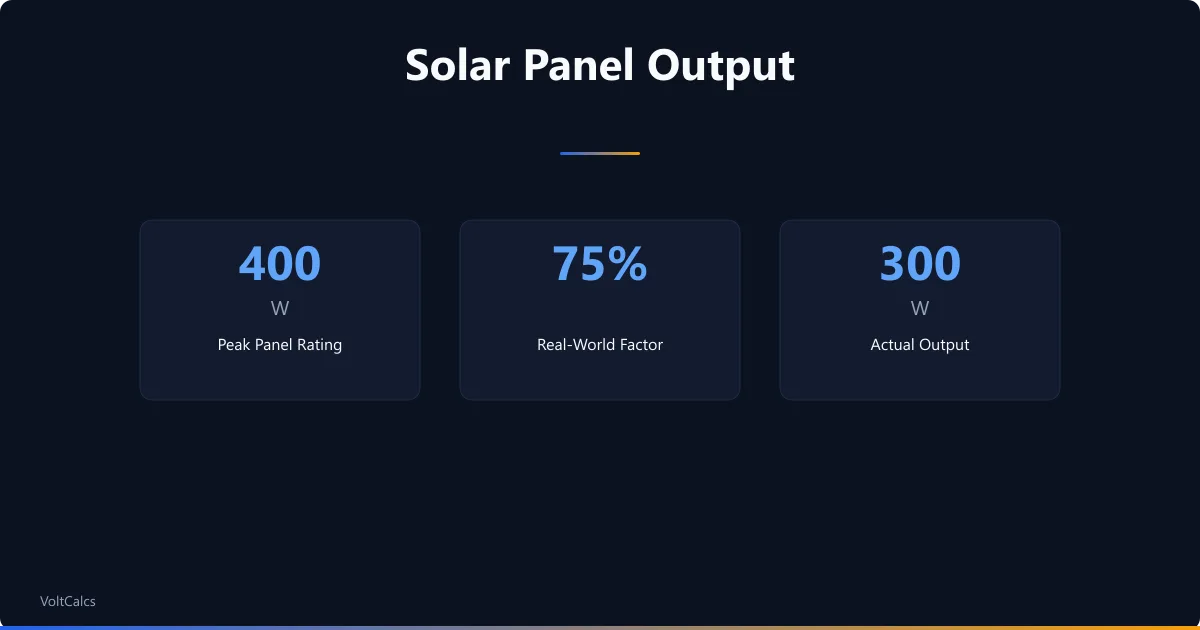
A 400W solar panel does not produce 400 watts. Not on your roof, not on a perfect sunny day, and not even close in winter. That 400W rating is measured under Standard Test Conditions (STC): 1,000 W/m² irradiance, 25°C cell temperature, and AM1.5 spectrum — laboratory conditions that rarely exist outdoors.
Real-world output from that same 400W panel is typically 300-340W at peak and averages far less across a full day. Understanding where the watts go — and how to estimate what you will actually get — matters for anyone sizing a solar system.
Rated Watts vs Real-World Watts
STC testing gives every panel a level playing field for comparison, much like EPA fuel economy ratings for cars. But just as your car never matches its EPA sticker, your panel never matches its STC rating in the field.
The main reasons your panel produces less than its rating:
Temperature. Solar cells lose efficiency as they heat up. The temperature coefficient for most silicon panels is around -0.3% to -0.4% per degree Celsius above 25°C. On a 35°C day, the cell temperature on a rooftop can reach 55-65°C — that is 30-40°C above STC. At -0.35% per degree, a 400W panel at 60°C cell temperature produces about 351W at peak irradiance. Heat alone can cut output by 10-15% on warm days.
Irradiance. STC assumes 1,000 W/m² hitting the panel surface. In practice, irradiance varies from 200 W/m² on an overcast morning to 1,100 W/m² at solar noon on a clear summer day at high altitude. For most of the day — mornings, afternoons, and especially cloudy periods — irradiance is well below the 1,000 W/m² test condition.
Angle and orientation. A panel tilted to match your latitude and facing true south (in the northern hemisphere) captures the most annual energy. Every degree away from optimal reduces output. A flat-mounted panel on a low-slope roof might produce 10-15% less than one tilted optimally. East or west-facing panels lose 10-20% compared to south-facing. Our solar panel angle calculator finds the optimal tilt for your latitude and season, and our panel angle guide explains the geometry behind the numbers.
Where the Watts Go: Loss Factors
| Loss Factor | Typical Loss | Notes |
|---|---|---|
| Temperature (above 25°C) | 8-15% | Worst in hot climates; roof-mounted panels run hotter than ground-mounted |
| Soiling (dust, pollen, bird droppings) | 2-5% | Higher in dry/dusty areas; rain provides partial cleaning |
| Shading (partial) | 0-25% | Even small shade on one cell can disproportionately reduce output |
| Wiring and connections | 1-3% | Resistive losses in cables and connectors; longer runs = more loss |
| Charge controller efficiency | 2-5% | MPPT controllers: 95-98%. PWM controllers: 75-85% |
| Inverter efficiency | 3-8% | For grid-tie or AC loads. DC-only systems skip this |
| Module mismatch | 1-3% | Panels in a string are limited by the weakest panel |
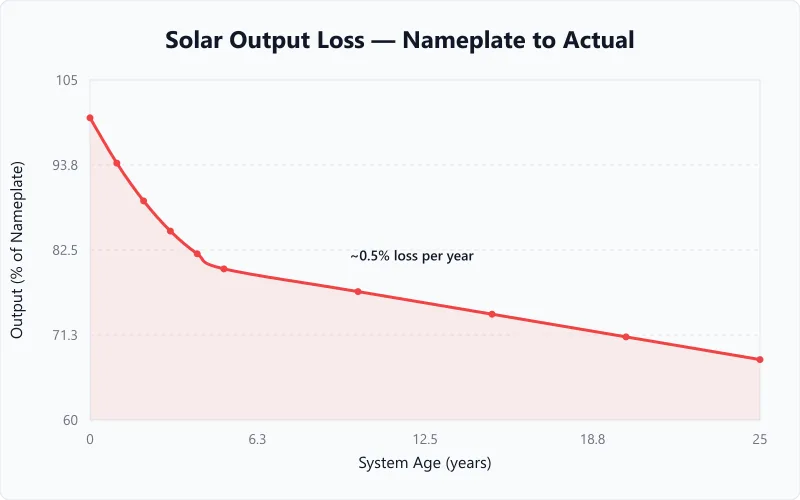
| Degradation (aging) | 0.5-0.8%/year | Most panels warranty 80% output at 25 years |
Combined, these losses reduce real-world system output to approximately 75-85% of the panel's STC rating under good conditions. For system sizing, NREL recommends using a derate factor of 0.80 (80%) as a reasonable starting point for most residential rooftop installations. Run your specific numbers through our solar panel output calculator.
How to Estimate Daily Output
Daily energy production depends on panel wattage, peak sun hours for your location, and system losses. The formula:
Daily output (Wh) = Panel watts × Peak sun hours × System derate factor
- Find your peak sun hours. Peak sun hours (PSH) represent the equivalent number of hours at 1,000 W/m² irradiance that your location receives per day. Phoenix, AZ averages 6.5 PSH. Seattle, WA averages 3.5 PSH. London, UK averages 2.5 PSH. Find your location using NREL's solar resource maps (page no longer available at time of checking) (U.S.) or the Global Solar Atlas for international locations.
- Apply the derate factor. Use 0.80 for a typical residential rooftop with MPPT controller. Use 0.70-0.75 for suboptimal conditions (partial shade, non-ideal tilt, PWM controller). Use 0.85 for ground-mounted systems with optimal tilt and MPPT.
- Multiply. A 400W panel in Phoenix: 400 × 6.5 × 0.80 = 2,080 Wh (2.08 kWh) per day. The same panel in Seattle: 400 × 3.5 × 0.80 = 1,120 Wh (1.12 kWh) per day. Nearly double the output simply by location.
For multi-panel systems, multiply by the number of panels. Four 400W panels in Phoenix: 4 × 2,080 = 8,320 Wh (8.3 kWh) per day. Use the solar panel size estimator to determine how many panels you need for your daily consumption.
Seasonal Output Variation
Solar output swings dramatically between summer and winter in temperate climates. The two main drivers: day length and sun angle. Our solar time calculator shows how these shift throughout the year for your location.
In summer at 40°N latitude (New York, Madrid, Beijing), the sun is high in the sky and days are 14-15 hours long. Peak sun hours reach 5-6. In winter at the same latitude, the sun is low, days are 9-10 hours, and peak sun hours drop to 2-3. That means winter output is roughly 40-50% of summer output — not a small difference.
Tropical locations near the equator have minimal seasonal variation. Temperate locations (30-50°N/S) have moderate variation. High-latitude locations (above 50°N/S) have extreme variation — summer days are very long with good output, but winter days are short with low sun angles and potentially snow-covered panels.
If you are sizing an off-grid system that must work year-round, size for your worst month — typically December or January in the Northern Hemisphere. A system sized for summer production will fall short in winter by 40-60%. This is where battery banks and backup generators fill the gap. Our solar battery bank sizing guide covers autonomy planning for cloudy periods, and the off-grid load calculation guide helps you build the seasonal energy budget that drives panel sizing.
Monocrystalline vs Polycrystalline: Output Differences
Modern residential panels are overwhelmingly monocrystalline. The older polycrystalline panels (recognizable by their blue, speckled appearance) still exist but are being phased out of mainstream production.
Monocrystalline panels use higher-purity silicon and achieve 20-23% efficiency. They produce more watts per square foot, which matters when roof space is limited. Most panels sold in 2026 are mono — specifically the PERC (Passivated Emitter and Rear Cell) or TOPCon variant. Newer heterojunction (HJT) and back-contact (IBC) designs push mono efficiency above 24%, though at a higher price point that currently limits them to premium residential and commercial installations.
Polycrystalline panels achieve 15-18% efficiency. They cost slightly less per panel but more per watt because you need more panels (and more roof area) for the same output. The cost gap has narrowed enough that mono is the default choice for nearly all new installations.
Both types degrade at similar rates (0.5-0.8% per year) and have similar temperature coefficients. The practical output difference per panel is about 15-25% — a 400W mono panel would be equivalent to a 320-340W poly panel of the same physical size. Given the small price premium for mono, there is rarely a reason to choose poly for new installations.
Regardless of panel type, what matters most for output is: location (peak sun hours), tilt and orientation, shading, and system efficiency. Panel technology matters, but it is not the largest variable. Use the solar watts-to-amps calculator to convert your panel's output into the current that actually reaches your batteries or grid-tie inverter.
Frequently Asked Questions
Written and maintained by Dan Dadovic, Commercial Director at Ezoic Inc. & PhD Candidate in Information Sciences. He works professionally as Commercial Director at Ezoic Inc., leading revenue strategy across digital publishing.
Disclaimer: Calculator results are estimates based on theoretical formulas. Actual performance varies with temperature, battery age, load patterns, and equipment condition. For critical electrical work, consult a licensed electrician.
Methodology reviewed by Doc. dr. sc. Damir Topić, Assistant Professor, FERIT Osijek.