LiFePO4 vs Lead-Acid Runtime Compared
Last updated:
9 min read
A 100Ah LiFePO4 battery delivers 80-100Ah of usable energy. A 100Ah lead-acid battery delivers 50Ah before you start damaging it. Same label, dramatically different runtime. This single fact reshapes every comparison between the two chemistries.
This guide puts real numbers behind the LiFePO4 vs lead-acid debate. Not marketing claims — actual runtime, cycle life, and cost-per-kWh figures that help you decide which battery makes sense for your application and budget.
The Runtime Gap at a Glance
| Specification | LiFePO4 (Lithium Iron Phosphate) | Lead-Acid (Flooded/AGM) |
|---|---|---|
| Rated capacity | 100Ah | 100Ah |
| Recommended max DoD | 80-100% | 50% |
| Usable energy (12V) | 960-1,200 Wh | 600 Wh |
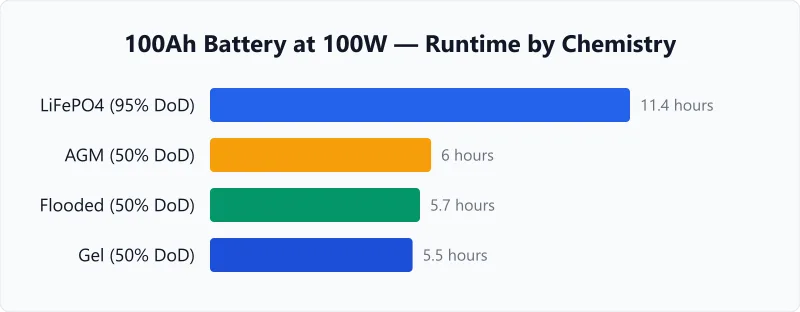
| Runtime on 100W load | 8.6-10.8 hours | 5.4 hours |
| Weight | ~26 lbs (12 kg) | ~65 lbs (30 kg) |
| Cycle life (at rated DoD) | 2,000-5,000 cycles | 200-500 cycles |
| Self-discharge rate | 2-3% per month | 5-15% per month |
| Charge efficiency | 95-98% | 80-85% |
| Voltage under load | Flat (12.8-13.2V) | Sags 1-2V under load |
The runtime difference is not 10% or 20% — it is 60-100%. A LiFePO4 battery at 80% depth of discharge (DoD) delivers more usable energy than a lead-acid battery at 50% DoD, despite both being labeled "100Ah." Run the comparison yourself with our LiFePO4 runtime calculator and lead-acid runtime calculator.
Why LiFePO4 Delivers More Usable Energy
Three factors combine to give LiFePO4 its runtime advantage: deeper safe discharge, flatter voltage curve, and higher round-trip efficiency.
Deeper safe discharge
Lead-acid batteries suffer permanent sulfation damage when discharged below 50%. The lead sulfate crystals that form during discharge become hard and irreversible if the battery sits in a deeply discharged state. This is not a theoretical concern — it is the primary cause of premature lead-acid battery failure.
LiFePO4 cells handle 80% DoD routinely, and many manufacturers rate them for 100% DoD without meaningful capacity loss. The lithium iron phosphate chemistry does not suffer from sulfation or memory effects. A built-in Battery Management System (BMS) prevents over-discharge by cutting off output before the cells reach a damaging voltage.
Flat voltage curve
A fully charged lead-acid battery sits at 12.7V. Under a 100W load, voltage drops immediately to 12.3-12.4V and continues sagging as the battery discharges. By 50% DoD, voltage is around 12.0V. This sag means your inverter receives progressively less voltage, which increases current draw and reduces overall efficiency.
LiFePO4 holds between 13.2V and 12.8V for roughly 90% of its discharge cycle. The voltage barely moves until the battery is nearly empty. This means consistent power delivery from start to finish — your devices run the same at 20% remaining as they did at 80% remaining.
Higher charge efficiency
Lead-acid batteries waste 15-20% of charging energy as heat, especially during the absorption and float stages. If you put 1,200Wh into a lead-acid battery, you get about 960-1,020Wh back out. LiFePO4 batteries convert 95-98% of charging energy into stored energy. In solar applications where every watt-hour of panel output counts, this efficiency gap means LiFePO4 banks charge faster and waste less of your solar harvest.
Real-World Runtime Scenarios
Lab specs are useful, but real applications are what matter. Here are three common scenarios comparing a single 100Ah 12V battery of each type.
Scenario 1: Running a 12V DC fridge overnight
A typical 12V compressor fridge draws 40-50W average (cycling between 0W and 150W as the compressor kicks on and off). Over 12 hours overnight:
LiFePO4 at 80% DoD: 960Wh usable / 45W average = 21.3 hours. Easily handles the night with capacity to spare.
Lead-acid at 50% DoD: 600Wh usable / 45W average = 13.3 hours. Covers the night, but you wake up with a battery that needs immediate recharging to avoid sulfation damage.
Run your own fridge scenario with the 12V battery refrigerator calculator.
Scenario 2: Powering a CPAP machine for camping
A modern CPAP draws 30-60W depending on pressure settings and humidifier use. For an 8-hour sleep:
LiFePO4: 960Wh / 45W = 21.3 hours. Three nights on one charge at typical settings.
Lead-acid: 600Wh / 45W = 13.3 hours. One full night with a partial second night — but the battery weighs 65 lbs vs 26 lbs for the LiFePO4. For backpack camping, weight matters as much as runtime. Dial in exact runtime for your machine with the CPAP battery runtime calculator.
Scenario 3: Home UPS backup during a power outage
A basic home office setup (monitor, laptop, router, modem) draws about 150W total:
LiFePO4: 960Wh / 150W = 6.4 hours. Enough for most utility outages.
Lead-acid: 600Wh / 150W = 4 hours. Tight for a long outage. Add inverter efficiency losses (roughly 10-15% for a pure sine wave inverter) and practical runtime drops to about 3.4 hours.
Cost Per Cycle: The Long-Term Math
LiFePO4 batteries cost 2-3x more upfront than equivalent lead-acid batteries. But upfront cost is not the right metric — cost per usable kWh over the battery's lifetime is.
| Metric | LiFePO4 100Ah 12V | Lead-Acid 100Ah 12V |
|---|---|---|
| Purchase price (as of early 2026) | $250-450 | $100-180 |
| Usable energy per cycle | 960 Wh | 600 Wh |
| Cycle life at rated DoD | 3,000 cycles (typical) | 300 cycles (typical) |
| Lifetime energy delivered | 2,880 kWh | 180 kWh |
| Cost per kWh delivered | $0.09-0.16 | $0.56-1.00 |
At typical pricing, LiFePO4 delivers each kilowatt-hour for one-fifth to one-sixth the cost of lead-acid over its lifetime. The math is even more lopsided in solar applications where daily cycling accelerates lead-acid degradation. A lead-acid battery cycled daily to 50% DoD might last 12-18 months. The same cycling pattern on a LiFePO4 battery lasts 8-14 years. Over a decade, you would buy 6-8 lead-acid batteries for every one LiFePO4. To compare these economics against your grid electricity rate, check the cost per kWh calculator.
The exception: if you need batteries for a system that cycles only occasionally — a boat used 20 weekends per year, or a cabin visited monthly — lead-acid's lower upfront cost can make financial sense because you'll never reach the cycle count where LiFePO4's longevity advantage kicks in.
Voltage Under Load: The Hidden Runtime Advantage
Runtime calculations assume constant voltage, but lead-acid batteries do not deliver constant voltage. A 12V lead-acid battery under load drops to 11.5-12.0V within the first 30% of discharge. This voltage sag forces your inverter to draw more current to maintain output power (P = V × I — as voltage drops, current must rise to keep watts constant).
Higher current draw means higher losses in wiring, connectors, and the inverter itself. A 1,000W inverter connected to a lead-acid battery at 11.8V draws 85A. The same inverter on a LiFePO4 battery holding 13.0V draws only 77A. That 10% current reduction translates to lower I²R wiring losses and less heat generation throughout the system.
This effect compounds with larger loads. If you are sizing cables for an inverter system, the lower voltage of lead-acid under load means you need thicker cables to avoid excessive voltage drop — a hidden cost that rarely shows up in battery comparison articles. Size your cables correctly with the inverter cable sizing calculator.
Charging Infrastructure: What Each Chemistry Demands
The battery itself is only part of the system cost. Charging infrastructure differs between the two chemistries in ways that affect both performance and total investment.
Charger compatibility. Lead-acid batteries use a well-established three-stage charging profile (bulk, absorption, float) that almost every charger, converter, and alternator supports out of the box. LiFePO4 requires a different profile — higher bulk current acceptance, a lower absorption voltage cutoff (14.4-14.6V vs 14.4-14.8V for lead-acid), and no float stage.
Most modern smart chargers and MPPT charge controllers include a LiFePO4 mode, but older RV converters and marine chargers default to lead-acid profiles. Upgrading a converter to one with a LiFePO4 setting typically costs $150-300.
Solar charge rate. LiFePO4 batteries accept charge current much faster than lead-acid. A 100Ah LiFePO4 battery can absorb 50-100A of charge current (0.5-1C rate) without damage. Lead-acid batteries should not exceed 0.2-0.25C — meaning a 100Ah lead-acid battery should charge at no more than 20-25A.
In a solar system, this means LiFePO4 can capture a full day's solar harvest in 3-4 hours of peak sun, while lead-acid needs the entire day to absorb the same energy. On partly cloudy days with short windows of strong irradiance, LiFePO4 captures 20-40% more energy because it can absorb power as fast as the panels produce it.
Alternator charging. For marine and RV applications, alternator charging while the engine runs is a major energy source. LiFePO4's high charge acceptance means a DC-DC charger can push 30-60A into the house battery during a drive. Lead-acid accepts less current and takes longer to reach full charge because of the extended absorption phase. A 4-hour drive can restore 60-80% of a depleted LiFePO4 bank but only 40-50% of a lead-acid bank of the same size.
Temperature restrictions. LiFePO4 batteries cannot be charged below freezing (32°F / 0°C) — the BMS blocks charge current to prevent lithium plating that permanently damages cells. Lead-acid charges slowly in cold weather but has no hard cutoff. For winter marine or RV use, some LiFePO4 batteries include internal heaters that warm the cells above the charge threshold automatically, adding $50-100 to the battery cost. This cold-weather limitation is one reason engine starting still relies on lead-acid batteries and their cold cranking amps rating rather than lithium. Calculate how quickly your solar system can recharge after a cold night with the solar battery charge time calculator.
Which Battery Should You Choose?
LiFePO4 wins on runtime, weight, cycle life, efficiency, and lifetime cost. Lead-acid wins on upfront price and availability. The choice depends on your application.
Choose LiFePO4 if: you cycle the battery daily (solar, RV, van life), weight matters (boats, portable systems), you want the battery to last 5+ years, or you need maximum runtime from a given physical space. Our CPAP off-grid guide is a good example of a weight-sensitive application where LiFePO4's advantages are most pronounced.
Choose lead-acid if: the battery cycles infrequently (seasonal cabin, emergency backup only), upfront cost is the primary constraint, or you need batteries immediately and cannot wait for shipping (lead-acid is available at every auto parts store).
Choose AGM (a lead-acid subtype) if: you want maintenance-free lead-acid, need the battery in an enclosed space (no hydrogen venting), or you are upgrading an existing lead-acid system and do not want to change your charging setup.
For a detailed capacity comparison for your specific setup, the deep cycle battery runtime calculator lets you adjust DoD, efficiency, and load to see exact runtime differences between chemistries.
Frequently Asked Questions
Written and maintained by Dan Dadovic, Commercial Director at Ezoic Inc. & PhD Candidate in Information Sciences. He works professionally as Commercial Director at Ezoic Inc., leading revenue strategy across digital publishing.
Disclaimer: Calculator results are estimates based on theoretical formulas. Actual performance varies with temperature, battery age, load patterns, and equipment condition. For critical electrical work, consult a licensed electrician.
Methodology reviewed by Doc. dr. sc. Damir Topić, Assistant Professor, FERIT Osijek.