LiFePO4 vs Other Battery Chemistries
| Specification | LiFePO4 | AGM Lead-Acid | Flooded Lead-Acid | Lithium-Ion (NMC) |
|---|---|---|---|---|
| Usable DoD | 100% | 50% | 50% | n/a |
| Cycle Life | 2,500 at 80% DoD, 5,000 at 50% | 400 at 80%, 600 at 50% | n/a | 1,000-2,000 |
| Round-trip Efficiency | 92-99% | 80-85% | 75-85% | 85-95% |
| Weight per kWh | about 10-11 kg (manufacturer packs on record) | ~25 kg | ~30 kg | ~6 kg |
| Self-discharge/month | 2-3% | 1-3% | 5-15% | 3-5% |
| Thermal Runaway Risk | Very low | None (but gassing risk) | None (but gassing risk) | Moderate |
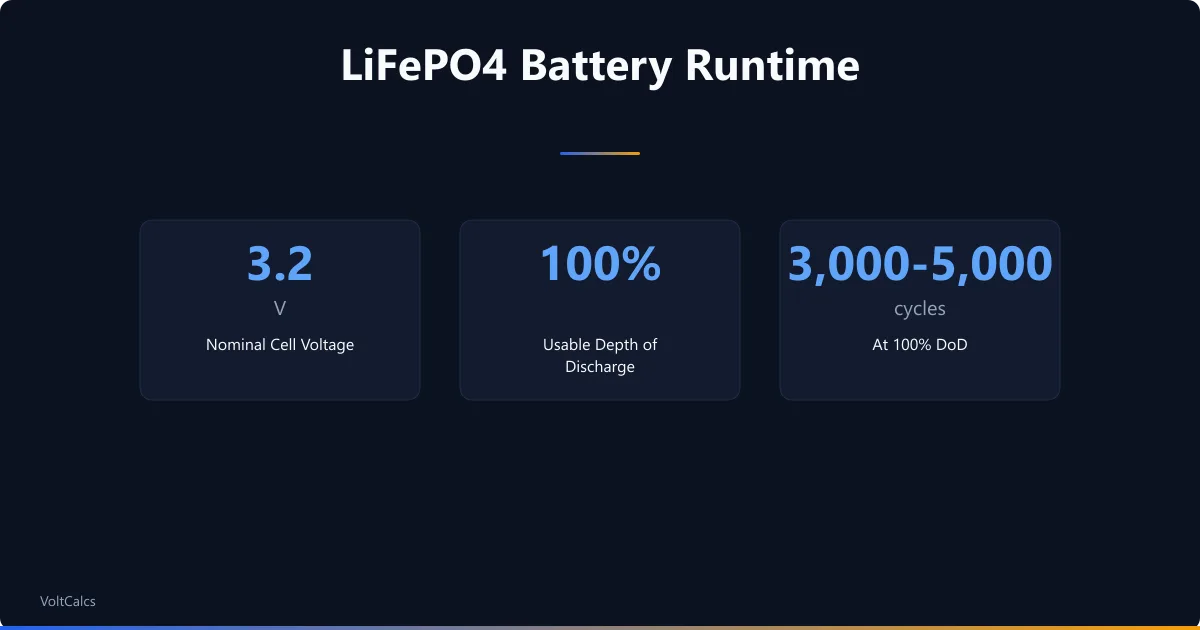
Each depth-of-discharge and cycle-life figure above is the maker's own. Victron prints 2,500 cycles at 80% DoD for its LiFePO4 batteries, rising to 3,000 at 70% and 5,000 at 50%, and 400 cycles at 80% for its AGM line, so those two cycle figures are directly comparable at the same depth. Battle Born rates its 100Ah LiFePO4 battery for 100% usable depth of discharge at 3,000-5,000 deep discharge cycles, the only 100% figure any maker we opened publishes. Battery University's summary table puts NMC at 1,000-2,000 cycles. An n/a marks a cell this page does not publish a figure for.
The usable capacity gap is the key difference. A 100Ah LiFePO4 battery at 80% DoD delivers 80Ah of usable power. A 100Ah AGM at its safe 50% DoD delivers just 50Ah — 37.5% less usable energy from the same amp-hour rating.
The LiFePO4 Voltage Curve Advantage
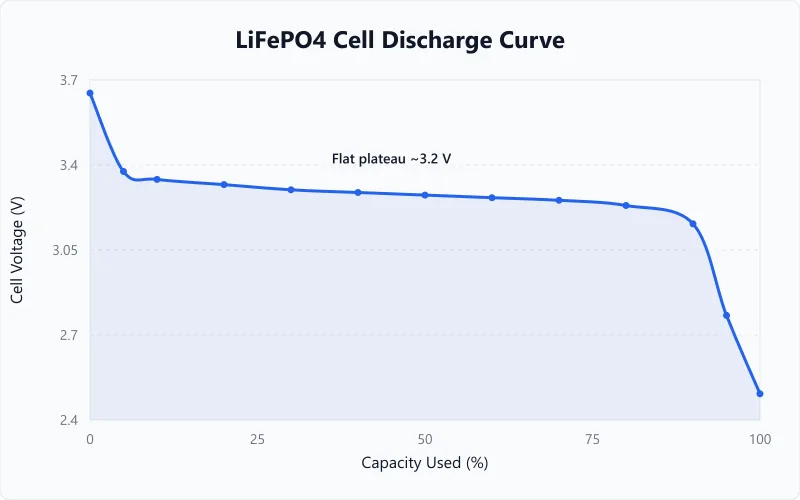
LiFePO4 cells hold a remarkably flat voltage throughout discharge. A single cell stays between 3.2V and 3.3V from 10% to 90% state of charge. This flat curve means your 12V system delivers nearly constant power whether the battery is nearly full or nearly empty.
Compare that to lead-acid, where U.S. Battery's own chart puts a 12V battery at 12.73V full and 12.10V at 50% discharge. That voltage sag reduces the effective wattage available to your devices and makes some sensitive electronics behave erratically.
The practical impact: a LiFePO4-powered inverter maintains consistent AC output right up until the BMS cuts off, while a lead-acid system gradually loses capacity as voltage drops. For devices with minimum voltage requirements — like 12V compressor fridges — LiFePO4 delivers noticeably longer effective runtimes than the raw numbers suggest.
Worked Examples
Upgrading from Lead-Acid to LiFePO4 in an RV
Context
You currently run two 100Ah lead-acid batteries (200Ah) at 50% DoD, giving you 1,056 Wh delivered. You want to switch to a single 200Ah LiFePO4 at 80% DoD. Your load is 150W.
Calculation
LiFePO4 delivered: 200 x 12.8 x 0.80 x 0.90 = 1,843 Wh → runtime = 12.3 hrs
Lead-acid is not a straight division: at 150W through a 90% inverter the bank supplies 13.9A, and at that rate our flooded correction — fitted to Trojan T-105 printed discharge points — returns 6.5 hrs at 50% DoD. The comparison rows under your result do this for you.
Interpretation
The LiFePO4 gives 90% more runtime from the same amp-hour capacity. That is 5.8 extra hours from one battery in place of two, and a good deal lighter.
Takeaway
LiFePO4 wins on usable capacity, weight, and cycle life. To see how fast solar can recharge it, use our solar battery charge time calculator.
Sizing a 48V LiFePO4 Bank for Off-Grid Solar
Context
Your cabin draws 1,500W average for 6 hours per evening (9 kWh). You want one night of autonomy from a 48V LiFePO4 bank at 80% DoD and 92% inverter efficiency.
Calculation
Energy needed: 9,000 Wh / 0.92 eff = 9,783 Wh from battery
A 48V LiFePO4 string is 51.2V nominal, so at 80% DoD: 9,783 / (51.2 x 0.80) = 238.8 Ah minimum
Standard option: 3 x 100Ah modules in parallel (300Ah).
Interpretation
300Ah at 51.2V nominal gives 12,288 Wh usable against the 9,783 Wh the bank has to hold, about 26% headroom. That margin covers colder nights, when Victron prints capacity dropping about 20% at 0C.
Takeaway
After sizing the bank, size the solar array to replenish it daily. Our solar panel and battery sizing calculator handles both sides in one step.
Frequently Asked Questions
Glossary
Lithium Iron Phosphate
A lithium battery chemistry (LiFePO4) known for exceptional safety, long cycle life — Battle Born prints 3,000-5,000 deep discharge cycles at 100% depth of discharge, and flat discharge voltage. It is heavier per kWh than other lithium chemistries but does not suffer thermal runaway.
Battery Management System
An electronic circuit built into LiFePO4 batteries that monitors voltage, current, and temperature of each cell. It prevents overcharging, over-discharging, and short circuits. Without a BMS, individual cells can become dangerously unbalanced.
Flat Discharge Curve
LiFePO4 batteries maintain a nearly constant voltage (near 13.2V for a 12.8V nominal battery) through most of the discharge cycle. This means your devices receive stable power from full charge down to 80% DoD, unlike lead-acid which sags progressively.
Sizing a solar system for your LiFePO4 battery bank? Our solar battery bank size calculator helps you match panels to storage.
Related calculators
Lead-Acid Battery Runtime Calculator
Work out flooded, AGM or gel runtime using a rate correction fitted to maker discharge tables, and see how lithium compares on the same load.
Battery
AGM Battery Runtime Calculator
Estimate AGM battery discharge time with chemistry-specific defaults. Compare AGM vs flooded lead-acid for your use case.
Battery
Deep Cycle Battery Runtime Calculator
Estimate deep cycle battery runtime for marine, RV, and off-grid use. Accounts for depth of discharge and system efficiency.
Battery
Battery Charge Time Calculator
Calculate how long a battery takes to charge from capacity, charger amps, and chemistry. Returns the bulk stage and the absorption stage separately.
Battery
Runtimes here are the energy identity at the 12.8V-per-block nominal Victron prints, and LiFePO4 takes no rate correction up to the 1C discharge its datasheets are rated at; the lead-acid and AGM comparison rows use a correction fitted to the discharge tables Trojan, Lifeline and Victron print for their own batteries, which reproduces their printed points within about 10% for flooded and about 6% for AGM. LiFePO4 dominates the off-grid and mobile power space for good reason. Higher usable capacity, longer cycle life, and flat voltage output make it the best chemistry for most applications — provided you can handle the upfront cost. Run your numbers above, then check whether the cost-per-cycle math works for your use case. For a side-by-side chemistry breakdown, read our LiFePO4 vs lead-acid runtime comparison. If AGM is on your shortlist, the AGM runtime calculator uses AGM-specific defaults. And for applications needing heavy cycling on a budget, check the deep cycle runtime calculator which covers flooded and gel types too.
More Battery calculators
Browse all battery calculators — LiFePO4, lead-acid, AGM, and lithium-ion runtime, charge time, and capacity sizing.
Last updated:
Written and maintained by Dan Dadovic, Commercial Director at Ezoic Inc. & PhD Candidate in Information Sciences. He works professionally as Commercial Director at Ezoic Inc., leading revenue strategy across digital publishing.
Disclaimer: Calculator results are estimates based on theoretical formulas. Actual performance varies with temperature, battery age, load patterns, and equipment condition. For critical electrical work, consult a licensed electrician.
Methodology reviewed by Doc. dr. sc. Damir Topić, Assistant Professor, FERIT Osijek.