RV Battery Sizing Guide
Last updated:
9 min read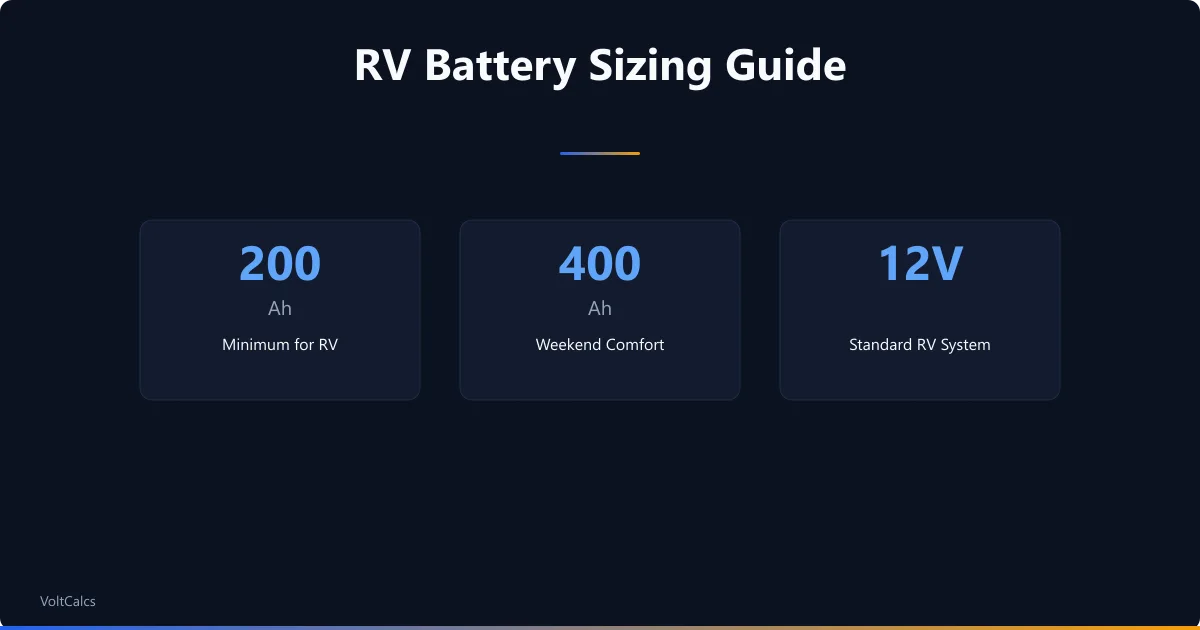
How many batteries does an RV actually need? The answer depends on what you run, how long you boondock, and whether you have solar. A weekend warrior with LED lights and a phone charger needs a very different battery bank than a full-time RVer running a residential fridge, an air conditioner, and a coffee maker.
This guide walks through the complete sizing process — from auditing your loads to choosing a chemistry to wiring your bank. No hand-waving, no vague "it depends" answers. Just the math and the trade-offs.
How an RV Power System Is Wired
RVs have two separate electrical systems that confuse many owners. The chassis battery starts the engine and powers driving systems (headlights, turn signals, engine ECU). The house battery (also called the coach battery) powers everything in the living space: lights, water pump, fridge, outlets, slides, and entertainment.
This guide is about the house battery system. You never want to drain your chassis battery running a fridge — you need that battery to start the engine and get home. A battery isolator or DC-DC charger separates the two systems, allowing the alternator to charge the house battery while driving without risking a dead engine battery at camp.
Most factory RVs ship with a single Group 24 or Group 27 lead-acid battery (70-100Ah). This provides roughly 350-500Wh of usable energy at 50% DoD — enough for one night of light use (LED lights, water pump, phone charging) but nowhere near enough for extended boondocking with a fridge, entertainment, and other comforts. Upgrading the house battery bank is one of the most impactful modifications an RV owner can make.
Common RV Appliance Power Draws
| Appliance | Watts | Typical Hours/Day | Daily Wh |
|---|---|---|---|
| LED interior lights (all) | 20-40 | 5 | 100-200 |
| 12V compressor fridge | 40-50 avg | 24 | 960-1,200 |
| Residential fridge (AC, via inverter) | 50-80 avg | 24 | 1,200-1,920 |
| Water pump | 50-70 | 0.3 | 15-21 |
| Furnace blower fan | 30-80 | 4 (cold weather) | 120-320 |
| Vent fan (MaxxAir, Fantastic) | 15-40 | 8 | 120-320 |
| Phone/tablet charging | 10-15 | 3 | 30-45 |
| Laptop | 45-65 | 3 | 135-195 |
| TV (12V or AC via inverter) | 30-80 | 3 | 90-240 |
| Coffee maker (AC via inverter) | 800-1,200 | 0.1 (6 min) | 80-120 |
| Microwave (AC via inverter) | 1,000-1,500 | 0.1 (6 min) | 100-150 |
| RV air conditioner | 1,200-1,800 | 6 | 7,200-10,800 |
A few things stand out. The fridge dominates daily consumption because it runs 24 hours. The air conditioner dwarfs everything else — running an RV AC on battery requires a massive bank that most boondockers cannot justify. Short-burst appliances (coffee maker, microwave) use surprisingly little energy daily because they run for only minutes.
For AC appliances running through an inverter, add 10-15% to the listed wattage to account for inverter efficiency losses. A coffee maker rated at 1,000W actually draws about 1,100-1,150W from the battery through the inverter.
How to Size Your RV Battery Bank
Use this five-step process to calculate the battery capacity your RV actually needs.
- List your daily loads. Use the table above as a starting point. Be honest about what you actually use — not what you hope to use. If you have never boondocked before, start conservative and upgrade later. Track actual usage on your first few trips with a battery monitor. Our electrical load calculator helps you inventory every appliance, and the off-grid load calculator turns that list into battery and panel recommendations.
- Calculate daily watt-hours. Multiply each appliance's wattage by its hours of daily use. Add 10-15% for AC loads going through an inverter. Sum the totals. A typical weekend boondocker (fridge, lights, water pump, phone charging, vent fan) totals 1,200-1,800 Wh per day. A full-timer adds laptop, TV, coffee maker, and more — hitting 2,000-3,000 Wh per day (not counting AC).
- Decide your autonomy. How many days without recharging (no solar, no generator, no shore power)? Weekend trips: 2 days. Extended boondocking with solar: 1-2 days (solar recharges daily). No solar: 3-4 days if you bring a generator for recovery charging.
- Apply the sizing formula. Bank capacity (Ah) = (Daily Wh × Days) / (Voltage × DoD). For 1,500 Wh/day, 2 days, 12V, LiFePO4 at 80% DoD: (1,500 × 2) / (12 × 0.80) = 312 Ah. Round up to 400Ah (two 200Ah batteries or four 100Ah batteries).
- Check physical fit. Measure your RV's battery compartment before buying. LiFePO4 batteries are smaller than lead-acid for the same capacity, but compartment dimensions still limit what fits. Group 31 is the most common RV battery form factor. Many 100Ah LiFePO4 batteries are designed in Group 24 or Group 31 cases for drop-in replacement.
Skip the manual math and use the RV battery runtime calculator for instant results based on your specific loads.
Battery Chemistry Comparison for RVs
Four battery types are commonly used in RVs. Each has trade-offs in cost, weight, lifespan, and maintenance.
Flooded lead-acid (FLA)
Cheapest upfront. Requires regular maintenance — checking water levels monthly and equalizing quarterly. Produces hydrogen gas during charging, requiring ventilation. Heavy: 60-70 lbs per 100Ah. At 50% DoD, delivers 300-800 cycles. Best for: budget builds with easy compartment access for maintenance. Not suitable for sealed or interior-mounted battery boxes.
AGM (Absorbed Glass Mat)
Sealed, maintenance-free. No water to add, no hydrogen venting. Can be mounted in any orientation. Same 50% DoD and weight as flooded lead-acid, but shorter cycle life (300-500 cycles) and higher cost ($150-250 per 100Ah). Best for: upgraders who want drop-in simplicity without the maintenance of flooded batteries or the cost of lithium.
LiFePO4 (Lithium Iron Phosphate)
80-100% usable DoD, 2,000-5,000 cycle life, half the weight of lead-acid. No maintenance, no venting, consistent voltage under load. Costs $250-450 per 100Ah as of early 2026 — 2-3x the price of lead-acid but 5-10x the lifespan. Requires a compatible charger/converter and charge controller. Best for: anyone who boondocks regularly, values weight savings, or plans to keep the RV for 5+ years. Read the full comparison in our LiFePO4 vs lead-acid guide.
6V golf cart batteries (flooded lead-acid)
A traditional RV upgrader's choice: wire two 6V batteries in series for 12V. Trojan T-105 (225Ah at 6V) is the classic. Thicker plates than standard 12V batteries give them 800-1,200 cycles at 50% DoD. Heavy (62 lbs each) and need regular watering, but deliver excellent value per cycle. Best for: budget-conscious boondockers willing to do maintenance and who have the space for larger batteries.
Weekend Boondocking vs Full-Time: Two Sizing Examples
Weekend boondocker: Sarah's truck camper
Sarah takes her truck camper out 30 weekends per year. She arrives Friday evening and leaves Sunday afternoon — about 44 hours off-grid. Her loads:
- 12V compressor fridge: 45W avg × 24h = 1,080 Wh/day
- LED lights: 25W × 4h = 100 Wh/day
- Vent fan: 20W × 6h = 120 Wh/day
- Phone charging: 10W × 2h = 20 Wh/day
- Water pump: 60W × 0.25h = 15 Wh/day
Total: 1,335 Wh/day. For 2 days of autonomy with LiFePO4 at 80% DoD:
(1,335 × 2) / (12 × 0.80) = 278 Ah
Sarah installs a single 300Ah 12V LiFePO4 battery — fits in her truck camper's battery box and weighs about 69 lbs (vs 195+ lbs for three 100Ah lead-acid batteries). With a 200W roof-mounted solar panel, the battery recharges by mid-afternoon Saturday, extending her autonomy well beyond 2 days even under cloud cover.
Total cost: approximately $700-900 for the battery, $200-300 for the solar panel and MPPT controller. The LiFePO4 battery will outlast the truck camper itself at 30 cycles per year. If you want to verify these numbers with your own loads, our battery runtime calculation guide walks through every variable in the formula.
Full-time RVer: Jake's fifth wheel
Jake lives in his fifth wheel full-time, boondocking 3-4 nights per week and spending the rest on shore power. His loads are substantially higher:
- Residential fridge (AC via inverter): 70W avg × 24h × 1.12 (inverter loss) = 1,882 Wh/day
- LED lights: 40W × 6h = 240 Wh/day
- Vent fans (2): 50W × 8h = 400 Wh/day
- Laptop: 60W × 4h × 1.12 = 269 Wh/day
- TV: 50W × 3h × 1.12 = 168 Wh/day
- Coffee maker: 1,000W × 0.1h × 1.12 = 112 Wh/day
- Phone/tablet: 15W × 3h = 45 Wh/day
- Water pump: 60W × 0.5h = 30 Wh/day
Total: 3,146 Wh/day. For 2 days of autonomy (covering his longest boondocking stretches):
(3,146 × 2) / (12 × 0.80) = 655 Ah
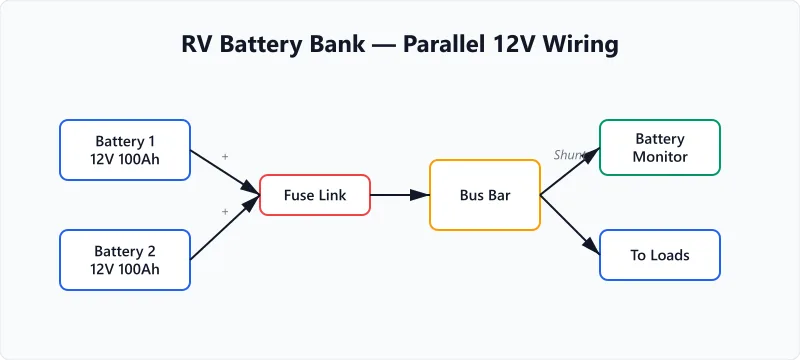
Jake installs four 200Ah 12V LiFePO4 batteries in parallel (800Ah total), a 3,000W pure sine wave inverter, and 600W of rooftop solar with an MPPT controller. Total weight: roughly 260 lbs for the batteries. Total battery cost: approximately $3,200-3,600 as of early 2026.
With 600W of solar in a sunny location, Jake recovers 2,400-3,000 Wh per day — nearly matching his daily consumption. On cloudy days, he runs a portable generator for 2-3 hours to top off. He chose not to run AC on battery — at 7,200-10,800 Wh per day, that would require a 2,000+ Ah bank and massive solar array. Instead, he uses shore power or a propane generator for AC when needed.
Size your own system with the camper battery calculator or calculate total energy needs with the solar panel and battery sizing calculator.
Charging Your RV Battery Bank
A battery bank is only as useful as your ability to recharge it. RVs have three common charging sources:
Shore power. The RV's built-in converter/charger tops off the battery bank whenever you plug in. Make sure your converter supports your battery chemistry — most factory converters are set for lead-acid charging profiles and will undercharge LiFePO4 without a firmware update or replacement. A quality 3-stage converter from Progressive Dynamics or WFCO with a LiFePO4 profile works well.
Solar panels. Roof-mounted solar with an MPPT charge controller provides silent, maintenance-free daily recharging. Plan for 200-400W of solar for a weekend setup, 400-800W for full-time boondocking. Solar output varies dramatically by season and location — see our solar panel output guide for realistic expectations.
Alternator charging (DC-DC). A DC-DC charger (like a Victron Orion or Redarc BCDC) takes power from the engine alternator while driving and delivers it to the house battery at the correct voltage and current. A 30-40A DC-DC charger adds 30-40Ah per hour of driving — enough to meaningfully recharge during travel days. This is especially valuable for truck camper and van life setups that drive frequently between camps.
A well-designed RV power system uses all three sources: solar for daily passive charging, the alternator for recharging during travel, and shore power for full recovery when available. The battery bank acts as the buffer that absorbs and releases energy as needed.
Frequently Asked Questions
Written and maintained by Dan Dadovic, Commercial Director at Ezoic Inc. & PhD Candidate in Information Sciences. He works professionally as Commercial Director at Ezoic Inc., leading revenue strategy across digital publishing.
Disclaimer: Calculator results are estimates based on theoretical formulas. Actual performance varies with temperature, battery age, load patterns, and equipment condition. For critical electrical work, consult a licensed electrician.
Methodology reviewed by Doc. dr. sc. Damir Topić, Assistant Professor, FERIT Osijek.