NEMA Code Letter Starting Current Multipliers
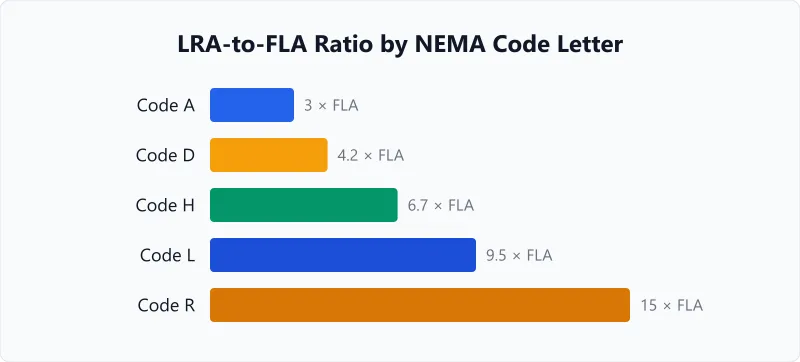
| NEMA Code Letter | kVA/HP Range | Indicative LRA multiple (varies with hp and voltage) | Typical Motor Type |
|---|---|---|---|
| A | 0-3.15 | 2-3x | High-efficiency, low starting torque |
| B | 3.15-3.55 | 3-4x | Energy-efficient designs |
| C-D | 3.55-4.50 | 4-5x | Standard efficiency motors |
| E-G | 4.50-6.30 | 5-7x | Most common general-purpose motors |
| H-K | 6.30-9.00 | 7-9x | High starting torque (compressors, crushers) |
| L-N | 9.00-12.5 | 9-12x | Very high starting torque |
| P-V | 12.5+ | 12-14x | Extreme starting requirements (rare) |
The multiple depends on the motor's hp and voltage as well as its code letter; for a specific motor use LRA = kVA/hp × hp × 1,000 ÷ (√3 × V) from Table 430.7(B) (single-phase: drop the √3). This is our own estimate; no published source backs these figures. Check your results against your product data or a licensed professional before acting. Compressors and high-torque applications often land in the H-K range. Check the motor nameplate for the NEMA code letter. If the code letter is missing, 6x is a working assumption for standard induction motors. Cited to NEC Table 430.7(B). The code text itself is not freely available to link; confirm the figure against the current edition or your authority having jurisdiction before acting.
What Happens When a Motor Starts
When you apply power to a stopped motor, the rotor is not turning. The motor's windings see full voltage across zero back-EMF (the voltage a spinning rotor generates to oppose the supply). With no back-EMF, the windings behave almost like a short circuit, and current surges to 5-8 times the normal running amps (NEMA MG 1). Cited to NEMA MG 1. The standard text is not freely available to link; confirm against the current edition before acting. Our explainer on why motors spike at startup walks through the physics and the code-letter method in depth.
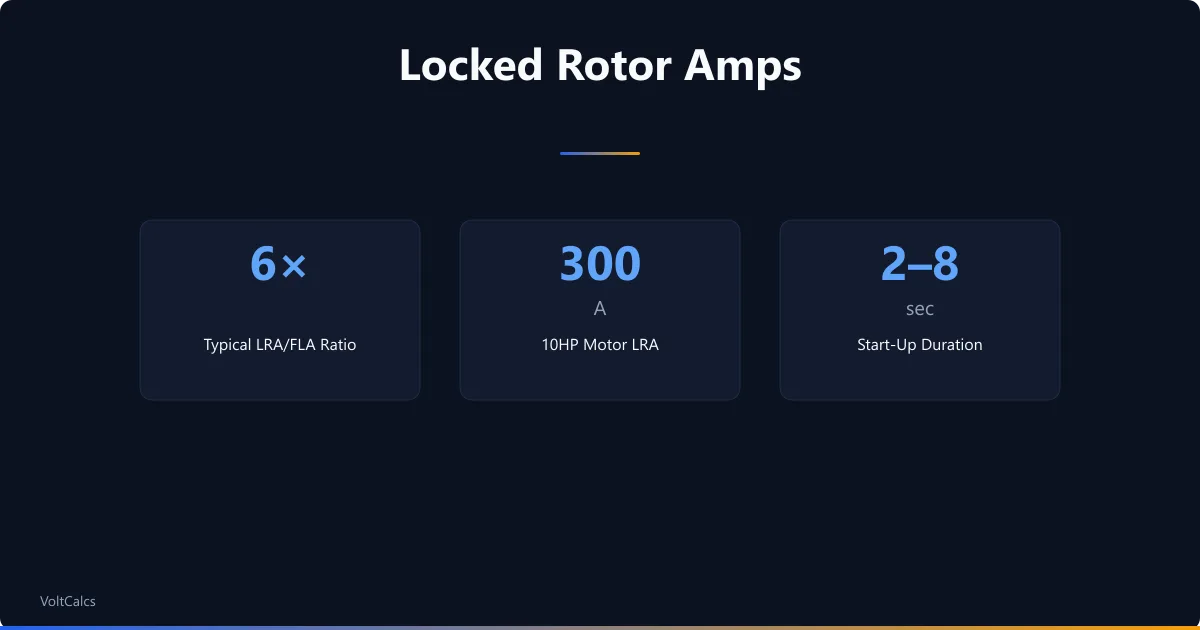
This inrush lasts 0.5-3 seconds for most motors. As the rotor accelerates, back-EMF builds and current drops toward normal FLA. A 28A motor briefly draws 168A at startup. That 168A is what your breaker, wiring, and power source must survive without tripping or sagging.
The locked rotor condition is the worst case: the rotor is physically prevented from turning (locked), so inrush current never subsides. A motor that jams (seized bearing, stuck compressor, frozen pump) draws locked rotor amps continuously until the overload relay opens or the breaker trips. This is why motor circuits use dual protection: a breaker sized for starting inrush (250-300% of FLA) and an overload relay sized for running current (115-125% of FLA).
Temperature affects starting current too. A cold motor has lower winding resistance and draws slightly more inrush than a warm one. If you are sizing protection for a motor in an unheated shop that starts from cold every morning, use the higher end of the multiplier range for that code letter.
Example: Sizing a Starter for a 5HP Compressor
A 5HP three-phase air compressor at 230V has a nameplate FLA of 15.2A and a NEMA code letter of H (typical compressor territory). Using a 7x multiplier, the LRA is about 106A.
To handle this startup surge, you need:
- Breaker: 250% of 15.2A = 38A. Next standard size is 40A inverse-time breaker. NEC Article 430 allows up to 250% for inverse-time breakers because the brief 106A inrush does not trip a thermal breaker fast enough to cause a nuisance trip.
- Contactor: Rated for at least the FLA (15.2A) with an inrush rating matching the LRA. A NEMA Size 1 starter is rated 27A continuous with a published closing-inrush rating of 288A peak — that covers this motor with room to spare.
- Overload relay: Set to 115% of FLA = 17.5A. This trips on sustained overcurrent but rides through the brief starting surge.
- Wiring: Must carry 125% of FLA = 19A minimum. 12 AWG copper handles that, but check voltage drop if the run exceeds 50 feet.
If you do not know your motor's FLA, use our motor FLA calculator to estimate it from horsepower, voltage, efficiency, and power factor.
Running this compressor off a battery-powered inverter? The inverter must handle the 106A surge. Most pure sine inverters list a surge rating of 2x continuous — a 3,000W inverter at 230V can only surge to about 26A. You would need a much larger inverter or a soft starter to reduce the inrush. Our battery size for inverter calculator can help you figure out how much battery capacity the system needs.
Worked Examples
Will a 7,000W Generator Start a Well Pump?
Context
A 1.5HP well pump motor has a nameplate FLA of 10A at 230V. The starting multiplier is 7x (code letter J). Your portable generator is rated 7,000W running / 8,750W surge.
Calculation
LRA = 10 A x 7 = 70 A
Starting power: 70 A x 230 V = 16,100 W (surge)
Generator surge capacity: 8,750 W
Interpretation
The motor's 16,100W starting surge exceeds the generator's 8,750W surge capacity by nearly double. The generator will bog down or trip its breaker when the pump tries to start.
Takeaway
You either need a larger generator or a soft-start device on the pump. To size a battery backup instead, use our UPS battery backup calculator — make sure the inverter's surge rating exceeds the LRA wattage.
Selecting a Motor Starter for a Compressor
Context
A 10HP three-phase compressor motor has a FLA of 28A. The nameplate code letter is G — mid-range starting current, roughly 6x FLA. You need to size the magnetic contactor and overload relay.
Calculation
LRA (at 6.0x): 28 x 6.0 = 168 A
Contactor: must handle 168A inrush. NEMA Size 2 is rated 45A continuous with a 483A peak closing-inrush rating — adequate.
Overload relay: set trip at 125% of FLA = 35 A.
Interpretation
The contactor must handle the starting surge without welding its contacts. A NEMA Size 1 starter is ruled out before inrush even enters the picture: its 27A continuous rating sits below this motor's 28A FLA. Size 2 carries 45A continuously and its 483A peak closing rating clears the 168A surge with room to spare.
Takeaway
The FLA used here comes from the motor nameplate. If you only know the HP rating, convert it to watts first with our HP to watts calculator before sizing the starter.
Frequently Asked Questions
Glossary
Locked Rotor Amps
The current a motor draws at the instant of startup when the rotor is stationary (locked). This inrush current is typically 5-8 times the running current (NEMA MG 1) and lasts 0.5-3 seconds depending on the load inertia.
NEMA Code Letter
A letter on the motor nameplate (A through V) indicating the locked rotor kVA per HP. Higher code letters mean higher starting current. Code A is the gentlest start; code V is the most aggressive.
Soft Starter
An electronic device that gradually ramps up voltage to the motor during startup, reducing the inrush current from 6-8x FLA down to 2-4x FLA. Reduces mechanical stress, voltage dip, and breaker trips.
Planning to run motors from an off-grid battery system? Our battery runtime calculator shows if your bank has the energy capacity for the load.
Related calculators
Motor FLA Calculator
Calculate motor full load amps for single-phase and three-phase motors. Enter HP, voltage, efficiency, and power factor for instant FLA results.
Electrical
HP to Watts Calculator
Convert horsepower to watts and watts to HP instantly. Supports mechanical, electrical, and metric horsepower with precise conversion factors.
Electrical
Cold Cranking Amps (CCA) Calculator
Size a starting battery from engine displacement and fuel type, using the original-equipment minimum CCA figures for cars and light trucks.
Battery
Fusing Transformer Calculator
Calculate primary and secondary fuse sizes for power transformers. Enter kVA, primary and secondary voltages, and NEC multipliers.
Electrical
Locked rotor amps is the number your breaker, generator, and inverter must survive during every startup. Underestimate it and you get nuisance trips. Ignore it and you risk undersized wiring that overheats under inrush. For motors driving critical equipment, always verify the LRA from the nameplate and size protection accordingly. These results are theoretical estimates — actual inrush varies with motor design, supply impedance, and load conditions. For critical installations, consult a licensed electrician.
More Electrical calculators
Browse all electrical calculators — Motor FLA, wire sizing, voltage drop, load calculations, and transformer fusing based on NEC standards.
Last updated:
Written and maintained by Dan Dadovic, Commercial Director at Ezoic Inc. & PhD Candidate in Information Sciences. He works professionally as Commercial Director at Ezoic Inc., leading revenue strategy across digital publishing.
Disclaimer: Calculator results are estimates based on theoretical formulas. Actual performance varies with temperature, battery age, load patterns, and equipment condition. For critical electrical work, consult a licensed electrician.
Methodology reviewed by Doc. dr. sc. Danijel Jerković-Štil, Assistant Professor, FERIT Osijek.