Single-Phase vs Three-Phase FLA Formulas
The core relationship is Power = Voltage x Current x Efficiency x Power Factor. Rearranging for current gives you FLA.
Single-phase: FLA = (HP x 746) / (V x Efficiency x Power Factor)
Three-phase: FLA = (HP x 746) / (V x 1.732 x Efficiency x Power Factor)
The 746 converts horsepower to watts. The 1.732 (square root of 3) accounts for the three-phase power advantage — three-phase motors draw less current per line than single-phase motors of the same power because the current is shared across three conductors.
A 5HP single-phase motor at 230V with 85% efficiency and 0.85 power factor draws about 22.5A. The same motor in three-phase draws about 13A per line — roughly 42% less current per wire, which means smaller wire gauges and cheaper installation.
Power factor matters more than most people expect. A motor with 0.75 power factor draws 13% more current than one at 0.85, even at identical horsepower and efficiency. That extra current generates heat in wiring without doing useful work. If you are sizing cables for a motor with a poor power factor, you need to account for that higher current or risk overheating. Our motor FLA guide covers how FLA affects breaker selection, wire sizing, and overload protection in detail.
Calculator Results vs NEC Table Values
This calculator gives you the theoretical FLA based on the motor's electrical characteristics. If the motor will run from a battery-powered inverter, the FLA determines the minimum inverter size. See our battery runtime calculator to estimate how long the bank lasts under that draw. For wire sizing, breaker selection, and code compliance in the US, always cross-reference NEC Table 430.248 (single-phase) or 430.250 (three-phase). Those tables list standardised FLA values that may differ from your motor's actual nameplate amps.
NEC tables assume typical efficiency and power factor for each motor size and voltage. Your specific motor might draw more or less depending on its design, age, and loading. A 10HP three-phase motor at 230V has a NEC table FLA of 28A, but an older motor with poor efficiency could draw 32A or more.
Use the calculator result for quick estimation and load planning. Use NEC tables for final design decisions on a permitted project. The NEC tables exist specifically because nameplate data is not always available or accurate, especially on older equipment where labels have faded or been painted over.
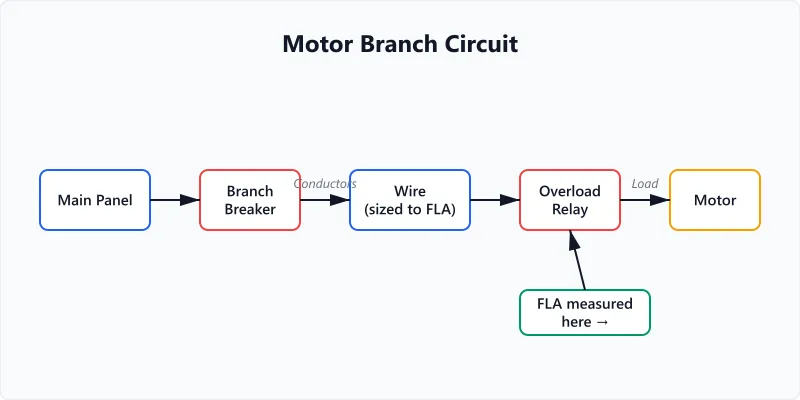
Wire sizing follows NEC 430.22: conductors must handle at least 125% of the motor's Table 430.248 / 430.250 FLC. NEC 430.6(A)(1) does not permit a nameplate or calculated FLA in that step, so 125% of this calculator's result is not the code minimum. If the table FLC for your motor is 22.5A, you need conductors rated for at least 28.1A — 10 AWG copper territory for most insulation types. If you are pulling a long run to a shop motor, voltage drop becomes the limiting factor; use our wire distance calculator to check the drop before selecting your final gauge.
For critical or permitted installations, verify your numbers against NEC tables and consult a licensed electrician. This calculator is an estimation tool, not a substitute for professional design.
Worked Examples
Sizing Wire for a Workshop Table Saw
Context
You are installing a 3HP single-phase table saw in a detached workshop. The motor runs on 230V, has a nameplate efficiency of 86%, and a power factor of 0.84. The panel is 80 feet from the saw.
Calculation
FLA = (3 HP x 746) / (230 V x 0.86 x 0.84)
= 2,238 / 166.15
= 13.5 A
This estimate is 13.5 A. The NEC minimum is 125% of the Table 430.248 FLC for 3 HP at 230 V (17.0 A), i.e. 21.3 A — not 125% of the estimate.
Interpretation
At 13.5A, a 20A breaker and 12 AWG wire handle the load with headroom. But the 80-foot run means voltage drop could exceed 3% on a 230V circuit.
Takeaway
Before pulling wire, check the voltage drop over that 80-foot distance with our voltage drop calculator. You may need to bump up to 10 AWG to keep the drop under 3%.
Comparing Three-Phase Motor Options for a Pump Station
Context
A facility needs a 15HP pump motor. You are comparing 208V and 480V three-phase options to decide which requires less expensive wiring. Both have 91% efficiency and 0.87 power factor.
Calculation
At 208V: FLA = (15 x 746) / (208 x 1.732 x 0.91 x 0.87) = 11,190 / 285.2 = 39.2 A
At 480V: FLA = (15 x 746) / (480 x 1.732 x 0.91 x 0.87) = 11,190 / 658.3 = 17.0 A
Interpretation
The 480V motor draws less than half the current of the 208V option. That means smaller wire gauge, smaller conduit, and a smaller breaker — all of which reduce material and labor costs.
Takeaway
Higher voltage pays for itself in wiring savings on any motor above 5HP. To estimate the energy cost difference, run both through our electricity cost calculator — the efficiency is the same, so the cost per hour is identical, but the installation is far cheaper at 480V.
Frequently Asked Questions
Glossary
Full Load Amps
The current a motor draws when operating at its rated horsepower and voltage under full mechanical load. FLA determines wire size, breaker rating, and overload protection settings for the motor circuit.
Power Factor
The ratio of real power (watts) to apparent power (volt-amps) in an AC circuit. Motors with low power factor draw more current than necessary to do the same work, increasing wire heating and energy waste.
Nameplate Data
The specifications stamped on a motor's identification plate by the manufacturer. Includes rated HP, voltage, FLA, efficiency, power factor, RPM, and frame size. Nameplate FLA governs overload-device sizing, but NEC 430.6(A)(1) requires the Table 430.248 / 430.250 FLC — not the nameplate — for branch-circuit conductor and short-circuit/ground-fault device sizing.
Locked Rotor Current
The surge of current a motor draws at the instant of startup, before the rotor begins spinning. Typically 5-8 times the FLA (NEMA MG 1). Cited to NEMA MG 1. The standard text is not freely available to link; confirm against the current edition before acting. Determines breaker and starter sizing to prevent nuisance tripping.
Running a motor from a battery-powered inverter? Use our battery size for inverter calculator to find out how much battery capacity the motor needs.
Related calculators
Locked Rotor Amps (LRA) Calculator
Calculate motor locked rotor amps (LRA) for starting current estimation. Enter FLA and multiplier based on NEMA code letter.
Electrical
HP to Watts Calculator
Convert horsepower to watts and watts to HP instantly. Supports mechanical, electrical, and metric horsepower with precise conversion factors.
Electrical
Amps Draw Calculator
Calculate current draw in amps from watts and volts for any device. Supports single-phase and three-phase loads with power factor adjustment.
Electrical
Electrical Load Calculator
Calculate your home's electrical load and NEC 220 demand for panel and service sizing. Enter loads and quantities for connected and demand estimates.
Electrical
Motor FLA is a starting point for proper electrical design, not the finish line. Real-world factors (starting method, ambient temperature, altitude, and duty cycle) all affect the final wire and protection sizing. Converting horsepower to watts is the first step. Our HP to watts converter handles all three horsepower definitions. For critical or permitted installations, verify your numbers against NEC tables and consult a licensed electrician. These results are theoretical estimates based on the values you enter, not guarantees of actual motor performance.
More Electrical calculators
Browse all electrical calculators — Motor FLA, wire sizing, voltage drop, load calculations, and transformer fusing based on NEC standards.
Last updated:
Written and maintained by Dan Dadovic, Commercial Director at Ezoic Inc. & PhD Candidate in Information Sciences. He works professionally as Commercial Director at Ezoic Inc., leading revenue strategy across digital publishing.
Disclaimer: Calculator results are estimates based on theoretical formulas. Actual performance varies with temperature, battery age, load patterns, and equipment condition. For critical electrical work, consult a licensed electrician.
Methodology reviewed by Doc. dr. sc. Danijel Jerković-Štil, Assistant Professor, FERIT Osijek.