
What Happens When You Undersize a Generator
An undersized generator does not just struggle — it fails. When the load exceeds the rated capacity, the voltage and frequency drop. Sensitive electronics (computers, medical equipment, modern refrigerators with inverter compressors) can be damaged or destroyed by low-voltage output. The generator itself overheats, and sustained overloading shortens its lifespan dramatically or trips the circuit breaker, cutting power to everything.
An oversized generator wastes fuel and money. A 10kW generator running a 3kW load burns more fuel per useful watt than a properly sized 5kW unit. Diesel and propane generators running below 30% load also suffer from “wet stacking” — unburned fuel accumulates in the exhaust system, causing carbon buildup and premature wear. The sweet spot is running at 50-75% of rated capacity: efficient, reliable, and with enough headroom for surges.
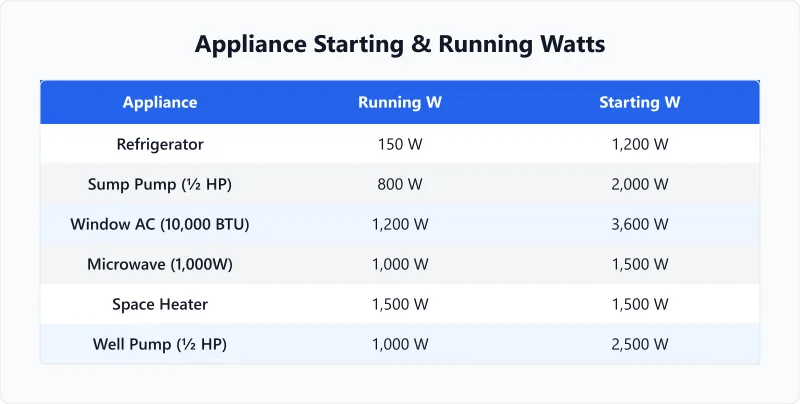
The biggest sizing mistake people make is forgetting about motor starting surges. A 1,500W well pump might draw 3,500-4,500W for the first 2-3 seconds when the compressor kicks in. If your generator cannot deliver that momentary spike, the pump will not start — even if the generator handles the running load fine. That is why this calculator separates running watts from starting surge watts.
Generator Sizes for Common Scenarios
| Scenario | Typical Running Load | Largest Surge | Recommended Size |
|---|---|---|---|
| Camping / Tailgating | 1,000-2,000W | ~1,000W (small cooler) | 2-3 kW |
| RV / Travel Trailer | 2,500-4,000W | ~2,200W (AC compressor) | 4-5.5 kW |
| Home Backup (Essentials) | 3,000-5,000W | ~2,500W (fridge + sump pump) | 5-7.5 kW |
| Home Backup (Full House) | 8,000-15,000W | ~5,000W (central AC) | 12-20 kW |
| Job Site (Power Tools) | 3,000-7,000W | ~3,000W (table saw or compressor) | 5-10 kW |
| Food Truck / Market Stall | 4,000-8,000W | ~3,000W (commercial fridge) | 7-12 kW |
These are starting points. Your actual loads may differ — use the calculator above with your real numbers rather than relying on generic ranges. If you are not sure what your appliances draw, our amps draw calculator converts between watts and amps for any voltage.
How to Size a Generator in 4 Steps
- List every load that will run simultaneously. Write down each appliance with its running wattage (check the nameplate label or owner's manual). Include everything that will be on at the same time — not just the big items. LED lights, phone chargers, and Wi-Fi routers all add up. Our electrical load calculator can help tally everything systematically.
- Identify the largest motor starting surge. Find the appliance with the highest starting (surge) wattage. AC compressors, well pumps, refrigerator compressors, and power tools with induction motors all draw 2-3× their running wattage for the first few seconds. If you cannot find the surge rating, multiply running watts by 3 for a conservative estimate.
- Account for power factor. Purely resistive loads (heaters, incandescent lights, toasters) have a power factor of 1.0 — the generator delivers all its rated watts as useful power. Mixed loads with motors and electronics run at 0.80-0.90. This matters because a “5,000W” generator with a 0.80 PF load only delivers 4,000W of real work. Use the kVA to amps calculator to dig into the relationship between apparent and real power.
- Add a safety margin. A 20-25% buffer keeps the generator in its efficient range and prevents nuisance tripping under slight load fluctuations. Running at 100% continuously overheats the engine and reduces lifespan. 25% margin is the default in this calculator — reduce it only if you are extremely confident in your load figures.
Worked Examples
Hurricane Season Home Backup in Florida
Context
Calculation
Total running load = 200 + 1,200 + 30 + 100 + 80 + 800 = 2,410W
Largest single motor surge = 2,400W (window AC)
Power factor for mixed loads: 0.85
Running VA = 2,410 / 0.85 = 2,835 VA
Surge VA = 2,835 + 2,400 = 5,235 VA
With 25% margin: 2,835 × 1.25 = 3,544 VA
Recommended = max(3,544, 5,235) / 1,000 = 5.3 kW
Interpretation
The surge requirement (5.2kW) drives the sizing here, not the running load (2.8kW). A 5.5kW portable generator with 6,500W+ peak rating covers this comfortably. A 3.5kW unit would handle the running load but would trip when the AC compressor kicks in.
Takeaway
Motor surges are the deciding factor for most home backup systems. To estimate how many hours that 5.5kW generator will run during a multi-day outage, pair the generator with a UPS battery backup to keep critical loads running during the seconds it takes for the generator to start.
Remote Construction Site with Power Tools
Context
Calculation
Total running load = 1,800 + 1,500 + 500 + 300 + 50 = 4,150W
Largest single motor surge = 4,500W (air compressor)
Power factor for heavy motor loads: 0.80
Running VA = 4,150 / 0.80 = 5,188 VA
Surge VA = 5,188 + 4,500 = 9,688 VA
With 25% margin: 5,188 × 1.25 = 6,484 VA
Recommended = max(6,484, 9,688) / 1,000 = 9.7 kW
Interpretation
The air compressor's 4,500W surge pushes the requirement to nearly 10kW. In practice, the circular saw and compressor may not run simultaneously since one person operates the saw. If you can guarantee they never overlap, take the saw out of the running load (4,150W becomes 2,350W) and let the compressor keep the largest-surge slot at 4,500W, which brings the recommendation down to 7.5kW. But on a busy site with multiple workers, plan for worst-case overlap.
Takeaway
Job sites benefit from slightly oversized generators because load profiles are unpredictable. Before purchasing, tally every tool's running and surge wattage using our load calculation guide to build a complete picture — it is easy to forget items like battery chargers and compressor duty cycles that add up quickly.
Frequently Asked Questions
Glossary
Running Watts (Rated Watts)
The continuous power a generator can deliver indefinitely under normal operating conditions. This is the number you size against for your total simultaneous load. A generator rated at 5,000 running watts can sustain that output all day. Exceeding this number causes overheating and trips the overload breaker.
Starting Watts (Surge Watts)
The brief peak power a generator can deliver for a few seconds to start electric motors. Motor compressors in air conditioners, refrigerators, and pumps draw 2-3× their running wattage for the first 1-3 seconds. Generators typically offer 20-25% more surge watts than their rated continuous output.
Power Factor
The ratio of real power (watts) to apparent power (volt-amperes). Resistive loads like heaters and incandescent bulbs have a power factor of 1.0 — every volt-amp delivered does useful work. Motors, fluorescent lights, and electronics have power factors of 0.7-0.9, meaning the generator must deliver more apparent power than the real watts consumed. A 5,000W generator at 0.80 PF only delivers 4,000W of usable power to inductive loads.
Once you know your generator size, find out how long it will run on a tank of propane with our propane generator runtime calculator.
Related calculators
Electrical Load Calculator
Calculate your home's electrical load and NEC 220 demand for panel and service sizing. Enter loads and quantities for connected and demand estimates.
Electrical
Propane Generator Run Time Calculator
Calculate how long a propane generator runs on a given tank size. Enter tank weight, load, and generator efficiency.
Battery
kVA to Amps Calculator
Convert kVA to amps for single-phase and three-phase systems. Enter kVA, voltage, and power factor for instant current and true power results.
Electrical
Off-Grid Load Calculator
Calculate your total daily energy needs for off-grid living. Get recommended battery bank size and solar panel wattage for your system.
Solar
A generator is only as good as the sizing behind it. Err on the side of slightly larger rather than smaller — the fuel cost difference between a 5kW and 7kW unit running at moderate load is minimal, but the headroom gives you room to add loads later without buying a second generator. If fuel consumption is your primary concern, run your load figure through our propane generator runtime guide to estimate daily fuel costs for the size you are considering.
More Electrical calculators
Browse all electrical calculators — Motor FLA, wire sizing, voltage drop, load calculations, and transformer fusing based on NEC standards.
Last updated:
Written and maintained by Dan Dadovic, Commercial Director at Ezoic Inc. & PhD Candidate in Information Sciences. He works professionally as Commercial Director at Ezoic Inc., leading revenue strategy across digital publishing.
Disclaimer: Calculator results are estimates based on theoretical formulas. Actual performance varies with temperature, battery age, load patterns, and equipment condition. For critical electrical work, consult a licensed electrician.
Methodology reviewed by Doc. dr. sc. Danijel Jerković-Štil, Assistant Professor, FERIT Osijek.