What Is Motor FLA and How Electricians Use It
Last updated:
7 min read
Full Load Amps (FLA) is the current a motor draws when running at its rated horsepower and voltage under normal conditions. It is the single number electricians use to size wire, select breakers, and choose overload protection. Get it wrong and you either trip breakers constantly or — worse — undersize wiring and create a fire hazard.
This guide explains what FLA means in practice, where to find it, and how it connects to the electrical decisions that keep motors running safely.
FLA Defined: What the Number Actually Tells You
A motor draws current proportional to its mechanical load. An unloaded motor spins freely and draws minimal current — typically 30-50% of its FLA rating. As you add mechanical load (a pump pushing water, a compressor compressing refrigerant, a saw cutting wood), the motor draws more current to produce the required torque. At full rated load, the motor draws its FLA.
FLA is a steady-state number. It does not account for the brief surge of current when a motor first starts — that is LRA (Locked Rotor Amps), which can be 5-8x higher than FLA and lasts 0.5-3 seconds depending on the motor and load. Circuit breakers and fuses are designed to tolerate this startup surge without tripping, but they rely on FLA for continuous protection sizing.
The formula for estimating FLA when the nameplate is unreadable or unavailable:
FLA = (HP × 746) / (Voltage × Efficiency × Power Factor)
For a typical single-phase motor: HP × 746 / (230V × 0.85 × 0.90) = HP × 4.27A. A 5 HP single-phase motor at 230V draws roughly 21A at full load. For three-phase motors, divide by (V × eff × PF × √3), which gives substantially lower current per phase. Calculate your specific motor with the motor FLA calculator.
NEC Full Load Current Reference Values
The National Electrical Code (NEC) Tables 430.247-430.250 publish standard FLA values by motor type, horsepower, and voltage. These tables — not the motor nameplate — are what the NEC requires electricians to use for sizing branch circuit conductors and overcurrent protection.
| HP | Single-Phase 115V | Single-Phase 230V | Three-Phase 230V | Three-Phase 460V |
|---|---|---|---|---|
| 1/2 | 9.8A | 4.9A | 2.2A | 1.1A |
| 1 | 16A | 8A | 3.6A | 1.8A |
| 2 | 24A | 12A | 6.8A | 3.4A |
| 3 | 34A | 17A | 9.6A | 4.8A |
| 5 | 56A | 28A | 15.2A | 7.6A |
| 7.5 | 80A | 40A | 22A | 11A |
| 10 | 100A | 50A | 28A | 14A |
Notice the pattern: doubling voltage roughly halves the current for the same horsepower. This is why commercial and industrial facilities use 480V three-phase power — a 10 HP motor at 460V draws only 14A vs 100A at 115V. Lower current means thinner wire, smaller breakers, and less voltage drop over long cable runs. Need the exact watt equivalent? Our HP to watts calculator converts between mechanical, electrical, and metric horsepower.
The NEC table values may differ slightly from the nameplate FLA of your specific motor. That is normal — the table represents the worst-case motor of that horsepower class. A high-efficiency motor might draw less than the table value, while an older or smaller-frame motor might draw slightly more. The NEC requires using the table values for conductor sizing and the nameplate FLA for overload protection sizing.
How to Read a Motor Nameplate
Every motor nameplate contains the information you need, though the abbreviations can be cryptic if you have not seen them before.
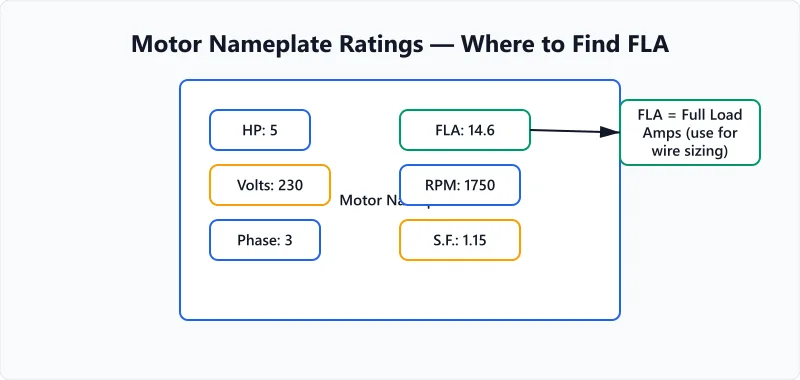
- Find the FLA or "AMPS" rating. Look for "FLA," "Full Load Amps," "Rated Amps," or simply "AMPS." On some motors, you will see two current ratings for different voltages: "115V / 12.0A" and "230V / 6.0A." Use the one matching your supply voltage.
- Note the voltage. The FLA rating is only valid at the listed voltage. Running a 230V motor on 208V (common in commercial buildings) increases current draw by roughly 10%. This matters for protection sizing.
- Check the service factor. A service factor of 1.15 means the motor can continuously deliver 115% of rated HP. At service factor load, current draw exceeds FLA by roughly the same percentage. Some overload relays use this value to set their trip point above FLA.
- Look for the NEMA design letter. Design B (the most common) has moderate starting current. Design C and D have higher starting current. This affects breaker selection but not continuous FLA.
If the nameplate is faded, damaged, or missing, measure the motor's actual current draw with a clamp meter while it runs under full load. Compare this to the NEC table for the motor's horsepower and voltage. If measured current exceeds the NEC table value by more than 10%, the motor may be overloaded, running on low voltage, or experiencing bearing failure.
FLA in Practice: Wire Sizing, Breakers, and Overload Protection
Wire sizing
Branch circuit conductors must carry at least 125% of the motor's FLA per NEC 430.22. A motor with 28A FLA requires conductors rated for at least 35A. This 125% margin accounts for the motor occasionally running at or near service factor load without overheating the wire.
Use NEC Table 310.16 to select the wire gauge. For 35A on copper THHN in conduit, 8 AWG is the safe pick: with 75°C-rated terminations, 10 AWG (35A) meets the number with zero headroom, and with 60°C terminations (NEC 110.14(C)) 8 AWG is the minimum outright. For long runs where voltage drop becomes a concern, size up — our wire distance calculator accounts for cable length and checks whether your chosen gauge stays within NEC limits.
Branch circuit breaker
The branch circuit breaker must be large enough to handle motor starting current without nuisance tripping, but small enough to protect the circuit from short circuits. NEC 430.52 allows breakers up to 250% of FLA for inverse-time breakers with Design B motors. For 28A FLA: 28 × 2.5 = 70A maximum breaker size — conveniently a standard rating itself. When the percentage lands between standard sizes, NEC 430.52(C)(1) Exception No. 1 permits rounding up to the next standard rating instead.
This is larger than the wire's 35A rating — and that is by design. The breaker protects against short circuits, while overload relays (discussed below) protect against sustained overcurrent. The wire is sized for continuous load (FLA × 1.25), and the brief startup surge does not heat the wire enough to cause damage.
Overload protection
Overload relays (often called heaters) protect the motor from sustained overcurrent due to mechanical overload, bearing failure, or low voltage. They are sized based on the motor nameplate FLA — not the NEC table value. The typical trip setting is 115-125% of FLA, matching the motor's service factor.
If a motor repeatedly trips its overload relay, the problem is not the relay — the motor is drawing more current than it should. Common causes: mechanical binding, worn bearings, low supply voltage, or simply trying to drive a load beyond the motor's rating. When the motor's power factor is poor, the apparent power (kVA) exceeds the real power (kW), which also affects how generators and transformers handle the load.
When FLA Matters Most
FLA drives decisions beyond basic wire and breaker sizing. Generator sizing, transfer switch rating, and electrical load calculations all depend on accurate motor current data. If you are planning an off-grid system, every motor in your load audit needs its FLA accounted for when sizing the inverter and battery bank. Underestimating motor loads on a generator causes voltage sag that damages both the generator and the motors connected to it. A well pump, HVAC compressor, and shop equipment all have FLA ratings that must be included in any panel load calculation.
For systems that combine motor loads with battery or solar power, FLA helps you size the inverter. The inverter must handle both the continuous FLA and the LRA startup surge. Use the locked rotor amps calculator to find the surge rating you need, then size your inverter accordingly. Most inverter manufacturers specify a surge rating (lasting 5-10 seconds) that must exceed the motor's LRA.
Frequently Asked Questions
Written and maintained by Dan Dadovic, Commercial Director at Ezoic Inc. & PhD Candidate in Information Sciences. He works professionally as Commercial Director at Ezoic Inc., leading revenue strategy across digital publishing.
Disclaimer: Calculator results are estimates based on theoretical formulas. Actual performance varies with temperature, battery age, load patterns, and equipment condition. For critical electrical work, consult a licensed electrician.
Methodology reviewed by Doc. dr. sc. Danijel Jerković-Štil, Assistant Professor, FERIT Osijek.