Where Horsepower Came From
James Watt coined the term "horsepower" around 1783 to market his improved steam engine. He needed a way to tell coal mine operators how many horses his engine could replace. After observing mill horses, he estimated that a strong horse could do 33,000 foot-pounds of work per minute by turning a mill wheel in a circle. That figure became the definition of one mechanical horsepower.
Whether Watt's measurement was accurate is debatable. Modern studies suggest a horse can sustain about 0.7 HP over an extended period, with brief bursts up to 15 HP. But the number stuck because it was useful, not because it was precise. Two centuries later, we still rate motors, engines, and compressors in a unit based on an 18th-century estimate of equine output.
The watt, named after the same James Watt, is the SI unit of power. One watt equals one joule per second. It is a precisely defined unit, unlike horsepower, which has accumulated three different definitions depending on the industry and country using it. When you see a motor rated in HP, the first question should be: which horsepower? For most US-market motors, it is mechanical HP. Our locked rotor amps calculator uses this definition when estimating the starting current a motor draws.
Three Types of Horsepower Compared
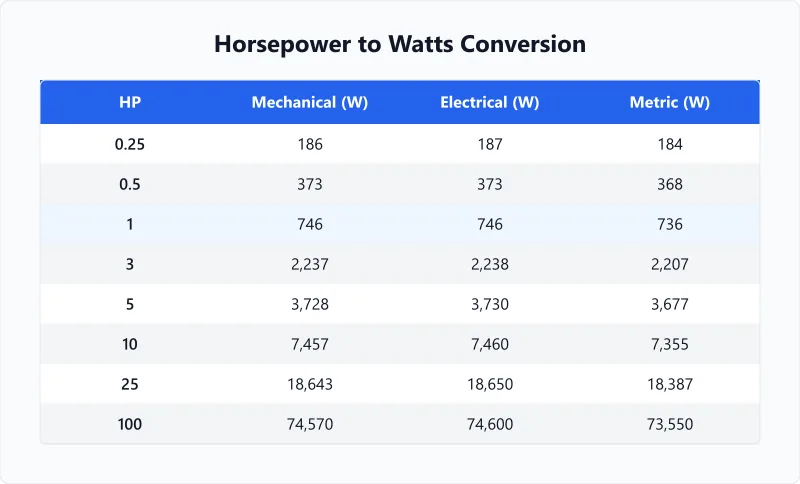
Mechanical (Imperial) Horsepower: 745.7 watts. This is the original Watt definition: 33,000 foot-pounds per minute. Used on virtually all US motor nameplates, compressors, pumps, and power tools. When an American spec sheet says "5 HP" without qualification, it means mechanical horsepower. This is the default you should use for wire sizing, breaker selection, and load calculations in North American electrical work.
Electrical Horsepower: 746 watts. Defined by convention as exactly 746 watts. The difference from mechanical HP (0.3W) is trivial in practice, but it exists because electrical engineers wanted a round number for calculations. You will encounter this in generator ratings, UPS specifications, and some industrial motor documentation. For all practical circuit sizing purposes, 745.7W and 746W are interchangeable.
Metric Horsepower (PS): 735.5 watts. Defined as 75 kilogram-force meters per second. Common in European and Asian automotive specifications. A car rated at 200 PS (Pferdestärke, literally "horse strength") has about 197 mechanical HP. The 1.4% difference occasionally causes confusion when comparing vehicle specs across markets. If the motor drives a pump in a solar installation, our solar panel output calculator shows whether your array produces enough daily energy to run it. If you are converting a European motor rating for use in a North American installation, the metric-to-watts conversion gives you the correct power figure to work with.
HP to Watts Conversion Table (Mechanical HP)
| Horsepower | Watts | Kilowatts | Common Application |
|---|---|---|---|
| 0.5 HP | 373 | 0.37 | Bathroom exhaust fan, small sump pump |
| 1 HP | 746 | 0.75 | Garbage disposal, garage door opener |
| 2 HP | 1,491 | 1.49 | Pool pump, dust collector |
| 3 HP | 2,237 | 2.24 | Table saw, commercial mixer |
| 5 HP | 3,729 | 3.73 | Air compressor, large shop tool |
| 7.5 HP | 5,593 | 5.59 | HVAC blower, small irrigation pump |
| 10 HP | 7,457 | 7.46 | Industrial fan, grain auger |
| 15 HP | 11,186 | 11.19 | Large compressor, elevator motor |
| 20 HP | 14,914 | 14.91 | Commercial HVAC, conveyor system |
| 25 HP | 18,643 | 18.64 | Large pump station, industrial blower |
| 50 HP | 37,285 | 37.29 | Industrial motor, large chiller |
| 100 HP | 74,570 | 74.57 | Heavy industrial, large generator |
Values use the mechanical horsepower definition (745.7 watts). For metric HP, multiply the HP value by 735.5 instead. The kilowatt column is what you will find on European motor nameplates — a "7.5 kW" motor is the metric equivalent of a 10 HP motor.
Worked Examples
Sizing a Circuit for a 5 HP Workshop Motor
Context
You purchased a 5 HP air compressor for your workshop. The nameplate says 5 HP mechanical. You need to know the wattage to figure out what circuit and breaker the compressor requires on a 230V single-phase supply.
Calculation
5 HP x 745.7 W/HP = 3,728.5 W
This is the mechanical output power. The electrical input power is higher because no motor is 100% efficient.
At 85% efficiency: 3,728.5 / 0.85 = 4,386 W input
Current at 230V: 4,386 / (230 x 0.85 PF) = 22.4 A
Interpretation
The motor draws about 22.4A at full load. Per NEC, conductors must handle 125% of motor FLA (28A minimum), and a typical inverse-time breaker would be sized at 250% of FLA (56A, rounded to a standard 60A breaker).
Takeaway
HP is just the starting point — you need amps for the actual circuit design. Our kVA to amps calculator handles the conversion from apparent power to current when the motor rating is in kVA rather than HP.
Converting a European Motor Rating to US Standards
Context
You are importing a German-made pump rated at 3 PS (metric horsepower). You need to know the equivalent wattage and how it compares to a US 3 HP pump for your 240V installation.
Calculation
Metric HP: 3 PS x 735.5 W/PS = 2,206.5 W
US mechanical HP: 3 HP x 745.7 W/HP = 2,237.1 W
Difference: 2,237.1 - 2,206.5 = 30.6 W (1.4% less power from the metric-rated pump)
Interpretation
The German pump delivers about 31W less than a US-rated 3 HP pump. In most applications, this 1.4% difference is insignificant — the pump will perform essentially the same. However, the circuit sizing should use the actual wattage (2,207W) for accurate current calculations.
Takeaway
When cross-referencing international motor specs, always convert to watts first to avoid apples-to-oranges comparisons. To check the wire gauge needed for the pump's 240V circuit over a long run, enter the current in our wire distance calculator.
Frequently Asked Questions
Glossary
Mechanical Horsepower
The original horsepower definition from James Watt, equal to 33,000 foot-pounds per minute or 745.7 watts. This is the standard used on virtually all US motor nameplates, power tools, compressors, and pumps. When a product says "HP" without further qualification in North America, it means mechanical horsepower.
Electrical Horsepower
A horsepower definition set at exactly 746 watts by convention for use in electrical power calculations. The 0.3W difference from mechanical HP is negligible in practice. You may encounter this in generator output ratings, UPS specs, and some industrial electrical documentation.
Metric Horsepower (PS)
The metric system equivalent of horsepower, equal to 75 kilogram-force meters per second or 735.5 watts. Known as PS (Pferdestärke) in German, CV (cheval-vapeur) in French, and pk (paardenkracht) in Dutch. Standard in European and Asian automotive and industrial specifications. About 1.4% less than mechanical HP.
Want to know what that motor costs to run? Our kWh calculator turns watts and run hours into daily, monthly, and yearly electricity costs.
Related calculators
Motor FLA Calculator
Calculate motor full load amps for single-phase and three-phase motors. Enter HP, voltage, efficiency, and power factor for instant FLA results.
Electrical
Locked Rotor Amps (LRA) Calculator
Calculate motor locked rotor amps (LRA) for starting current estimation. Enter FLA and multiplier based on NEMA code letter.
Electrical
kVA to Amps Calculator
Convert kVA to amps for single-phase and three-phase systems. Enter kVA, voltage, and power factor for instant current and true power results.
Electrical
Generator Sizing Calculator
Find the right generator size for your loads. Enter running watts, motor surge, and power factor for an instant recommendation with safety margin.
Electrical
The confusion between horsepower types rarely causes safety problems — the differences are small. But it can cause purchasing mistakes. A European-market motor rated at 10 PS delivers about 1.4% less power than a US motor rated at 10 HP. On a small motor that is negligible. On a 200 HP industrial drive, 1.4% is nearly 3 HP of "missing" capacity. When comparing equipment across markets, convert everything to watts first. Watts are watts everywhere — no regional variants, no historical baggage, no ambiguity. Our horsepower-to-watts guide covers the history, all three HP types, and a worked example of sizing a pool pump circuit from HP to breaker.
More Electrical calculators
Browse all electrical calculators — Motor FLA, wire sizing, voltage drop, load calculations, and transformer fusing based on NEC standards.
Last updated:
Written and maintained by Dan Dadovic, Commercial Director at Ezoic Inc. & PhD Candidate in Information Sciences. He works professionally as Commercial Director at Ezoic Inc., leading revenue strategy across digital publishing.
Disclaimer: Calculator results are estimates based on theoretical formulas. Actual performance varies with temperature, battery age, load patterns, and equipment condition. For critical electrical work, consult a licensed electrician.
Methodology reviewed by Doc. dr. sc. Danijel Jerković-Štil, Assistant Professor, FERIT Osijek.