Horsepower to Watts: The Three Types of HP Explained
Last updated:
7 min read
Our HP to watts calculator converts between all three types of horsepower and watts in both directions. One horsepower equals 745.7 watts — unless you mean metric horsepower (735.5 watts) or electrical horsepower (746 watts exactly). These three definitions exist because the unit evolved separately in different industries and countries. The differences are small (under 1.4%) but they matter when you are sizing electrical circuits, converting motor specs across international datasheets, or doing precise engineering calculations.
This guide explains where each type comes from and when you need to care about the distinction.
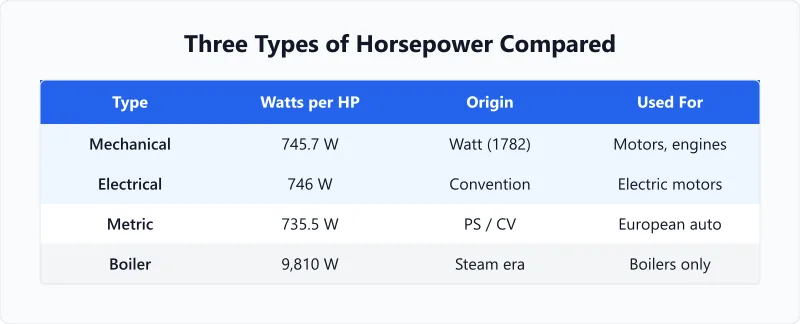
The Three Types of Horsepower Compared
| HP Type | Exact Value | Where Used | Symbol |
|---|---|---|---|
| Mechanical (Imperial) | 745.69987 W | US, UK — motors, engines, industrial equipment | hp |
| Electrical | 746.000 W | US — electric motor nameplates (NEMA standard) | hp(E) |
| Metric | 735.49875 W | Europe, Asia — automotive, industrial equipment | PS, CV, pk |
Mechanical and electrical horsepower are so close (0.04% difference) that they are interchangeable for all practical electrical work. Metric horsepower is 1.4% lower — small but noticeable when converting high-HP ratings. A European motor rated at 100 PS produces 73,550 watts, while an American motor rated at 100 hp produces 74,600 watts. That 1,050 watt gap can affect circuit sizing on large industrial installations. If you need to understand the full picture of apparent vs real power for motor circuits, our kVA vs kW guide covers the power factor side of the equation.
Where Horsepower Came From
James Watt coined the term in the 1780s to market his improved steam engine. He needed a way to tell mine owners how many horses his engine could replace. Through a series of experiments with draft horses pulling weight out of a coal mine, he arrived at 33,000 foot-pounds per minute — the rate at which a strong horse could do sustained work.
The modern SI unit of power is the watt, named after the same James Watt. One watt equals one joule per second. The horsepower-to-watt conversion (745.7 W) is a fixed constant that follows directly from converting foot-pounds per minute to joules per second. The metric horsepower (735.5 W) was defined separately using the metric system: the power needed to lift 75 kilograms by 1 meter in 1 second.
Electrical horsepower (746 W exactly) was standardized by IEEE and NEMA as a clean round number close to the mechanical value. When you see "HP" on an American electric motor nameplate without further qualification, it means electrical horsepower — 746 watts per HP. This is the number most electricians and homeowners will use.
HP to Watts Conversion Table
This table covers the range of motors commonly found in residential, commercial, and light industrial settings. All values use electrical horsepower (746 W/HP).
| Horsepower | Watts | Kilowatts | Common Applications |
|---|---|---|---|
| 1/4 HP | 187 W | 0.19 kW | Small fans, furnace blowers |
| 1/3 HP | 249 W | 0.25 kW | Sump pumps, exhaust fans |
| 1/2 HP | 373 W | 0.37 kW | Garbage disposals, well jet pumps |
| 3/4 HP | 560 W | 0.56 kW | Pool pumps, large fans |
| 1 HP | 746 W | 0.75 kW | Air compressors, submersible pumps |
| 1.5 HP | 1,119 W | 1.12 kW | Pool pumps, table saws |
| 2 HP | 1,492 W | 1.49 kW | Large air compressors, dust collectors |
| 3 HP | 2,238 W | 2.24 kW | Industrial fans, commercial pumps |
| 5 HP | 3,730 W | 3.73 kW | Large HVAC, irrigation pumps |
| 10 HP | 7,460 W | 7.46 kW | Industrial motors, elevators |
The watts column shows the motor's output power — the mechanical work it delivers to the shaft. The electrical input power is higher because no motor is 100% efficient. A 1 HP motor with 85% efficiency draws 746 / 0.85 = 878 watts from the electrical supply. This distinction between output HP and input watts is critical for circuit sizing.
From HP to Circuit Sizing
Knowing the wattage of a motor is only the first step. To size the circuit (wire gauge, breaker), you need the full-load amps (FLA) — the current the motor draws at rated output. Our motor FLA calculator converts HP to amps for any voltage and phase combination.
As discussed in the motor FLA guide, the relationship between HP and amps depends on voltage and efficiency. A 1 HP motor on 120V single-phase draws about 8-10 amps. The same 1 HP motor on 240V single-phase draws only 4-5 amps. And a three-phase version at 208V draws about 3.5 amps. Same output power, different current depending on the electrical supply.
Use the HP-to-watts conversion to estimate power, then use the FLA for actual circuit design. Never size a breaker directly from watts — always go through the amps calculation. The amps draw calculator converts watts to amps at any voltage for non-motor loads. From there, find the right breaker size and the matching wire for the circuit.
Worked Example: Sizing a Pool Pump Circuit
You are installing a new 1.5 HP variable-speed pool pump on a dedicated 240V single-phase circuit. What wire gauge and breaker do you need?
Power output: 1.5 HP x 746 W = 1,119 watts of mechanical output.
Power input (at 85% efficiency): 1,119 / 0.85 = 1,317 watts from the electrical supply.
Full-load amps: 1,317 W / 240V = 5.5 amps. (The motor nameplate will list the actual FLA, which may differ slightly depending on the specific motor design.)
Breaker sizing: NEC Table 430.52 lets an inverse-time breaker for a single motor run up to 250% of FLA, rounded to the next standard size where the result lands between ratings: 5.5A x 2.5 = 13.75A, so a 15A breaker. (Dual-element time-delay fuses use a lower 175% column.) A 20A breaker is also common for pool pump circuits to allow for starting surge.
Wire gauge: For a 20A, 240V circuit at a distance under 50 feet, 12 AWG copper is sufficient by both ampacity and voltage drop standards. For runs over 50 feet, check voltage drop with the voltage drop calculator — you may need 10 AWG.
This example shows how a simple HP rating flows through the calculation chain: HP to watts to amps to breaker to wire gauge. Each step uses a different conversion or code requirement, and skipping a step leads to incorrect sizing.
Why the Nameplate HP Does Not Tell the Whole Story
A motor's HP rating describes its continuous output at full load. During startup, the motor draws 5-8 times its FLA for a few seconds until the rotor reaches operating speed. A 1 HP motor rated at 8 amps may pull 40-64 amps during that initial surge. This is called locked-rotor amperage (LRA), and it is the reason motor circuits use oversized breakers compared to what the running amps alone would require.
Variable-speed motors and soft starters reduce this inrush by ramping voltage gradually. A variable-frequency drive (VFD) on a 5 HP motor can limit starting current to 150% of FLA instead of 600%. This changes the economics of HP-to-circuit sizing: the motor draws less peak current, so the circuit can use smaller wire and a lower-rated breaker for the same HP output. Reduced starting current also means less voltage drop on the feeder, which matters for long cable runs to outbuildings or pump houses. If your application allows it, a VFD-controlled motor is both more efficient and cheaper to wire than a standard across-the-line starter.
Frequently Asked Questions
Written and maintained by Dan Dadovic, Commercial Director at Ezoic Inc. & PhD Candidate in Information Sciences. He works professionally as Commercial Director at Ezoic Inc., leading revenue strategy across digital publishing.
Disclaimer: Calculator results are estimates based on theoretical formulas. Actual performance varies with temperature, battery age, load patterns, and equipment condition. For critical electrical work, consult a licensed electrician.
Methodology reviewed by Doc. dr. sc. Danijel Jerković-Štil, Assistant Professor, FERIT Osijek.