What Makers Publish for Propane Run Time
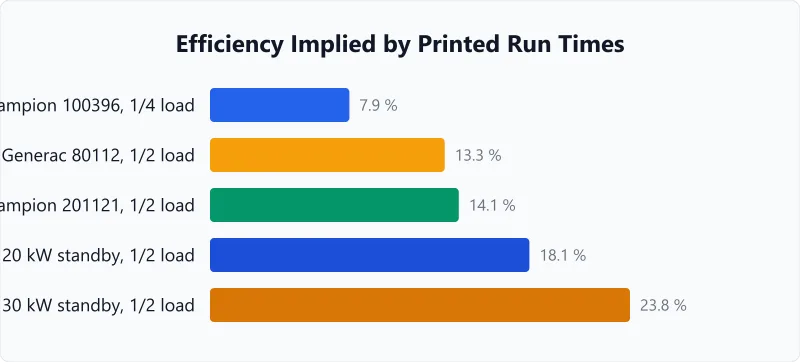
Five generators, five published propane figures. Each row is what the maker prints on its own product page, plus the efficiency that figure works out to once you put the tank energy on the same basis the calculator uses.
| Generator | Propane running watts | Load tested | Tank | Published run time | Efficiency this implies |
|---|---|---|---|---|---|
| Champion 100396 inverter | 2,790 W | 1/4 (698 W) | 20 lb | 14.5 h | 7.9% |
| Generac 80112 dual fuel | 6,800 W | 1/2 (3,400 W) | 20 lb | 5 h | 13.3% |
| Champion 201121 tri-fuel | 7,200 W | 1/2 (3,600 W) | 20 lb | 5 h | 14.1% |
| Westinghouse WGen5300DFv | 4,800 W | 1/2 (2,400 W) | not published | 9 h | cannot be worked out |
| DuroMax XP13000EH | 9,975 W | 1/2 (4,988 W) | not published | 6 h | cannot be worked out |
The last two rows print a run time without saying what tank it was measured on, so there is nothing to divide by. The first three do, and the arithmetic is the same every time: a full 20 lb cylinder is 20 / 4.2 = 4.76 gallons, and 4.76 x 91,420 / 3,412 = 127.6 kWh of fuel energy. Champion's 201121 turns that into 3,600 W for 5 hours, which is 18 kWh out of 127.6 kWh, or 14.1%. Run the same division on the other two and you get 13.3% and 7.9%. The calculator defaults to 14%, the average of the two half-load figures, which is why it reproduces Champion's and Generac's published hours instead of beating them.
How to Estimate Your Propane Generator Runtime
- Find your propane weight. A standard BBQ tank holds 20 lbs of propane when full. Larger tanks for whole-house generators hold 100-500 lbs. Weigh the tank and subtract the empty weight (stamped "TW" on the collar) to find remaining fuel.
- Add up your loads. List every device you will run simultaneously. A refrigerator draws 150-400W (check the compressor rating, not the running average). Space heater: 1,500W. Sump pump: 800-1,500W starting, 400-800W running.
- Check your generator efficiency. One pound of propane holds about 21,767 BTU: 91,420 BTU per gallon (AFDC, higher heating value) divided by 4.2 lb per gallon (PERC, at 60°F), or roughly 6.38 kWh. How much of that reaches your sockets is the only figure you have to judge. Three makers' published propane run times work out to 7.9% at quarter load and 13.3-14.1% at half load. Standby sets are better: PERC's own fuel table, supplied by Generac, works out to 14-24% at half load and 17-27% at full load for 8 kW to 150 kW machines.
- Run the calculator. Enter your values above. Then add a 15% safety buffer — generators lose efficiency as altitude increases and temperatures drop.
Why Generator Efficiency Varies So Much
A propane generator is a heat engine, so most of the fuel leaves as heat and exhaust. The published numbers say how much. PERC's propane generator fuel table, supplied by Generac, prints fuel use in BTU per hour for standby sets from 8 kW to 150 kW at half and full load. Divide the electricity produced by the fuel burned and the answer lands between 14% and 24% at half load, and between 17% and 27% at full load. Portable generators do worse: the three makers' run times in the table above imply 13.3% and 14.1% at half load.
| Standby set | Fuel at half load | Fuel at full load | Efficiency, half load |
|---|---|---|---|
| 8 kW | 79,000 BTU/h | 129,000 BTU/h | 17.3% |
| 13 kW | 149,000 BTU/h | 268,000 BTU/h | 14.9% |
| 20 kW | 189,000 BTU/h | 350,000 BTU/h | 18.1% |
| 48 kW | 393,000 BTU/h | 755,000 BTU/h | 20.8% |
| 130 kW | 933,000 BTU/h | 1,798,000 BTU/h | 23.8% |
Light load is where the losses bite. Champion publishes 14.5 hours at quarter load for its 100396 inverter on a 20 lb cylinder, and that works out to 7.9%, roughly half the figure the same class of machine reaches at half load. The engine still has to spin, pump and overcome its own friction whether it is delivering 700 W or 2,800 W. This is also why the calculator's answer drops faster than you might expect when you raise the load: it holds efficiency constant, so it cannot show the part-load penalty on its own. PERC's two columns can: doubling the load from half to full raises fuel use by less than double, which makes full-load run times 39% to 48% shorter than half-load ones rather than exactly half.
Altitude costs power on top of that. Engines lose roughly 3 to 3.5% of rated output per 1,000 feet of elevation, so a 5,000 W generator at 5,000 feet delivers about 4,250 W. You are then running a higher share of a smaller machine, which is the light-load penalty working against you from the other direction.
Worked Examples
Reproducing Champion's Published 14.5 Hours
Context
Champion publishes a propane run time for its 100396 inverter: 14.5 hours at quarter load on a 20 lb cylinder. The same page prints 2,790 propane running watts, so quarter load is 698 W. If the calculator is any good it should land on Champion's own figure rather than above it.
Calculation
Fuel volume: 20 lb / 4.2 lb per gal = 4.76 gal
Fuel energy: 4.76 x 91,420 BTU/gal = 435,340 BTU
Electrical share at 7.9%: 435,340 x 0.079 = 34,392 BTU
Convert to Wh: 34,392 / 3.412 = 10,080 Wh
Runtime: 10,080 / 700 = 14.4 hours
Interpretation
14.4 hours against Champion's published 14.5. The gap is rounding: 7.9% is the derived figure to one decimal, and 700 W is the preset's round number against the exact 697.5 W. The old 25% default gave 45.7 hours for the same machine, more than three times what Champion prints.
Takeaway
7.9% is a quarter-load figure and it is the worst on this page for a reason. Light load wastes fuel. If a generator spends most of its time barely loaded, a battery bank charged in short full-power bursts uses far less propane. Size one with our battery runtime calculator.
A 20 kW Standby Set Through a Multi-Day Outage
Context
A winter storm cuts power for three days. A 20 kW standby generator carries about half the house, 10,000 W. The 500-gallon tank gauge reads 80%, which is 400 gallons, or 1,680 lb at 4.2 lb per gallon. PERC's propane generator fuel table prints 189,000 BTU per hour for a 20 kW set at half load, and that works out to 18.1% efficiency.
Calculation
Fuel volume: 1,680 lb / 4.2 lb per gal = 400 gal
Energy per gallon delivered: (91,420 / 3,412) x 0.181 = 4.85 kWh
Total delivered: 400 x 4.85 = 1,940 kWh
Runtime: 1,940 / 10 kW = 194 hours, or 8.1 days
Interpretation
Checking it the other way round, straight off PERC's printed figure: 400 gal x 91,420 BTU = 36,568,000 BTU, divided by 189,000 BTU per hour is 193.5 hours. The two agree within 0.3%, the rounding of 18.05% to 18.1%. The three-day outage uses about 37% of the tank, not the 6% a 25% efficiency figure would have suggested.
Takeaway
Standby sets are the efficient end of the range and they still drink. Knowing the house load is what makes the number real, so start there with our electrical load calculator.
Frequently Asked Questions
Glossary
Generator Efficiency
The share of fuel energy that leaves as electricity, measured here against the higher heating value of the propane. Worked back from published propane run times, portable generators land near 13-14% at half load and about 8% at quarter load. Standby sets reach 14-24% at half load. The rest leaves as heat and exhaust.
British Thermal Unit
A standard unit of heat energy. One pound of propane contains about 21,767 BTU (91,420 BTU per gallon (AFDC) divided by 4.2 lb per gallon (PERC, at 60°F)). Converting BTU to watt-hours requires dividing by 3.412 and multiplying by the generator's electrical efficiency.
Load Factor
The ratio of actual power draw to the generator's maximum rated output. Running a 3,500W generator at 1,500W means a load factor of 43%. Lower load factors improve fuel economy but reduce efficiency.
Considering solar as a backup instead? The solar panel and battery sizing calculator helps you design an alternative to fossil fuel generators.
Related calculators
Generator Sizing Calculator
Find the right generator size for your loads. Enter running watts, motor surge, and power factor for an instant recommendation with safety margin.
Electrical
Off-Grid Load Calculator
Calculate your total daily energy needs for off-grid living. Get recommended battery bank size and solar panel wattage for your system.
Solar
UPS Battery Backup Time Calculator
Work out how long your UPS runs on battery from the string inside it, the load you plug in, and the battery class it uses.
Battery
Battery Runtime Calculator
Calculate how long your battery will last under any load. Enter capacity, voltage, and wattage for an instant runtime estimate.
Battery
Generator runtime specs from manufacturers assume ideal conditions that rarely match the real world. Use this calculator with your actual load and tank size, then keep a 15% fuel reserve for cold snaps and altitude effects. For extended outages, track your actual consumption during the first few hours and adjust your rationing plan accordingly. If the plan is to run the generator a few hours a day and coast on stored power the rest, size the storage side with our UPS backup time calculator before you buy either.
More Battery calculators
Browse all battery calculators — LiFePO4, lead-acid, AGM, and lithium-ion runtime, charge time, and capacity sizing.
Last updated:
Written and maintained by Dan Dadovic, Commercial Director at Ezoic Inc. & PhD Candidate in Information Sciences. He works professionally as Commercial Director at Ezoic Inc., leading revenue strategy across digital publishing.
Disclaimer: Calculator results are estimates based on theoretical formulas. Actual performance varies with temperature, battery age, load patterns, and equipment condition. For critical electrical work, consult a licensed electrician.
Methodology reviewed by Doc. dr. sc. Damir Topić, Assistant Professor, FERIT Osijek.