How Long Will a Generator Run on Propane?
Last updated:
11 min read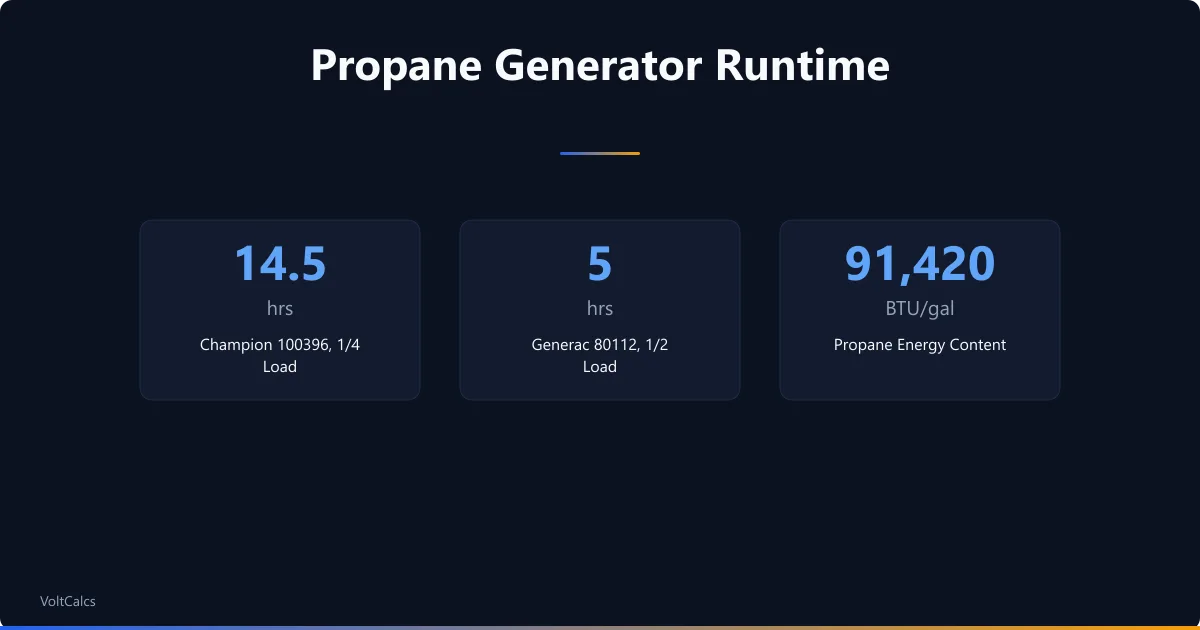
Propane generator runtime depends on three factors: tank size, generator wattage, and the load you are running. A full 20lb barbecue cylinder holds 4.8 gallons, and the makers publish what that buys. Champion prints 5 hours for a 7,200W tri-fuel at half load; Generac prints 5 hours for a 6,800W dual-fuel unit. Drop to a 1,000W draw and the same cylinder runs about 17.9 hours. A 100lb cylinder holds five times as much and runs five times as long. If you have not picked your generator yet, our generator sizing calculator recommends the right wattage based on your loads and motor surges.
Those numbers sound simple, but they mask real-world complexity. Generator efficiency, ambient temperature, altitude, and load variation all shift the result. This guide breaks down the math, compares propane to gasoline, and gives you brand-specific numbers so you can plan with confidence — whether you are prepping for storm season, running a job site, or powering an off-grid cabin.
Propane Generator Fuel Consumption Rates
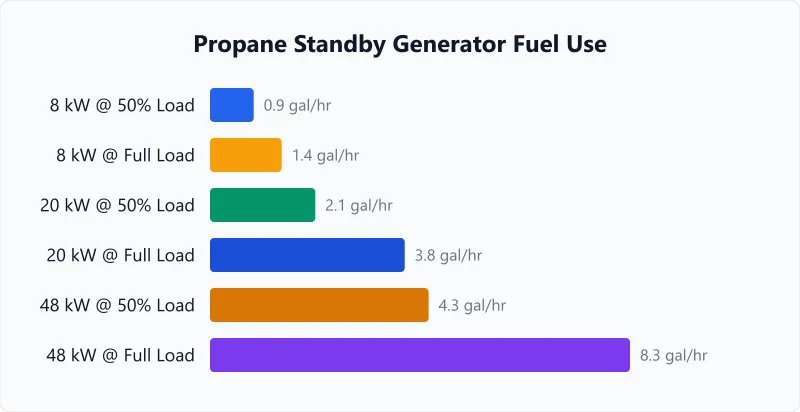
Fuel consumption scales with electrical load. A generator rated at 7,500W does not burn the same amount of propane running a single light as it does powering an entire house panel. Manufacturers test at specific load percentages, and the difference between 25% and full load is substantial.
| Standby set | Fuel at half load | Fuel at full load |
|---|---|---|
| 8 kW | 0.86 gal/hr | 1.41 gal/hr |
| 13 kW | 1.63 gal/hr | 2.93 gal/hr |
| 20 kW | 2.07 gal/hr | 3.83 gal/hr |
| 30 kW | 3.50 gal/hr | 5.39 gal/hr |
| 48 kW | 4.30 gal/hr | 8.26 gal/hr |
These are the propane industry's own published figures for standby sets, supplied by Generac. Portable generators are not in that table and burn more per kilowatt-hour than any row in it. The 50% load column is the most useful for planning because most home backup scenarios sit near that range — you are running essentials (fridge, lights, phone chargers, maybe a sump pump), not every appliance in the house. To figure out your actual electrical load, use our electrical load calculator.
The BTU Math Behind Propane Generator Runtime
Propane contains 91,420 BTU per gallon (higher heating value), as published by the U.S. Department of Energy's Alternative Fuels Data Center (AFDC). Other sources print 91,452 or round to 91,500 — close enough for generator planning. That BTU number is the starting point for every runtime calculation.
A 20lb propane cylinder is named for the 20 lb of propane it will safely hold, which is 4.8 gallons at 4.2 lb per gallon, or about 435,333 BTU. NIST points out that most exchange cylinders are filled and labelled to 15 lb net, so the one you swapped at the supermarket probably holds 3.6 gallons and 326,500 BTU. A 100lb cylinder holds 23.8 gallons, about 2.18 million BTU.
Generator engines convert fuel energy into electricity at a specific rate. Published fuel tables put standby generators between 12,700 and 24,000 BTU per kilowatt-hour, depending on size and load. A 2.5 kW output therefore burns somewhere between 31,700 and 60,000 BTU per hour. Portables sit at the thirsty end or beyond it.
Runtime formula: Tank BTU / BTU consumed per hour = Runtime in hours
For a 20lb tank on a 5,000W generator at 50% load:
435,333 BTU / 49,375 BTU per hour = about 8.8 hours
This calculator, at its 14% default, gives 7.1 hours for the same job.
Published run times sit below that once you check them against the tank the maker actually used, which is why this guide quotes the tank size beside every figure. The last 5-10% of a propane tank delivers inconsistent pressure, especially in cold weather, so most planning guides subtract a margin.
Why tank size matters more than you think
Propane pressure drops as the tank empties. Propane vapour pressure is set by temperature, not by how full the cylinder is. The propane industry's own table gives 127 psi at 70°F, 102 psi at 60°F, 72 psi at 40°F and 28 psi at 0°F. What a near-empty cylinder loses is not pressure but the ability to boil propane fast enough — potentially below the minimum operating pressure for some generators.
Larger tanks maintain higher pressure longer because there is more liquid propane available to vaporize. A 100lb tank at 25% remaining still has as much liquid as a full 20lb tank. This is why home standby generators use 250-500 gallon tanks: consistent pressure equals consistent performance, even during multi-day outages.
How to Estimate Your Propane Generator Runtime
Skip the BTU math and use this process instead — it gives practical results without a chemistry degree.
- Find your generator's propane consumption rate. Check the owner's manual or manufacturer's website. Look for "fuel consumption at 50% load" — this is the most realistic operating point. If you can only find full-load consumption, multiply by 0.55 to estimate 50% load (generators are less efficient at partial loads than a simple linear reduction would suggest).
- Determine your propane supply. A full 20lb cylinder holds 4.8 gallons, a 30lb cylinder 7.1, a 100lb cylinder 23.8. Your tank gauge shows percentage remaining, not gallons — multiply the tank's full capacity by the gauge reading.
- Divide gallons by consumption rate. If your generator burns 0.67 gallons per hour at half load and you have a full 20lb cylinder: 4.8 / 0.67 = 7.2 hours. Round down 10-15% for real-world conditions.
- Adjust for temperature. Below 40°F, propane vaporization slows. Expect 10-15% less runtime from small tanks in cold weather. Below 0°F, small tanks may not deliver enough vapor pressure at all — switch to a larger tank or use a tank heater blanket.
- Adjust for altitude. Above 5,000 feet, engines lose roughly 3-3.5% power per 1,000 feet of elevation. A generator rated at 5,000W at sea level produces about 4,250W at 5,000 feet. If you still need 2,500W of output, you are now running at 59% load instead of 50%, which burns more fuel.
For a quick answer without pulling out the manual, use our propane generator runtime calculator. Plug in your tank size, generator wattage, and load — the tool does the math instantly.
Propane vs Gasoline: Runtime and Cost Compared
Dual-fuel generators let you choose between propane and gasoline. Propane typically gives you less runtime per tank than an equivalent volume of gasoline — but the comparison is not as simple as gallons-to-gallons.
| Factor | Propane | Gasoline |
|---|---|---|
| Energy per gallon | 91,420 BTU | ~120,000 BTU |
| Runtime per gallon (5kW at 50%) | ~1.5 hours | not published here |
| Cost per gallon (AFDC, 1-15 April 2026) | $3.59 | not published here |
| Cost per hour of runtime | ~$2.39 | not published here |
| Shelf life | Indefinite (sealed tank) | 3-6 months (with stabilizer: 12 months) |
| Storage safety | Pressurized tank, outdoors only | Flammable liquid, ventilated area |
| Carbon monoxide output | Lower | Higher |
| Engine wear | Lower (cleaner burning) | Higher (carbon deposits) |
Propane costs more per hour of run time than gasoline, because a gallon holds less energy: 91,420 BTU against gasoline's 120,388 to 124,340, both from the same AFDC table. But propane stores indefinitely without degradation, produces fewer engine deposits, and generates less carbon monoxide. For emergency backup where the generator sits idle for months between uses, propane wins on practicality despite the slight cost premium. For daily job site use where fuel cost compounds over hundreds of hours, gasoline is cheaper per kilowatt-hour.
One hidden advantage of propane: you never deal with stale fuel. Gasoline left in a carburetor for six months creates varnish that clogs jets and requires disassembly to fix. Propane generators start reliably after months of storage with zero fuel prep. This alone makes propane the default choice for emergency backup generators that run only a few times per year.
Runtime by Generator Brand and Model
Manufacturer-published runtimes are tested under controlled conditions. Your results will vary, but these numbers provide a reliable baseline for planning.
| Brand / Model | Propane Running Watts | Tank | Load Tested | Published Run Time | Full Load Run Time |
|---|---|---|---|---|---|
| Champion 100396 | 2,790W | 20 lb | 1/4 load | 14.5 hours | not published |
| Generac 80112 | 6,800W | 20 lb | 1/2 load | 5 hours | not published |
| Champion 201121 | 7,200W | 20 lb | 1/2 load | 5 hours | not published |
| Westinghouse WGen5300DFv | 4,800W | not published | 1/2 load | 9 hours | not published |
Home standby sets connect to stationary tanks of 250 to 1,000 gallons. PERC's table puts a 22 kW set at 188,000 BTU per hour at half load, so 250 gallons of propane (22,855,000 BTU) runs it about 122 hours, a little over five days. Most utility outages in the U.S. last under 8 hours according to EIA reliability data, but multi-day outages from hurricanes or ice storms can stretch to 3-7 days — which is where a larger propane supply pays off.
Five Ways to Reduce Propane Consumption
You cannot change the BTU content of propane, but you can reduce how much your generator burns per hour.
Right-size your generator. A 10,000W generator running a 1,500W load operates at 15% capacity — well below its efficiency sweet spot. Knowing your actual load is critical — our off-grid load calculation guide shows how to audit every device. Generators are most fuel-efficient between 50-75% load. If your typical load is 2,000W, a 3,500W generator is a better match than a 7,500W unit. The smaller generator burns roughly half the fuel while delivering the same power to your loads.
Stagger large loads. Running the well pump, microwave, and space heater simultaneously spikes your load above 50%. Staggering them — pump first, then microwave after the pump cycles off — keeps your average load lower and consumption steadier.
Maintain your generator. A dirty air filter, fouled spark plug, or low oil level all reduce engine efficiency. Annual maintenance takes 30 minutes and can improve fuel economy by 5-10%. Clean the air filter, replace the spark plug, change the oil, and check the fuel system connections before every storm season.
Consider a battery backup as a complement. Instead of running the generator 24 hours a day, charge a battery bank for 6-8 hours, then shut down the generator and run essential loads from the battery overnight. This can cut propane consumption by 50-60% during an extended outage while still keeping your fridge and lights running around the clock. If you are building a hybrid generator-plus-battery system for an RV or cabin, our RV battery sizing guide covers the battery side of the equation in detail.
Use an inverter generator for light loads. Conventional generators run at a fixed RPM regardless of load. Inverter generators adjust engine speed to match demand, which dramatically improves fuel efficiency at partial loads. A 3,000W inverter generator at 25% load might burn 0.15 gallons per hour vs 0.3 gallons per hour for a conventional unit of the same size.
One final note: propane generator runtime calculators give you a theoretical maximum. Real-world runtime is typically 10-20% lower due to engine warm-up, load fluctuation, and the unusable propane remaining in the tank when pressure drops too low. Budget accordingly — if the math says 12 hours, plan for 10.
Seasonal Storage and Winterizing Your Propane Generator
A propane generator that sits idle for months between storm seasons still needs attention. Unlike gasoline generators that develop fuel system problems from stale gas, propane systems have no fuel degradation — but the engine and electrical components still require seasonal care.
Run the generator monthly. Even a 10-minute run under light load keeps the engine lubricated, circulates oil through bearings and seals, and prevents moisture buildup in the crankcase. Engines that sit for 6-12 months without running often develop stuck valves, corroded rings, or hard-starting behavior. Set a calendar reminder: once a month, connect a moderate load (500-1,000W) and let the generator run for 15-20 minutes until the engine reaches full operating temperature.
Change the oil before storage, not after. Used oil contains combustion acids and moisture that corrode internal engine surfaces during long storage. Fresh oil protects better. Change the oil and filter at the end of your last planned use, not when you pull the generator out next season. Most portable generators use 10W-30 oil (check your manual) and hold less than a quart — this is a 5-minute job.
Protect the battery. Most electric-start propane generators have a small 12V starting battery. This battery self-discharges during storage and can go dead within 2-3 months without a maintainer. Connect a battery tender or trickle charger during storage, or disconnect the negative terminal entirely if no maintainer is available. A dead starting battery on the first day of a power outage defeats the purpose of having a backup generator.
Verify propane connections annually. Apply soapy water to all hose connections, regulator fittings, and the tank valve while the system is pressurized. Bubbles indicate a leak. Propane hoses degrade from UV exposure and temperature cycling — replace any hose that shows cracking, hardening, or discoloration. Most propane hose manufacturers recommend replacement every 5-10 years regardless of visual condition.
Cold weather considerations. Propane generators start reliably in cold weather because propane vaporizes at -44°F — well below any inhabited climate. The weak link is the engine itself: cold oil resists cranking, and the starting battery loses capacity in freezing temperatures. If your generator stores in an unheated garage or shed, consider a synthetic oil (5W-30) that flows better at low temperatures and a battery rated for cold-cranking amps appropriate to the engine size.
Propane Safety and Storage
Propane is heavier than air. A leak settles in low spots — basements, crawl spaces, pits — and creates an invisible explosion risk. Store tanks upright, outdoors, on a flat surface, away from ignition sources. Never run a propane generator indoors, in a garage, or in any enclosed space. Carbon monoxide from engine exhaust is the leading cause of generator-related deaths according to the U.S. Consumer Product Safety Commission.
Keep spare tanks in a well-ventilated area, not in your vehicle trunk or a closed shed. Most local fire codes limit residential storage to two 40lb tanks or one 100lb tank without a permit. Check your local regulations before stockpiling for extended outage preparedness.
If you are planning a complete backup power system that combines a generator with battery storage and solar charging, our solar panel and battery sizing calculator helps you figure out the right mix for your energy needs and budget.
Frequently Asked Questions
Written and maintained by Dan Dadovic, Commercial Director at Ezoic Inc. & PhD Candidate in Information Sciences. He works professionally as Commercial Director at Ezoic Inc., leading revenue strategy across digital publishing.
Disclaimer: Calculator results are estimates based on theoretical formulas. Actual performance varies with temperature, battery age, load patterns, and equipment condition. For critical electrical work, consult a licensed electrician.
Methodology reviewed by Doc. dr. sc. Damir Topić, Assistant Professor, FERIT Osijek.