Level 1 vs Level 2 vs DC Fast: What Actually Differs
Level 1 charging uses a standard 120V outlet and the cable that came with the car. It adds range the slowest of the three levels, so it suits short daily drives that one overnight session can cover. This tool uses 85% charging efficiency for it, the figure ORNL's Table 5 (Charging types and features used in the scenarios) gives for Level 1, Level 2 and DC fast alike. INL's steady-state fact sheet for a 2012 Chevrolet Volt measures efficiency from the EVSE output (AC input) to the on-board charge module output (DC output), and prints 84.2% at its minimum and 86.6% at its maximum Level 1 charge rate (120 V). Part of the grid energy is lost as heat in the on-board charger. Cost: same as your home utility rate.
Level 2 charging uses 240V on a dedicated circuit, either at home with an installed wall connector or at public chargers. It adds range faster than Level 1. This tool uses the same 85% here; the same INL fact sheet, measured the same way from the EVSE output to the on-board charge module output, prints 82.2% at its minimum and 88.5% at its maximum Level 2 charge rate (INL tested Level 2 at 208 V). Cost at home: same as utility rate. Public L2 stations post their own price per kWh, and some add session or idle fees.
DC Fast Charging bypasses the on-board charger and feeds DC power directly to the battery. It adds range the fastest of the three levels. This tool uses 85% here as well; INL measured 88.7% overall charge efficiency on one DC fast session of a Nissan Leaf, from 480 V AC at the grid to DC at the battery (the energy storage system, ESS), 15.0 kWh from the grid for 13.3 kWh delivered to the battery. Station prices are set by each network: enter the price the station posts. DCFC is for road trips, not daily charging. To estimate the rate impact of any charger circuit, our electricity cost calculator handles the kWh × rate math.
How EV Charging Cost Compares to Gasoline
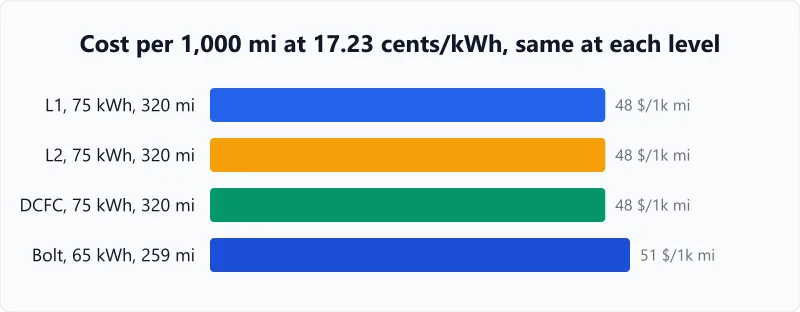
For a 320-mile-range EV with a 75 kWh usable battery, a full home L2 charge costs $15.2 at the default 17.23 cents per kWh and 85% charging efficiency. That works out to 4.75 cents per mile of driving. A gasoline car's fuel cost per mile is the price per gallon you pay divided by its miles per gallon: compare that with the EV figure for your own cars. Enter your own rate for a current result.
Public DC fast prices are set by each network. The same full charge draws 88.2 kWh from the grid at any charger level in this tool, so its cost is 88.2 kWh times the price per kWh the station posts. Combined with home solar from a system sized via our solar panel and battery sizing calculator, the per-mile cost can drop near zero once panels are paid off.
For an annual figure, multiply the cost per mile by your own miles a year: at 4.75 cents a mile, 15,000 miles cost $713 a year.
Cheapest-Possible Charging Strategy
Charge at home overnight on Level 2 if you have a garage or driveway. The 240V circuit installation costs less if your panel has spare capacity. Some utilities offer time-of-use rates with a cheaper off-peak window: schedule the car to charge during that window via the in-car charging timer. For one example, PG&E's EV2-A tariff, as a CPUC rate sheet reprints it (rates effective 8/1/2021), lists off-peak energy at $0.14427 and $0.14769 per kWh for its two seasons, 11:00 PM to 9:00 AM; the same sheet's PG&E Residential Whole House block, which also points to EV2-A, lists $0.18530 and $0.18531 off-peak, 12:00 AM to 3:00 PM. Enter your own tariff's off-peak rate to see your cost per mile.
If apartment-living without garage access, look for workplace L2 charging (often free or subsidized), public L2 at grocery stores and shopping centers, and only use DCFC for road trips. Level 1 from a 120V garage outlet is often enough for short daily commutes.
To plan the broader electrical impact of adding an EV charger to a home, our electricity bill estimator shows the monthly impact across all categories.
Worked Examples
Daily Commute on Home L2
Context
You drive a 2025 Kia EV6 Light Long Range RWD (84 kWh battery, 319 mi EPA) 31.9 miles round-trip per workday, which takes 10% of the battery. You charge at home on Level 2 at $0.17/kWh. What does daily charging cost, and what does a year of workdays cost?
Calculation
Daily charge needed: 31.9 miles / 319 mi/charge × 84 kWh = 8.4 kWh delivered to battery
Grid kWh at L2 (85% eff, ORNL Table 5): 8.4 / 0.85 = 9.9 kWh
Daily cost: 9.9 × $0.17 = $1.68
Annual at 250 work days: $1.68 × 250 = $420
Interpretation
About $420 a year in electricity for the commute, at 5.27 cents a mile. Add weekend and errand miles at the same cost per mile. To compare with a gasoline car, divide the price per gallon you pay by its miles per gallon.
Takeaway
Home L2 charging on a daily commute puts the cost per mile on your own utility rate, and daily use helps pay back the charger installation. To estimate solar that could cover this charging entirely, our solar ROI calculator takes annual kWh as input.
Cross-Country Road Trip on DCFC
Context
Same 2025 Kia EV6 Light Long Range RWD. You drive 1,200 miles on a road trip and charge entirely at DCFC stations. How much energy does the trip draw from the grid, and what sets its cost?
Calculation
Energy delivered: 1,200 mi / 319 mi × 84 kWh = 316.0 kWh
Grid kWh at DCFC (85% eff, ORNL Table 5): 316.0 / 0.85 = 371.7 kWh
Trip cost: 371.7 kWh × the price per kWh each station posts
Interpretation
On a road trip that relies entirely on DCFC, the stations set the cost: 371.7 kWh at each network's posted price. To compare with a gasoline car, divide the trip miles by its miles per gallon and multiply by the price per gallon you pay.
Takeaway
EV economics live and die on home charging, where your own utility rate sets the cost. To estimate how long a battery powers any load, useful for planning EV battery backup or off-grid charging, our battery runtime calculator handles the discharge math.
Frequently Asked Questions
Glossary
Level 1 (L1) Charging
EV charging from a standard 120V wall outlet using the portable cable shipped with the car. Adds range the slowest of the three levels. No installation needed beyond a grounded outlet. Best for low-mileage commuters or as a backup option in apartments without dedicated charging.
Level 2 (L2) Charging
EV charging from a dedicated 240V circuit, often a hardwired wall connector. Adds range faster than Level 1. Requires a 240V outlet or hardwired install. The right balance of cost and speed for nearly all daily home charging.
DC Fast Charging (DCFC)
High-power public charging that bypasses the car’s on-board AC charger and delivers DC power directly to the battery. Adds range the fastest of the three levels. Meant for road trips; each station posts its own price per kWh. ORNL modelled up to 22% less battery capacity after 10 years of daily DC fast charging than after daily Level 1 charging, for a driver in the New England area; INL found similar minimal capacity fade at 10,000 miles in 6 Nissan Leafs charged on DC fast or Level 2.
Charging Efficiency
The fraction of grid energy that ends up stored in the battery. Energy losses occur in the on-board AC-to-DC charger (L1/L2), the station-side rectifier (DCFC), and the battery thermal management system. This tool uses 85% for every level, the figure of ORNL's Table 5; INL measured 88.7% overall on one DC fast session of a Nissan Leaf, from 480 V AC at the grid to DC at the battery. Cold weather lowers efficiency as battery preconditioning consumes additional energy.
Sizing solar panels to fully cover EV charging at home is a common goal. Our solar panel size estimator handles the array sizing math.
Related calculators
Electricity Cost Calculator
See the daily, monthly, and annual electricity bill impact of running any device. Plug in wattage, hours, and your utility rate for a full cost breakdown.
Electrical
Electricity Bill Estimator
Estimate a monthly electricity bill from four categories (HVAC, water heating, refrigeration, other) and your all-in rate, with defaults from RECS 2020.
Electrical
Electric Scooter Battery Range Calculator
Estimate electric scooter range from pack watt-hours, consumption rate and riding mode, using figures four makers and one road tester publish.
Battery
Kilowatt-Hour (kWh) Calculator
Calculate kilowatt-hours and energy cost for any appliance or device. Enter watts, hours of use, and your electricity rate for instant results.
Electrical
A note on charging efficiency. The 85% this calculator uses for every charger level is the charging efficiency ORNL's Table 5 (Charging types and features used in the scenarios) gives for Level 1, Level 2 and DC fast; the calculator divides the energy put into the battery by it to find the energy drawn from the grid. The rest is lost as heat in the on-board charger (L1/L2) or station-side equipment (DCFC). Efficiency drops further in cold weather as the battery preconditioning system pulls extra energy to warm the pack. The calculator above uses ORNL's single figure and does not model cold weather. The two named-vehicle presets carry a pack size and range for you to replace with your own car's. EPA rates the 2025 Kia EV6 Long Range RWD at 319 miles and 30 kWh per 100 miles, and Kia prints 84.0 kWh of battery energy for its Light Long Range trim. EPA rates the 2023 Chevrolet Bolt EV at 259 miles and 28 kWh per 100 miles, and GM prints its battery as a 65+ kilowatt-hour pack. EPA says its MPGe values include charging losses. For the bigger picture of how driving pattern, rate plan, and charger location combine into a wide spread in annual EV charging cost, our guide to the real cost of charging an electric car walks through five common driver-profile scenarios. For a single device, our kWh calculator turns its watts, hours a day and days into kWh and prices them at the rate you enter.
More Electrical calculators
Browse all electrical calculators: Motor FLA, wire sizing, voltage drop, load calculations, and transformer fusing based on NEC standards.
Last updated:
Written and maintained by Dan Dadovic, Commercial Director at Ezoic Inc. & PhD Candidate in Information Sciences. On the energy side, Dan has hands-on experience with residential solar panel installation, DIY battery bank construction, off-grid power systems, wind power, and EV ownership/driving, all from building, maintaining, and operating his own systems.
Disclaimer: Calculator results are estimates based on theoretical formulas. Actual performance varies with temperature, battery age, load patterns, and equipment condition. For critical electrical work, consult a licensed electrician.
Methodology reviewed by Doc. dr. sc. Danijel Jerković-Štil, Assistant Professor, FERIT Osijek.