What Number to Enter for Fridge Watts
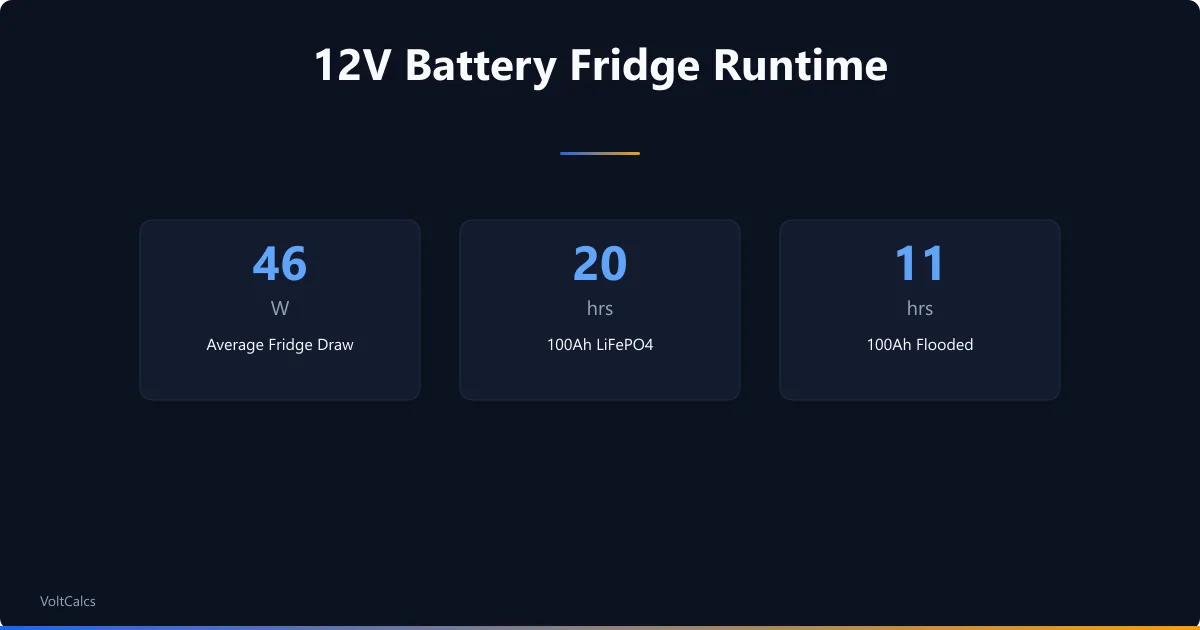
Getting this one field right matters more than everything else on the page. A refrigerator's rating plate carries the maximum current the unit may draw, not what the compressor pulls while it runs, and not the average over an hour. Dometic prints both figures for the same cooler: the plate says 7.6A at 12V, which is 91W, while the product page prints an energy consumption of 1.11 Ah/h at a 90F ambient, which is 13.3W. Enter the plate figure and your runtime comes out roughly seven times too short.
So either enter the compressor's running watts and a duty cycle, or take the maker's average and set duty cycle to 100. Both routes appear below, with the printed figure each one starts from.
| What the maker prints | Printed figure | Enter it as | Runtime, 100Ah 12V LiFePO4 |
|---|---|---|---|
| Dometic CFX5 35, energy use at 90F ambient | 1.11 Ah/h = 13.3W average | 13W at 100% duty | 2 days 23 hours |
| Secop BD35F, 12V power at 2,000 rpm, -10C evaporating | 36.7W running | 37W at 36% duty | 2 days 21 hours |
| DOE FEMP, 18.1 cu ft top-freezer, ENERGY STAR | 363.5 kWh/yr = 41.5W average | 42W at 100% duty | 21 hours 57 minutes |
| DOE FEMP, same fridge, less efficient model | 404 kWh/yr = 46.1W average | 46W at 100% duty | 20 hours 2 minutes |
| Embraco EM3D60HLT household compressor, AHRI rated point | 74W running | 74W at 36% duty | 34 hours 36 minutes |
The runtime column runs every row on a 100Ah 12V LiFePO4 bank at 80% depth of discharge and 90% system efficiency, this page's defaults. LiFePO4 counts at the 12.8V nominal Victron prints, so 100Ah is 1,280Wh rather than 1,200Wh. Skipping the inverter and wiring a DC fridge straight to 12V removes that 90% step, which is 11% more runtime on the same battery. A lead-acid bank of the same rating gives back less as you pull harder, which is why the chemistry selector changes the answer and not just the label. Our lead-acid battery runtime calculator shows the same effect on a bigger load.
Example: Keeping a Fridge Running During a Power Outage
The power goes out and the kitchen fridge has to keep running. Its plate says 150W. At the 36% duty this page derives, the average draw is 150 x 0.36 = 54W. That sits a little above the 46W the DOE publishes for an 18.1 cu ft top-freezer, which is the check worth doing on any plate figure.
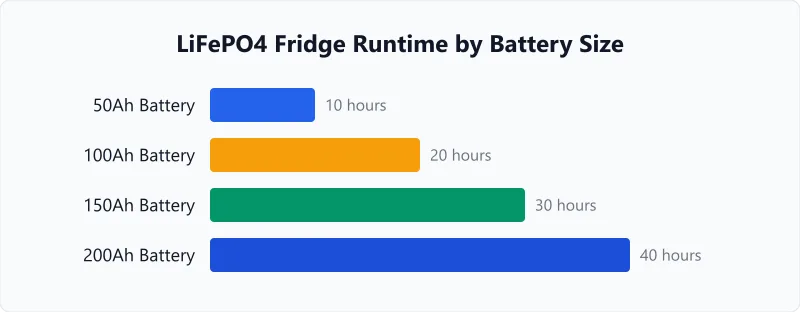
You have a 200Ah 12V LiFePO4 battery and a 1,000W pure sine inverter at 90%. Victron prints 12.8V nominal for LiFePO4, so the bank holds 200 x 12.8 = 2,560Wh. At 80% depth of discharge and 90% inverter efficiency: 200 x 12.8 x 0.80 x 0.90 = 1,843.2Wh at the outlet.
Runtime: 1,843.2 / 54 = 34.1 hours, which this calculator prints as 34 hours 8 minutes. That covers a long outage with room left.
Keeping the door shut is the one lever that reliably helps, because every opening dumps cold air the compressor then has to replace. Pre-cooling and thermal mass work the same way. Nobody publishes a figure for how much they buy you, so we do not print one.
Worked Examples
Keeping Food Cold During a 24-Hour Power Outage
Context
A full-size fridge draws 150W while the compressor runs and runs about 36% of the hour, so 54W average. Behind it sits a 200Ah flooded lead-acid bank and a pure sine inverter at 90%, held to the 50% depth Trojan recommends.
Calculation
Average load: 150 x 0.36 = 54 W
Current from the bank: 54 / 0.90 / 12 = 5.0 A, which is 0.025 of the 200Ah twenty-hour rating
Trojan's printed discharge points put a full discharge at that rate near 42 hours; half of it, at 50% depth, is 21 hours
Interpretation
About 21 hours. Not the full day, and the door is the variable that decides how close you get: every opening raises the duty cycle. The identity most calculators use would have promised 20 hours here, and at a harder load it would have promised far more than the battery delivers.
Takeaway
For a full 24 hours you want either more bank or a panel topping it up through the afternoon. Size the panel with our solar panel output calculator.
A 12V Portable Fridge from the Maker's Own Figure
Context
A Dometic CFX5 35 in the back of a van, wired straight to a 100Ah LiFePO4 battery with no inverter. Dometic prints its energy use rather than a wattage: 1.11 amp-hours per hour at a 90F ambient with the box at 39F.
Calculation
Average draw: 1.11 Ah/h x 12V = 13.3W, entered as 13W with duty cycle at 100
Bank energy: 100 x 12.8 = 1,280 Wh at the nominal voltage Victron prints
Usable at 80% depth, no inverter: 1,280 x 0.80 x 1.00 = 1,024 Wh
Runtime: 1,024 / 13 = 78.8 hours, which the calculator prints as 3 days 7 hours
Interpretation
Three days and change, on one 100Ah battery. Feed the same fridge in through its rating plate instead, at 7.6A and 12V, and the answer collapses to about eleven hours. The fridge did not change; the number you typed did.
Takeaway
When the maker prints an average, use it and set duty cycle to 100. For the rest of a van or RV electrical budget, our RV battery runtime calculator handles the other loads.
Frequently Asked Questions
Glossary
Compressor Duty Cycle
The share of each hour the fridge compressor actually runs. A 36% duty cycle means the motor runs about 22 minutes per hour. Heat, frequent door opening and warm food all push it up, which is why the same fridge empties a battery faster in a summer garage than in a kitchen.
Average Power Draw
The effective continuous wattage: compressor watts multiplied by the duty cycle fraction. A 150W fridge at 36% duty averages 54W, and that is the number battery sizing runs on. Makers who print amp-hours per hour or kilowatt-hours per year are giving you this figure directly.
Modified vs Pure Sine
Modified sine inverters are cheaper and produce a stepped approximation of mains AC rather than a smooth wave. Pure sine inverters produce a wave like the grid's, and manufacturers of motor-driven appliances generally specify them. We have not found a manufacturer figure for how much a modified wave costs a fridge compressor, so this page does not model a penalty.
Adding solar to keep your fridge running indefinitely? The solar battery count calculator sizes a complete off-grid system.
Related calculators
12V Battery Runtime Calculator
Calculate how long a 12 volt battery lasts under any load, with flooded, AGM, gel and LiFePO4 each corrected for discharge rate.
Battery
Deep Cycle Battery Runtime Calculator
Estimate deep cycle battery runtime for marine, RV, and off-grid use. Accounts for depth of discharge and system efficiency.
Battery
RV Battery Runtime Calculator
Calculate how long your RV battery bank powers your camper. Enter your loads, battery size, and get real runtime.
Battery
Off-Grid Load Calculator
Calculate your total daily energy needs for off-grid living. Get recommended battery bank size and solar panel wattage for your system.
Solar
Two numbers decide this calculation: what the compressor really draws while it runs, and how much of the hour it runs. The first is on a datasheet, not a rating plate. The second nobody publishes, so we derive 36% from Dometic's and Secop's printed figures and ship that as the default, with the condition attached: one fridge, one compressor, a 90F ambient. A warm garage sits near it and a cool basement below it. A plug-in energy meter on your own fridge for 24 hours beats both routes: divide the kWh reading by 24, multiply by 1,000, and enter that as the watts with duty cycle at 100. If you want the fridge to run indefinitely, the solar panel and battery sizing calculator sizes an array that refills the bank faster than the fridge empties it.
More Battery calculators
Browse all battery calculators — LiFePO4, lead-acid, AGM, and lithium-ion runtime, charge time, and capacity sizing.
Last updated:
Written and maintained by Dan Dadovic, Commercial Director at Ezoic Inc. & PhD Candidate in Information Sciences. He works professionally as Commercial Director at Ezoic Inc., leading revenue strategy across digital publishing.
Disclaimer: Calculator results are estimates based on theoretical formulas. Actual performance varies with temperature, battery age, load patterns, and equipment condition. For critical electrical work, consult a licensed electrician.
Methodology reviewed by Doc. dr. sc. Damir Topić, Assistant Professor, FERIT Osijek.