How to Power a CPAP Machine Off-Grid
Last updated:
12 min read
Last summer a camper in Colorado posted on an off-grid forum that his CPAP battery died at 2 AM on the second night of a three-night trip. He had estimated battery size by gut feeling instead of running the numbers. His setup was undersized by roughly 40% — a common outcome when people guess at CPAP power draw without accounting for heated humidification and pressure settings.
Our CPAP battery runtime calculator prevents that scenario by computing exact runtime from your machine settings. This guide covers the math behind it and walks you through building a reliable off-grid CPAP power system — whether you are camping, traveling in an RV, or preparing for power outages at home.
A Real Camping Trip: Where the Numbers Go Wrong
Consider a three-night backcountry camping trip. You use a ResMed AirSense 11 on auto mode at pressure 8-12 cmH2O, with the heated humidifier set to medium and the heated hose on. Your machine draws about 70W on average across the night.
Over 8 hours of sleep, that consumes 560 Wh per night. Three nights: 1,680 Wh. At 12V, that requires 140Ah of usable battery capacity. If you brought a single 100Ah lead-acid battery thinking "100 amps should be plenty," you actually have only 50Ah of usable capacity (50% depth of discharge limit). Your battery dies halfway through night two — exactly what happened to the Colorado camper.
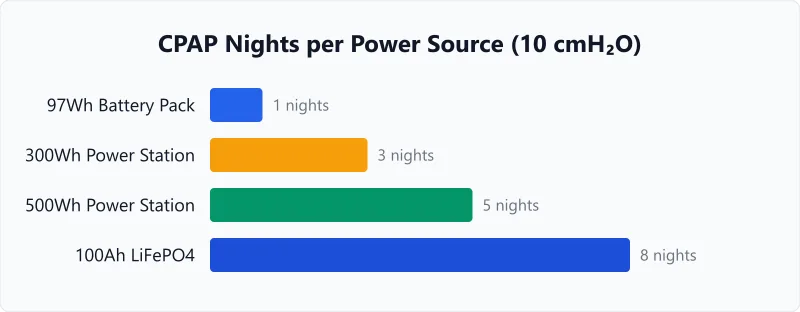
Now run the same scenario with a 100Ah LiFePO4 battery at 90% DoD: you get 90Ah usable, or about 1,080 Wh. That covers almost two full nights. A 200Ah LiFePO4 gives you 2,160 Wh — all three nights with margin. The battery chemistry you choose determines whether the trip works or fails. For the full breakdown of why LiFePO4 outperforms lead-acid on usable capacity, see our LiFePO4 vs lead-acid runtime comparison.
CPAP Power Draw by Machine and Setting
CPAP machines vary widely in power consumption. A basic fixed-pressure unit without humidification draws 30-40 watts. Turn on the heated humidifier and heated hose, and that same machine can pull 70-85 watts. Auto-adjusting machines (APAP) add 5-10 watts because the motor constantly adjusts pressure throughout the night.
| Machine Type and Settings | Avg. Power Draw | 8-Hour Energy Use | 12V Battery Ah Needed |
|---|---|---|---|
| CPAP, no humidifier, pressure 8-10 | 30-40W | 240-320 Wh | 22-29 Ah |
| CPAP with heated humidifier (low) | 50-60W | 400-480 Wh | 36-44 Ah |
| CPAP with heated humidifier (high) + heated hose | 70-85W | 560-680 Wh | 51-62 Ah |
| APAP/BiPAP, no humidifier | 40-55W | 320-440 Wh | 29-40 Ah |
| APAP/BiPAP with heated humidifier + heated hose | 80-100W | 640-800 Wh | 58-73 Ah |
The "12V Battery Ah Needed" column assumes 90% inverter efficiency for machines requiring AC power and includes a 10% safety margin. Some newer CPAP machines like the ResMed AirMini and AirSense 11 accept DC input directly at 12V or 24V, eliminating inverter losses and cutting battery requirements by 10-15%.
The heated humidifier is the single biggest variable. Turning it off or setting it to minimum cuts power draw nearly in half. Many CPAP users tolerate lower humidification for a few nights of camping — especially in humid climates where the air already carries moisture. Test at home first: run one night without the humidifier and see if your therapy quality suffers.
Choosing the Right Battery Chemistry for CPAP
LiFePO4 (lithium iron phosphate) batteries dominate the off-grid CPAP space for three reasons that go beyond the usual weight and cycle-life advantages.
A LiFePO4 battery delivers its full rated capacity. A 50Ah LiFePO4 gives you roughly 45-50Ah of usable power because you can safely discharge to 90-100% DoD. A 50Ah lead-acid battery gives you only 25Ah before you start damaging the cells. To get equivalent usable energy from lead-acid, you need double the rated capacity — and double the weight.
Weight matters enormously for CPAP users because many travel with their equipment. A 50Ah LiFePO4 battery weighs about 13 lbs (6 kg). An equivalent-capacity lead-acid setup (100Ah rated to get 50Ah usable) weighs 65 lbs (30 kg). For car camping this is inconvenient; for airline travel it is impossible.
LiFePO4 holds voltage steady throughout discharge. Lead-acid voltage sags as the battery empties, which can trigger low-voltage shutoffs on sensitive medical devices. Your CPAP might throw an error and stop at 3 AM — exactly when you need it. With LiFePO4, voltage stays between 12.8V and 13.2V until the BMS cleanly shuts down near empty.
Purpose-built CPAP batteries vs. general-purpose batteries
Several manufacturers sell batteries specifically designed for CPAP use (Medistrom Pilot-24 Lite, Freedom V2, EXP96 Pro). These are LiFePO4 or lithium-ion packs with DC output connectors matched to specific CPAP machines. They cost $200-$400 and provide 1-3 nights of runtime depending on settings.
A general-purpose 12V LiFePO4 battery (50Ah or 100Ah) with a DC-DC adapter for your CPAP model costs roughly the same or less and provides 2-4x more capacity. The trade-off is size and convenience: purpose-built CPAP batteries are compact and travel-ready; general-purpose batteries require you to source the correct adapter cable. For car camping or RV use, the general-purpose battery is better value. For backpacking or airline travel, purpose-built units win on portability.
Setting Up Your Off-Grid CPAP System
Once you know your power draw from the table above, follow these steps to build a system that works.
- Calculate your total energy requirement. Count nights away from a charging source. Multiply by nightly energy use. Add 20% as buffer for cold nights (when you want more humidification) and battery aging. For a 3-night trip with a CPAP drawing 60W for 8 hours: 3 x 480 Wh x 1.2 = 1,728 Wh, or about 144Ah at 12V.
- Choose your battery. For the scenario above, a 150Ah LiFePO4 battery provides enough capacity with margin. If weight is a constraint, two smaller batteries let you bring one for short trips and both for longer ones. Use our LiFePO4 runtime calculator to verify the match.
- Get the right power adapter. If your CPAP accepts DC input (most modern ResMed and Philips machines do), buy the manufacturer DC power cord. This connects directly to a 12V or 24V battery and bypasses the inverter, saving 10-15% energy. If your machine only has an AC plug, you need a pure sine wave inverter — modified sine wave inverters can damage CPAP motors and produce audible buzzing.
- Test the complete system at home. Set up everything and run your CPAP for a full night on battery power. Record battery state of charge before and after — our battery runtime guide explains the formula for verifying your results. Some machines draw more than published specs suggest, especially at higher pressure settings or with the EPR (expiratory pressure relief) feature active.
- Plan recharging for multi-day trips. A 100W portable solar panel produces roughly 400-500 Wh per day in good sun — enough to recharge one night of moderate CPAP use. In an RV, a DC-DC charger connected to the vehicle alternator charges faster: a 30A unit at 12V adds 360 Wh per hour of driving. Use our solar charge time calculator to plan your recharge schedule.
Flying with CPAP Batteries: FAA Rules
The FAA allows lithium batteries under 100 Wh in carry-on luggage without airline approval. Batteries between 100 Wh and 160 Wh require airline approval — usually just notifying the gate agent before boarding. Batteries over 160 Wh are prohibited on passenger aircraft entirely.
Most purpose-built CPAP batteries are designed around the 100 Wh limit. The Medistrom Pilot-24 Lite is 97 Wh, deliberately engineered to stay under the threshold. A general-purpose 12V 50Ah LiFePO4 battery stores 600 Wh — well over the limit and banned from passenger flights. If you fly regularly with your CPAP, the purpose-built battery is your only realistic option.
CPAP machines themselves are always allowed on aircraft and do not count against carry-on luggage limits under the Air Carrier Access Act — the machine is classified as a medical device. The battery is a separate item and must comply with hazmat rules. Always carry lithium batteries in your carry-on, never in checked luggage. Airlines require them in the cabin where the crew can respond to any thermal event.
International travel considerations
Voltage standards vary globally but your CPAP AC adapter almost certainly handles 100-240V automatically (check the label on the power brick). Outlet shapes differ by country, so bring the right plug adapter. The DC battery approach bypasses this entirely — 12V is 12V everywhere. For extended international trips, a 50-100W foldable solar panel keeps the battery topped off without hunting for compatible outlets in remote areas.
Temperature, Altitude, and Other Variables
Cold temperatures hit you from both sides. Cold air is drier, so you will probably want higher humidification — increasing power draw by 20-30W. Simultaneously, cold temperatures reduce battery capacity. A LiFePO4 battery at 32°F (0°C) delivers about 80% of its rated capacity. Combined, a cold night can consume 30-40% more energy than a warm one. Always size your battery for the worst-case night, not the average.
Altitude changes pressure requirements. At higher elevations, air is thinner and your CPAP may auto-adjust to higher pressures to maintain effective therapy. Higher pressure means a harder-working motor and more power draw. Camping above 5,000 feet with an auto-adjusting machine typically increases energy consumption by 10-15% compared to sea level.
Battery aging reduces capacity. A LiFePO4 battery retains about 80% of its original capacity after 2,000 cycles. If your 100Ah battery is two years old with heavy use, plan for 80-90Ah of usable capacity rather than the full 100Ah. The first year of use typically shows minimal degradation; capacity loss accelerates after year three or four.
Have a backup plan. For people with severe obstructive sleep apnea, a CPAP failure at altitude in the backcountry is a legitimate health concern. Carry a small backup battery that provides at least a few hours, or bring a positional therapy alternative (like a mandibular advancement device) as a fallback. Equipment failure at 2 AM in a remote campsite is the wrong time to discover you have no Plan B.
Troubleshooting Common Off-Grid CPAP Issues
Even with proper planning, off-grid CPAP setups can hit problems. Most issues trace back to a handful of causes that are easy to fix once you know what to look for.
CPAP shuts off mid-night with battery showing charge remaining. This usually means the battery voltage sagged below the CPAP minimum input threshold. Lead-acid batteries are the most common culprit — voltage drops steadily under load and can dip below 11.5V at 40-50% remaining capacity. LiFePO4 batteries rarely cause this problem because they hold 12.8V+ until nearly empty. If you are using lead-acid, switch to LiFePO4 or set a conservative low-voltage cutoff on your inverter at 11.8V to shut down gracefully before the CPAP throws an error.
Inverter buzzing or humming audibly. Modified sine wave inverters produce a choppy waveform that causes CPAP motors to vibrate. The fix is straightforward: use a pure sine wave inverter, or better yet, eliminate the inverter entirely with a DC power cable for your CPAP model. ResMed sells a 12V DC cable (part number 38841) for the AirSense 10 and 11 series. Philips offers similar adapters for DreamStation models. The DC route also saves 10-15% battery capacity by cutting inverter conversion losses.
Heated humidifier drains the battery faster than expected. The humidifier heater plate draws 30-50W on its own — sometimes more than the CPAP motor itself. Three strategies reduce this drain without abandoning humidification entirely.
First, reduce the humidity setting by one or two levels from your home setting; most people sleep fine at a slightly lower level for a few nights. Second, use a battery charge time calculator to plan a midday top-up from solar or vehicle charging. Third, consider a heat moisture exchanger (HME) filter that recycles your exhaled moisture — these passive filters use zero electricity and work well in mild to humid climates.
Battery will not charge from the solar panel during the day. Check three things in order: the solar charge controller is set to the correct battery chemistry (LiFePO4 requires a different charge profile than lead-acid), the panel is getting direct sunlight (even partial shade on one cell reduces output dramatically due to string wiring), and the cable gauge between panel and controller is thick enough for the distance. A 100W panel 20 feet from the controller needs at least 12 AWG wire to avoid voltage drop that prevents charging.
Our wire distance calculator confirms the right gauge for your setup.
Condensation buildup in the hose on cold mornings. This is called rainout and it happens when warm humidified air hits a cold hose. Off-grid, you cannot rely on a heated hose to solve this because it adds 15-25W of continuous draw. Instead, run the hose under your sleeping bag or blanket so your body heat keeps it warm. Alternatively, wrap the hose in pipe insulation (closed-cell foam from any hardware store, under $5). Both approaches cost zero watts and eliminate rainout in most conditions.
With proper sizing and preparation, off-grid CPAP use is straightforward. Thousands of campers, RV travelers, and boondockers run CPAP on battery power every night. The key is doing the math before you leave — use the portable power bank runtime calculator and this guide to build a system that covers your actual needs with margin to spare.
Frequently Asked Questions
Written and maintained by Dan Dadovic, Commercial Director at Ezoic Inc. & PhD Candidate in Information Sciences. He works professionally as Commercial Director at Ezoic Inc., leading revenue strategy across digital publishing.
Disclaimer: Calculator results are estimates based on theoretical formulas. Actual performance varies with temperature, battery age, load patterns, and equipment condition. For critical electrical work, consult a licensed electrician.
Methodology reviewed by Doc. dr. sc. Damir Topić, Assistant Professor, FERIT Osijek.