This electric scooter range calculator divides the energy in your pack by the energy your scooter spends per mile. Enter the pack voltage and amp-hours printed on your scooter, the watt-hours per mile you expect, and the riding mode. That is the whole calculation: four inputs and no hidden adjustments. Every rate offered as a starting point below comes from a scooter maker's own specification or from a published road test, and each one is named and linked so you can check it yourself.
What Four Scooter Makers Print
Pick a starting rate from a scooter whose numbers are published, not from a category label. Each row below pairs a maker's own printed pack size with its own printed range and divides one by the other. The last column is what that pair implies; it is not a figure any maker states.
| Scooter | Printed pack | Printed range | Printed test conditions | Implied Wh/mile |
|---|---|---|---|---|
| Xiaomi Mi Electric Scooter 3 | 7650 mAh / 275 Wh, 36 V | 30 km (18.6 mi) | none printed | 14.8 |
| NIU KQi3 Pro | 486 Wh, 48 V | 31 miles | none printed | 15.7 |
| Segway-Ninebot MAX G2 | 551 Wh (15300 mAh), 36 V | Drive 55 km (34.2 mi); ECO 70 km; Sport 50 km | 75 kg (165 lb) load, 25°C, pavement, held at the speed for that mode | 16.1 in Drive, 12.7 in ECO |
| Apollo City 2.0 | 48 V 18 Ah (864 Wh) | 40.0 miles in Eco mode | Eco mode; no rider weight printed | 21.6 |
The arithmetic is one division per row: 275 ÷ 18.6 = 14.8, 486 ÷ 31 = 15.7, 551 ÷ 34.2 = 16.1, and 864 ÷ 40.0 = 21.6 watt-hours per mile. Segway's ECO row is 551 ÷ 43.5 = 12.7.
Read those as best cases under each maker's own conditions, and note that only Segway prints what its conditions are. They are a floor on what a scooter can do, not a budget for a commute. The same energy arithmetic shows up everywhere a battery does work, which the watts in a 12V battery page walks through on a stationary pack.
Claimed Range Against Measured Range
RiderGuide, an independent test publication, rode 12 scooters until the battery died and set the result against each maker's claim. Its published protocol is a 165.0 lb rider on a fully charged pack, the scooter in its maxed-out performance mode, over a route with many stops, rough roads and some uphill travel.
Across those 12 scooters the measured range averaged 71% of the claim. The best was 90%: the VMAX VX5 Pro GT returned 19.7 of a claimed 22 miles. The worst was 53%: the Segway Ninebot Max G30P returned 21.6 of a claimed 40.4. Two more models come from makers in the table above, the NIU KQi2 Pro at 63% (15.7 of 24.9 miles) and the Segway Ninebot E2 Pro at 74% (16.0 of 21.7). That spread is why a single derate applied to every scooter would be a guess.
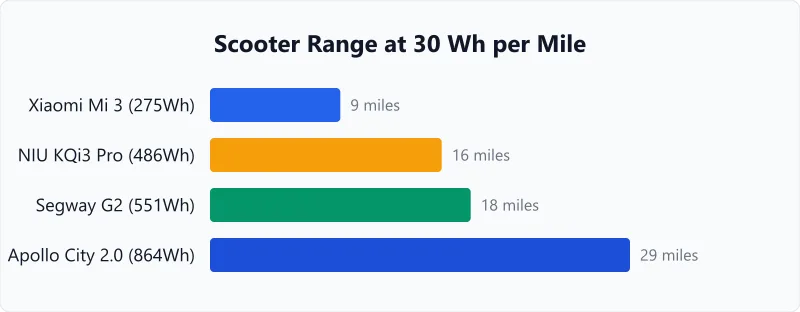
For a planning rate, RiderGuide prints a rule: divide the pack's watt-hours by 30, and says a 551 Wh battery gives roughly 18 real-world miles. It puts normal commuting between 25 and 35 Wh per mile. Apollo's own Explore 2.0 spec sheet prints a standard power consumption of 1.8 kW per 100 km, the units as printed, which read as energy is 18 Wh per kilometre or 29 Wh per mile. Those two independent figures are why this calculator opens at 30 Wh per mile on the 551 Wh Segway pack: the default result, 18.4 miles, is the same answer RiderGuide's own worked example gives. If you want the underlying energy-divided-by-load reasoning in its plainest form, the battery runtime calculator and the guide to how to calculate battery runtime cover it for loads that do not move.
Measure Your Own Watt-Hours Per Mile
Any rate in the table is a stand-in for the number you do not have yet. One ride replaces it with your own: your route, your weight, your weather, your tyres.
- Charge to full and write down the pack size. Volts times amp-hours gives watt-hours, so a 48 V 10.125 Ah pack is 486 Wh. The amp-hours calculator converts in either direction if your pack is labelled the other way round.
- Ride a route you actually ride, in the mode you actually use, and record the distance from the scooter odometer or a phone GPS.
- Read the battery percentage left at the end. Treat it as rough: most scooter gauges read voltage, and voltage reads high when the motor is off.
- Divide. Energy spent is pack watt-hours times the fraction used. A 486 Wh pack down to 40% over 11 miles is 486 × 0.60 = 291.6 Wh, and 291.6 ÷ 11 = 26.5 watt-hours per mile.
- Enter that number in the consumption field above, with the mode set to the one you rode in.
Do it again on a cold morning and you have a winter figure too. Two measured numbers beat any table, because the one thing a table cannot know is you. The same method works on a pedal-assist bike, which is why the e-bike battery range calculator starts from a lower base rate: there, the rider supplies part of the power.
Worked Examples
Will a 486 Wh Commuter Cover a 12-Mile Round Trip?
Context
You ride a NIU KQi3 Pro, whose spec sheet prints a 486 Wh pack at 48 V, on a 6-mile-each-way commute. You leave it in eco mode because you are not in a hurry. Does the pack cover the round trip?
Calculation
Pack energy: 48V × 10.125Ah = 486 Wh, the figure NIU prints. Consumption in eco mode at the tested planning rate: 30 Wh/mi × 0.78 = 23.4 Wh/mi. Range: 486 ÷ 23.4 = 20.8 miles, or 33.4 km.
Interpretation
20.8 miles against a 12-mile round trip leaves 8.8 miles spare, a little over 40% of the estimate. That is enough margin to absorb a detour, a cold morning, or a pack that has lost some capacity since new. NIU prints 31 miles for this scooter and does not print the conditions behind it, which is most of the difference between its number and this one.
Takeaway
The trip fits with room to spare in eco mode. Ride it once, work out your own watt-hours per mile from the battery gauge, and re-run this with that figure instead of 30. If you top up at work, the charge and discharge calculator estimates how much a midday hour puts back.
Eco Against Sport on One 864 Wh Pack
Context
You own an Apollo City 2.0, whose spec sheet prints a 48 V 18 Ah pack and three riding modes at 10, 21 and 32 mph. You want to know what the mode switch is actually worth on a weekend ride.
Calculation
Pack energy: 48V × 18Ah = 864 Wh, which Apollo prints as 864Wh. Eco: 30 Wh/mi × 0.78 = 23.4 Wh/mi, so 864 ÷ 23.4 = 36.9 miles. Sport: 30 × 1.11 = 33.3 Wh/mi, so 864 ÷ 33.3 = 25.9 miles.
Interpretation
Eco buys 11 extra miles, a ratio of 1.42 to 1. That is close to what Segway prints for its own scooters on one pack, 70 km in ECO against 50 km in Sport on the MAX G2 (1.40) and 65 against 45 on the Max G30 (1.44), which is where these factors come from. The mode switch is worth real distance, but it does not double anything.
Takeaway
Plan a long ride in eco and keep sport for the acceleration you actually want. Apollo prints 40 miles in Eco for this scooter, above the 36.9 here, because its figure is a best case and 30 Wh/mi is a tested one. The same budget-the-energy-first habit applies to any battery that has to last a fixed job, as the off-grid CPAP guide works through for an overnight load.
Frequently Asked Questions
Glossary
Watt-Hours (Wh)
The energy in a battery: voltage times amp-hours. A 36V 15.3Ah pack is 550.8 Wh, which Segway rounds to 551 Wh on its own spec sheet. Watt-hours is the number that decides range, which is why two scooters with the same motor and different packs travel different distances. The Wh to Ah calculator converts between the two labels.
Wh/mile (Consumption Rate)
The energy a scooter takes out of the pack per mile ridden. It is miles per gallon turned upside down, so a lower number is better. Maker figures on this page imply 12.7 to 21.6 Wh per mile under their own best-case conditions, while RiderGuide puts normal commuting at 25 to 35, which is the band the 30 Wh/mile default sits in.
Riding Mode
The speed and power cap the scooter applies, labelled Eco, Drive or Normal, and Sport on most dashboards. Segway is the one maker found that publishes a separate range for each mode on the same pack, so the factors here are derived from its MAX G2 and Max G30 figures. A lower mode adds no energy to the battery; it spends what is there more slowly by holding a lower speed.
Charging your scooter from solar? See our solar battery charge time calculator for panel-to-battery estimates.
Planning to charge at home? The kWh calculator estimates your electricity cost per charge cycle.
Read the e-bike battery range guide for background on how battery energy translates to real-world miles.
Compare different battery types for your scooter with our LiFePO4 vs lead-acid runtime comparison.
Related calculators
E-Bike Battery Range Calculator
Work out how far an e-bike goes on one charge: pack watt-hours divided by watt-hours per mile, with rates from three makers' own spec pages.
Battery
Drone Battery Flight Time Calculator
Calculate drone flight time from battery mAh, voltage and average power draw. Presets carry DJI printed pack energy and hover times.
Battery
Battery Pack Calculator
Size a custom battery pack using series and parallel cell configurations. Enter target voltage, capacity, and cell specs.
Battery
EV Charging Cost Calculator
Calculate the true cost of charging an electric car at home or on the road. Side-by-side Level 1 vs Level 2 vs DC Fast comparison with cost per mile.
Electrical
Range is energy divided by energy per mile, and the only part worth arguing about is the second number. This page hands you four makers' own printed figures, one independent tester's measured spread, and a five-step way to replace both with a number you measured. Use a printed rate to shortlist a scooter and your own rate to plan a route. The rest of the battery calculators apply the same arithmetic to packs that stay still, and the solar panel output guide covers charging one from panels.
More Battery calculators
Browse all battery calculators — LiFePO4, lead-acid, AGM, and lithium-ion runtime, charge time, and capacity sizing.
Last updated:
Written and maintained by Dan Dadovic, Commercial Director at Ezoic Inc. & PhD Candidate in Information Sciences. He works professionally as Commercial Director at Ezoic Inc., leading revenue strategy across digital publishing.
Disclaimer: Calculator results are estimates based on theoretical formulas. Actual performance varies with temperature, battery age, load patterns, and equipment condition. For critical electrical work, consult a licensed electrician.
Methodology reviewed by Doc. dr. sc. Damir Topić, Assistant Professor, FERIT Osijek.