Example: Reading a 12V Battery Label
You are looking at a 12V battery in the shop. The label says:
- 12V 100Ah: the two numbers every other figure comes from.
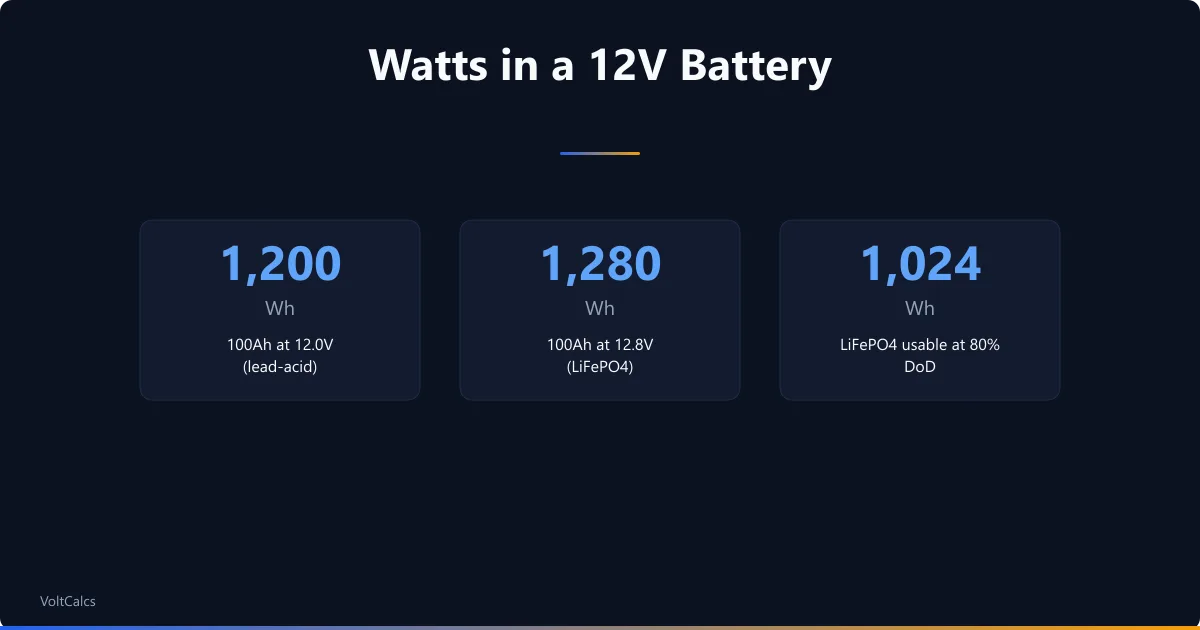
- Nominal Voltage 12.8V: this is a LiFePO4 battery, so multiply by 12.8, not 12. 100 x 12.8 = 1,280Wh, the figure Victron prints for its own 12,8V 100Ah model.
- Max Discharge 100A: at 12.8V that is 1,280W of power. Battle Born prints "100 Amps Continuous" for its 100Ah 12V LiFePO4, so 100A is a rating its maker stands behind rather than a stretch.
- Cycle Life 2,500 at 80% DoD: Victron's printed cycle-life table gives 2,500 cycles at 80% DoD, 3,000 at 70%, and 5,000 at 50%.
Usable watt-hours follow the depth of discharge you pick. At the 80% Victron publishes, a 100Ah LiFePO4 gives 1,280 x 0.80 = 1,024Wh. A lead-acid battery with the same 100Ah rating starts from 12.0V and stops at the 50% Concorde publishes: 100 x 12 = 1,200Wh total, 600Wh usable. Reaching the whole charge means running the pack flat, which costs cycle life on every chemistry.
Common 12V Batteries and Their Watt-Hours
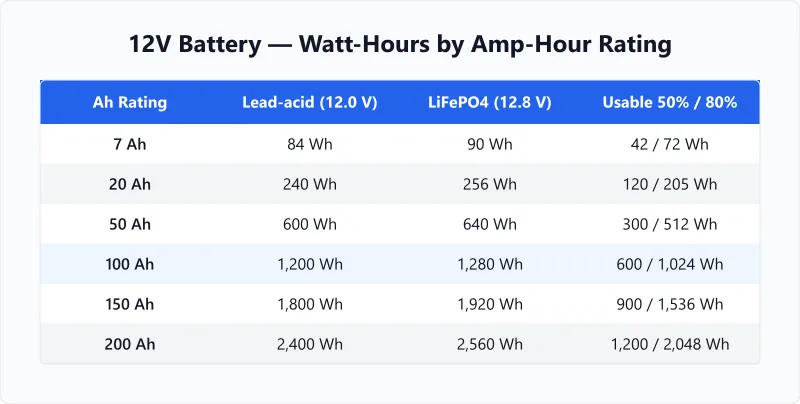
Every row below is a named product at its maker's own published rating, so the arithmetic can be checked against a datasheet instead of a rule of thumb.
| Battery | Nominal V | Rated Ah | Total Wh | Usable Wh |
|---|---|---|---|---|
| CSB GP1272 (UPS, alarm panel) | 12.0 V | 7.2 Ah (20-hr) | 86 Wh | 43 Wh (50%) |
| Yuasa YTX14-BS (motorcycle) | 12.0 V | 12 Ah (10-hr) | 144 Wh | 72 Wh (50%) |
| Odyssey ODX-AGM34R (car, group 34) | 12.0 V | 68 Ah (20-hr) | 816 Wh | 408 Wh (50%) |
| AIMS AGM12V100AH (deep cycle) | 12.0 V | 100 Ah (20-hr) | 1,200 Wh | 600 Wh (50%) |
| Lifeline GPL-31T (marine AGM) | 12.0 V | 105 Ah (20-hr) | 1,260 Wh | 630 Wh (50%) |
| Two Trojan T-105 in series (golf cart) | 12.0 V | 225 Ah (20-hr) | 2,700 Wh | 1,350 Wh (50%) |
| Victron 12,8/100 (LiFePO4) | 12.8 V | 100 Ah | 1,280 Wh | 1,024 Wh (80%) |
| Victron 12,8/200 (LiFePO4) | 12.8 V | 200 Ah | 2,560 Wh | 2,048 Wh (80%) |
The usable column is where runtime maths should start. Lead-acid rows apply the 50% ceiling Concorde publishes for its own AGM batteries; the LiFePO4 rows apply the 80% point in Victron's printed cycle-life table. Watch the rating basis as well: the motorcycle battery is rated at the 10-hour rate and the rest at the 20-hour rate, and a lead-acid battery returns less than its label when you pull harder than that. Our deep cycle runtime calculator shows what a heavier draw does to the hours.
Worked Examples
Can a 100Ah LiFePO4 Run a 600W Microwave?
Context
Your 100Ah LiFePO4 battery is nominally 12.8V, not 12.0V, so the energy total starts higher than the label suggests. You want to run a 600W microwave through an inverter. How long does the charge last?
Calculation
Total energy: 100 Ah x 12.8 V = 1,280 Wh
Usable at the 80% depth of discharge Victron publishes: 1,280 x 0.80 = 1,024 Wh
Inverter: the smallest Victron Phoenix VE.Direct inverter that carries 600W is the 12/800, printed at 650W continuous at 25°C (the 12/500 is printed at 400W). Its printed maximum efficiency on 12V is 90%: 1,024 x 0.90 = 922 Wh
Runtime: 922 / 600 = 1.5 hours
Interpretation
At most about 1 hour 32 minutes of microwave time, or 15 reheat cycles of six minutes each. Treat that as an upper bound: 90% is the inverter's maximum efficiency, and at most loads it converts less. The 650W rating is the 25°C figure as well; Victron prints 560W for the same inverter at 40°C, which would not carry this microwave.
Takeaway
For a runtime at your exact load and chemistry, use our LiFePO4 runtime calculator or lead-acid runtime calculator with chemistry-specific DoD and efficiency values.
Total Watt-Hours in a Parallel Battery Bank
Context
You wire two 200Ah LiFePO4 batteries in parallel at 12.8V. What is the total energy, and how does it compare with a single 100Ah 25.6V battery?
Calculation
Parallel bank: 400 Ah at 12.8 V = 400 x 12.8 = 5,120 Wh
Victron prints 2,560 Wh for one 12,8V 200Ah unit, and two of them come to the same 5,120 Wh.
Single 100Ah 25.6V: 100 x 25.6 = 2,560 Wh, which Victron prints as well.
Interpretation
The parallel 12.8V bank stores exactly twice the energy of the single 25.6V battery. Parallel wiring adds amp-hours and holds the voltage; series wiring adds voltage and holds the amp-hours.
Takeaway
For help designing series-parallel battery configurations, see our battery pack calculator which handles multi-cell arrangements.
Frequently Asked Questions
Glossary
Watt-Hours
The total energy stored in a battery: amp-hours multiplied by the pack's nominal voltage. A 100Ah lead-acid battery at 12.0V holds 1,200 Wh, the same energy as a 100W light running for 12 hours. A 100Ah LiFePO4 at 12.8V holds 1,280 Wh, which is the figure its maker prints on the datasheet.
Usable vs Total Energy
Total energy (Ah x nominal V) is the theoretical maximum. Usable energy subtracts the depth-of-discharge ceiling and the inverter's conversion losses. A 100Ah LiFePO4 holds 1,280 Wh, and at the 80% depth of discharge Victron publishes with a 90% inverter it delivers 922 Wh to your AC devices.
Parallel Wiring
Connecting batteries positive-to-positive and negative-to-negative. This adds amp-hours while keeping voltage the same. Two 100Ah 12V batteries in parallel = 200Ah at 12V.
Pairing your 12V battery with solar panels? The solar panel output calculator shows daily energy generation for comparison.
Related calculators
12V Battery Runtime Calculator
Calculate how long a 12 volt battery lasts under any load, with flooded, AGM, gel and LiFePO4 each corrected for discharge rate.
Battery
Watt Hours to Amp Hours Calculator
Convert watt-hours to amp-hours at any voltage. Use this to compare batteries rated in different units.
Battery
Battery Capacity (Amp Hours) Calculator
Calculate battery capacity in amp-hours from watt-hours and voltage. Convert between Wh, Ah, and watts easily.
Battery
Battery Size for Inverter Calculator
Find the right battery capacity for your inverter. Enter load, runtime, voltage and chemistry: lead-acid banks need more amp-hours than lithium.
Battery
Two numbers decide the answer: the nominal voltage of your chemistry, and how deep you are willing to discharge. Get both right and the maths is a single multiplication. Get them wrong and a LiFePO4 pack reads 80Wh smaller than its own datasheet says, while a lead-acid bank looks twice as useful as it will ever be. For worked examples of turning watt-hours into real hours across different loads, read our battery runtime guide.
More Battery calculators
Browse all battery calculators — LiFePO4, lead-acid, AGM, and lithium-ion runtime, charge time, and capacity sizing.
Last updated:
Written and maintained by Dan Dadovic, Commercial Director at Ezoic Inc. & PhD Candidate in Information Sciences. He works professionally as Commercial Director at Ezoic Inc., leading revenue strategy across digital publishing.
Disclaimer: Calculator results are estimates based on theoretical formulas. Actual performance varies with temperature, battery age, load patterns, and equipment condition. For critical electrical work, consult a licensed electrician.
Methodology reviewed by Doc. dr. sc. Damir Topić, Assistant Professor, FERIT Osijek.