The 3-Stage Charging Process
- Bulk (to about 80% state of charge): the charger pushes its full rated current and the battery voltage climbs steadily. Victron puts the arithmetic plainly: bulk time is the amp-hours you need back below that endpoint divided by the charger amps. At the defaults above, a battery at 50% has 30Ah sitting below the endpoint, which is 3 hours at 10A.
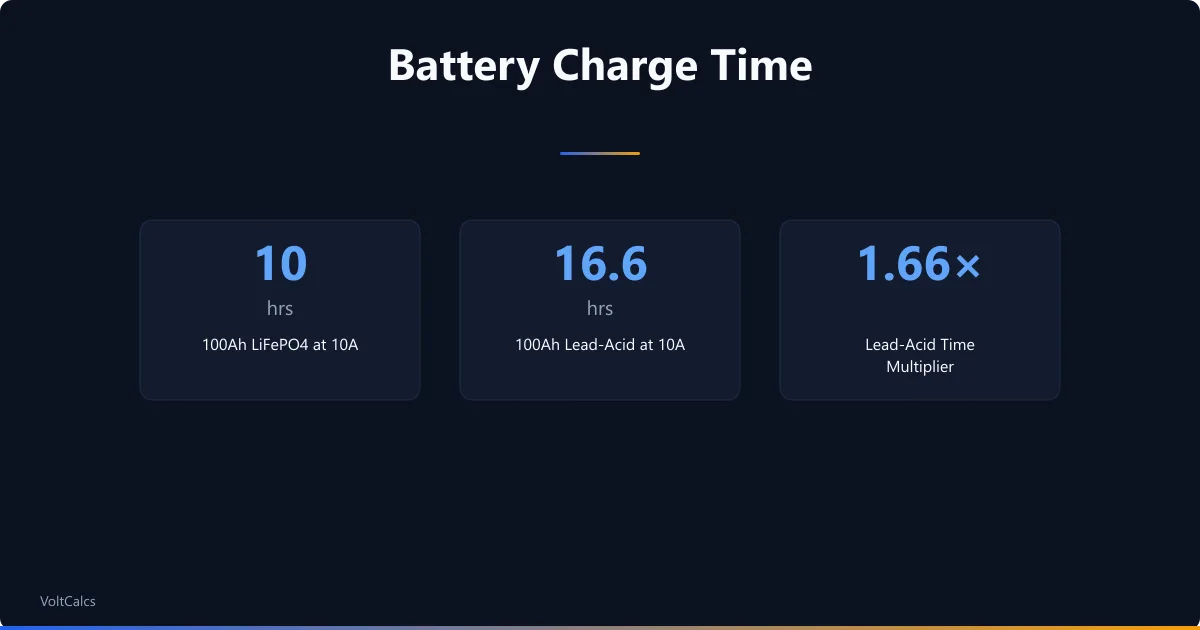
- Absorption (the rest of the way): the charger holds voltage constant and the current tapers towards nothing. This is where lead-acid loses its afternoon. Victron's charger varies the stage with how flat the battery was, between 30 minutes and 8 hours, and its own worked example gives a fully discharged 100Ah battery 8 hours of absorption on top of 8 hours of bulk. At the defaults the calculator returns 4 hours 17 minutes, longer than the bulk stage that preceded it.
- Float: a low maintenance voltage holds the battery full without cooking it. Nothing in the charge-time answer depends on it, because the battery is already at 100%. LiFePO4 should be disconnected at full charge rather than floated.
Why the Last 20% Takes So Long
Picture filling a glass. The first three-quarters goes in fast because the glass takes the stream easily. The last inch needs a slow pour, and pouring at full speed just makes a mess. A lead-acid battery behaves the same way: its internal resistance climbs as it fills, so the charger has to drop the current to stay under the absorption voltage East Penn prints for its own batteries, 2.40 volts per cell, which is 14.40V on a 12V AGM or gel monobloc and 14.70V on a flooded one.
LiFePO4 does not have that tail. It takes full current to about 95% state of charge and finishes the last 5% in minutes. A flat 100Ah LiFePO4 on a 20A charger is exactly 5 hours by this calculator, and Amptron prints “approximately 5 hours” for that same pairing on its own 100Ah datasheet. The same job in lead-acid is 8 hours 17 minutes from empty, or 6 hours 26 minutes if you only took it to 80% depth of discharge. If you are weighing the two chemistries on more than charge time, our LiFePO4 against lead-acid comparison puts the running costs beside the charging behaviour.
Where These Hours Come From
Victron’s Blue Smart charger manual prints the structure this calculator uses, including two worked examples for a 100Ah battery on a 10A charger. It gives the bulk formula outright and the bounds on the absorption stage, 30 minutes to 8 hours, but it does not print a rule for a battery that is only half flat. So we fitted one to the totals that manufacturers do print: absorption hours = 0.857 x (amp-hours to replace / charger amps), the least-squares line through the six rows below. One thing to know before you lean on it: every printed total behind that coefficient comes from a 10-amp charger, Victron’s worked example and all five rows of NOCO’s chart, so the way the absorption stage scales to bigger or smaller chargers rests on Victron’s printed statement that the time is calculated from the bulk time, not on figures measured at those sizes.
| Printed by | Battery and charge | Printed time | This calculator | Difference |
|---|---|---|---|---|
| Victron, Blue Smart IP65 manual | 100Ah lead-acid, flat, 10A | 16 hours | 16 hours 34 minutes | +3.6% |
| NOCO, GENIUS10 user guide | 20Ah, 50% DOD, 10A | 1.5 hours | 1 hour 27 minutes | −2.9% |
| NOCO, GENIUS10 user guide | 40Ah, 50% DOD, 10A | 3.0 hours | 2 hours 55 minutes | −2.9% |
| NOCO, GENIUS10 user guide | 80Ah, 50% DOD, 10A | 6.0 hours | 5 hours 50 minutes | −2.9% |
| NOCO, GENIUS10 user guide | 100Ah, 50% DOD, 10A | 7.0 hours | 7 hours 17 minutes | +4.1% |
| NOCO, GENIUS10 user guide | 230Ah, 50% DOD, 10A | 17.3 hours | 16 hours 45 minutes | −3.1% |
The worst of the six misses by 4.1%. One more caveat belongs with that number: NOCO prints a single chart for a charger with lead, AGM and lithium modes rather than a chart per chemistry, and we read it as lead-acid because the times it prints are about 1.5 times the plain amp-hours-divided-by-amps, which is lead-acid behaviour and not lithium behaviour. Note too that the smallest row, 20Ah on a 10A charger, is a 0.5C charge, above the 0.3C ceiling East Penn prints for lead-acid: the fit uses the row, and the calculator would warn you about that rate.
The LiFePO4 side is not fitted at all. Bulk runs to the 95% endpoint Victron prints, the last 5% follows at the charge current, and that reproduces three printed figures exactly: Victron’s 10 hours for a flat 100Ah battery at 10A, Victron’s 2 hours for the same battery at its recommended 0.5C, and Amptron’s approximately 5 hours at 20A. Battle Born’s printed “30 minutes per 100Ah” absorption time lands on the same half hour. If you want the charge leg and the discharge leg in one view, the charge and discharge calculator runs both.
Worked Examples
Charging a Depleted 100Ah LiFePO4 with a 20A Charger
Context
Your 100Ah LiFePO4 was run down to 20% remaining, so 80% depth of discharge. You plug in a 20A charger.
Calculation
Amp-hours to replace: 100 x 0.80 = 80 Ah
Bulk runs to the 95% endpoint: 100 x (80 - 5) / 100 = 75 Ah at 20A = 3.75 hours
Absorption returns the last 5 Ah: 5 / 20 = 0.25 hours
Total: 3.75 + 0.25 = 4 hours
Interpretation
Four hours, and the absorption tail is 15 minutes of it. That is the whole difference between the chemistries: a lead-acid battery in the same state on the same charger needs 6 hours 26 minutes, because its tail is 3 hours 26 minutes on its own.
Takeaway
If you are charging from solar instead of shore power, the charge current varies with sunlight. Size your panels with our solar panel size calculator to match your charging needs.
Why a 200Ah Lead-Acid Takes So Long with a 10A Charger
Context
Your 200Ah flooded lead-acid bank is at 50% depth of discharge. A 10A charger is your only option.
Calculation
Amp-hours to replace: 200 x 0.50 = 100 Ah
Bulk runs to the 80% endpoint: 200 x (50 - 20) / 100 = 60 Ah at 10A = 6 hours
Absorption: 0.857 x (100 Ah / 10A) = 8 hours 34 minutes
Total: 14 hours 34 minutes
Interpretation
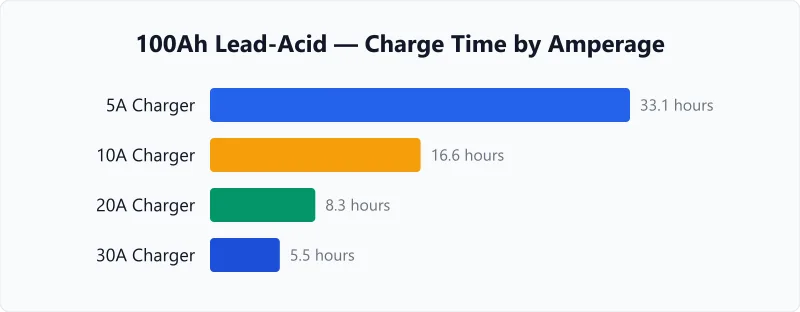
The tail is longer than the bulk stage. Plug in at bedtime and the bank is not full until mid-afternoon, and a 200Ah bank on a 10A charger is a 0.05C charge, well inside every printed limit, so there is no fixing this with patience alone. A bigger charger is the only lever: 20A halves it to 7 hours 17 minutes.
Takeaway
To understand how long this battery actually lasts under load once charged, try our lead-acid runtime calculator — it accounts for the Peukert effect that hits lead-acid at high discharge rates.
Frequently Asked Questions
Glossary
Bulk Stage
The constant-current part of a charge. Victron’s Blue Smart charger manual gives the arithmetic directly: bulk time is the amp-hours you need back divided by the charger amps, and the stage ends at about 80% state of charge on lead-acid and above 95% on LiFePO4. Everything after that is the tail.
Overcharge (Charge Factor)
East Penn defines it as the amp-hours charged divided by the amp-hours discharged, times 100, and prints 105% to 130% as typical for lead-acid. That is why a lead-acid charge can never be quicker than the amp-hours would suggest. The time ratio is larger still, 1.46 to 1.66 in this calculator, because the absorption stage returns its share at a falling current.
Absorption Phase
The stage after bulk, where the charger holds voltage constant and the current tapers towards nothing. Victron varies its length with how flat the battery was, between 30 minutes and 8 hours, and reaches the 8-hour end on a fully discharged lead-acid battery. On LiFePO4 it is typically under 30 minutes.
Charging from solar panels? The solar battery charge time calculator accounts for variable panel output throughout the day.
Related calculators
How Long to Charge a 100Ah Battery?
Calculate charge time for a 100Ah battery from solar, a mains charger, or a DC-DC charger. Lead-acid and LiFePO4 compared, stage by stage.
Battery
Battery Charge and Discharge Calculator
Work out both halves of one battery cycle. Pick the chemistry and the tool follows the discharge and charge behaviour the makers actually print.
Battery
Solar Battery Charge Time Calculator
Calculate how long your solar panels take to charge your battery bank. Accounts for sun hours, system voltage, and real-world losses.
Solar
Battery Capacity (Amp Hours) Calculator
Calculate battery capacity in amp-hours from watt-hours and voltage. Convert between Wh, Ah, and watts easily.
Battery
The two numbers beside the total are the whole story. Bulk is the fast part at full current; absorption is the tail. On lead-acid the tail runs nearly as long as the bulk stage again, which is why a 10A charger on a flat 100Ah battery is a 16-hour job and not a 10-hour one, and why plugging in at bedtime is the sane plan. On LiFePO4 the tail is half an hour, so amp-hours divided by amps is close enough to trust. Our depth of discharge guide covers why the state you start charging from sets both the charge time and how many cycles the battery has left.
More Battery calculators
Browse all battery calculators — LiFePO4, lead-acid, AGM, and lithium-ion runtime, charge time, and capacity sizing.
Last updated:
Written and maintained by Dan Dadovic, Commercial Director at Ezoic Inc. & PhD Candidate in Information Sciences. He works professionally as Commercial Director at Ezoic Inc., leading revenue strategy across digital publishing.
Disclaimer: Calculator results are estimates based on theoretical formulas. Actual performance varies with temperature, battery age, load patterns, and equipment condition. For critical electrical work, consult a licensed electrician.
Methodology reviewed by Doc. dr. sc. Damir Topić, Assistant Professor, FERIT Osijek.