What DJI's Printed Numbers Actually Measure
DJI publishes two flight figures for each aircraft, both measured in still air: a maximum hovering time and a maximum flight time. For the Mavic 3 it prints 40 minutes hovering and 46 minutes flying, on a pack it lists as 5,000 mAh at 15.4 V and 77 Wh. Divide that energy by each time and you get the average power the figure assumes: 77 Wh over 40 minutes is 116 W, and 77 Wh over 46 minutes is 101 W.
Those two divisions are the whole method behind this calculator. There is no hidden fudge factor and no blanket discount baked in. Feed it the pack DJI prints and the power DJI's own pair implies, and it hands back DJI's own minutes. The presets on this page all use the hovering figure, which is the higher of the two powers and so the shorter, safer estimate, because the flight-time number assumes a steady cruise in dead-calm air. Your own flight is shorter still, for two reasons you can name and enter: a higher average power, because wind, climbing and payload all cost watts, and a landing reserve you keep instead of flying the pack flat.
The energy step is the same one behind every runtime estimate, watt-hours divided by watts. Our Wh to Ah converter turns a pack listed in one unit into the other, and the same arithmetic drives our e-bike battery range calculator, where the divisor is watt-hours per mile instead of watts.
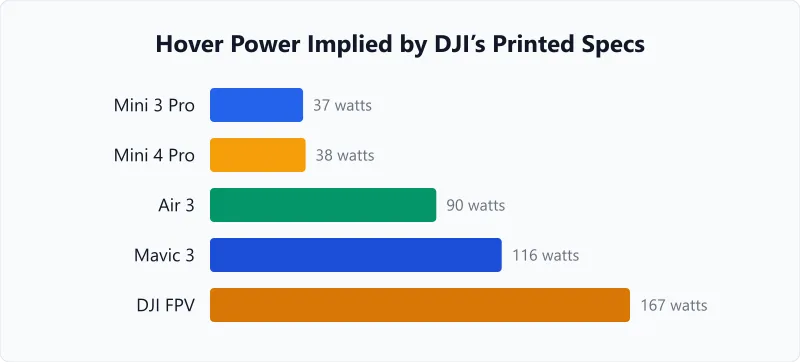
Average Power Behind DJI's Hover and Flight Figures
DJI prints each pack's capacity, voltage and energy beside two times it measures in still air: a maximum hovering time and a maximum flight time. The last two columns divide the pack energy by each of those times.
| Drone | Pack DJI prints | Max hovering time (no wind) | Max flight time (no wind) | Power the hover figure implies | Power the flight figure implies |
|---|---|---|---|---|---|
| DJI Mini 3 Pro | 2,453mAh, 7.38V, 18.1Wh | 30 min | 34 min | 37W | 32W |
| DJI Mini 4 Pro | 2,590mAh, 7.32V, 18.96Wh | 30 min | 34 min | 38W | 34W |
| DJI Air 3 | 4,241mAh, 14.76V, 62.6Wh | 42 min | 46 min | 90W | 82W |
| DJI Mavic 3 | 5,000mAh, 15.4V, 77Wh | 40 min | 46 min | 116W | 101W |
| DJI FPV | 2,000mAh, 22.2V, 44.4Wh | 16 min | 20 min | 167W | 134W |
Read the last two columns as the power each of the maker's own pairs implies, not as a measurement of your aircraft. Both round up to the next whole watt. The presets load the hover column, because it is the higher power and so the shorter, safer estimate, and because the flight figure assumes a steady cruise in dead-calm air: the Mavic 3 preset returns 39.8 minutes against a printed 40. If your flight log shows a higher average than the hover column, type it in. That number, not a blanket percentage, is what shortens your flight.
Pack Safety: Cut-Off Voltage, Charging and Storage
Lithium packs hold a lot of energy in a small space, and that is exactly what makes a damaged or over-discharged one dangerous. A punctured, over-discharged or overcharged pack can vent flammable gas and ignite, which is why the FAA publishes separate carriage rules for lithium batteries.
Tattu, which builds LiPo packs for unmanned aircraft, sets the floor in volts rather than percent. Its operating instructions read: "For Tattu series batteries which are used for Unmanned Aircraft system, The recommended cut off voltage is 3.5V per cell", with an absolute limit of "Never discharge battery to a level below 3V per cell under load." Set your flight controller alarm at the maker's figure and land when it sounds. That voltage floor, not a round percentage, is what the reserve you enter above protects.
Charge on a non-flammable surface and never unattended. Grepow, another pack maker, prints 3.85V per cell as the storage voltage for a 3.7V cell, so park packs there rather than leaving them full for a week. Never charge a puffed, dented or crash-damaged pack; hobby shops and battery recycling points take them. Deep discharges shorten the life of any lithium cell, which our depth of discharge guide covers in full.
Worked Examples
DJI Mavic 3 Photography Session
Context
You are planning a sunset shoot with a DJI Mavic 3. DJI prints the pack as 5,000mAh at 15.4V and 77Wh, with a maximum hovering time of 40 minutes in still air. Pick the 15.4V (4S, DJI Mavic 3) option. You fly at the 116W that DJI's own 77Wh and 40 minutes imply, and you land with a fifth of the pack still in reserve, so you enter 80% rather than 100%.
Calculation
Battery energy = 5,000 mAh x 15.4V = 77,000 mWh = 77 Wh, which is the Energy figure DJI prints for this pack
Energy you spend = 77 Wh x 0.80 = 61.6 Wh
Flight time = 61.6 Wh / 116 W = 0.531 hours = 31.9 minutes
Interpretation
31.9 minutes against DJI's printed 40. The whole 8-minute difference is the reserve you chose to keep: run the same pack and the same power at 100% and the calculator returns 39.8 minutes, just under DJI's hovering figure. Nothing here is a hidden penalty for the manufacturer being optimistic; it is the fifth of the pack you decided not to fly. Wind and climbing come off the top of that on the day.
Takeaway
Plan 31 to 32 minutes per pack on a Mavic 3 at that power, and take off less on a windy day. Carry two or three packs for a proper session. To compare packs across brands in one unit before you buy, use our battery capacity calculator.
Checking the Method Against DJI FPV
Context
Before you trust a calculator with your own numbers, make it reproduce one you can check. DJI prints the DJI FPV pack as 2,000mAh at 22.2V and 44.4Wh, with a maximum hovering time of approximately 16 minutes in windless conditions. Work backwards from those two printed figures: 44.4 Wh over 16 minutes is 167W. Enter 100%, because DJI measures on the whole pack.
Calculation
Battery energy = 2,000 mAh x 22.2V = 44,400 mWh = 44.4 Wh, matching DJI's printed Energy field
Energy you spend = 44.4 Wh x 1.00 = 44.4 Wh
Flight time = 44.4 Wh / 167 W = 0.266 hours = 16.0 minutes
Interpretation
16.0 minutes against DJI's printed "approx. 16 mins". The calculator has no drone-specific model in it at all: it divides energy by power, and when the power comes from the maker's own pair it returns the maker's own answer. That is the check worth running on any tool that promises to predict flight time.
Takeaway
Now swap in your own logged average power and your own reserve, and the same division gives your minutes rather than the lab's. The identity works for any pack, which is why the same arithmetic sits behind our runtime calculator for any pack.
Frequently Asked Questions
Glossary
C-Rating
The maximum continuous discharge rate a pack maker puts on the label, written as a multiple of capacity. A 1,300mAh pack marked 75C is rated for 1.3 Ah x 75 = 97.5 amps continuous. Running a pack above its marked rate causes voltage sag and heat, so match the label to the current your aircraft actually pulls rather than to a round number.
S-Count (Series Cell Count)
The number of lithium cells wired in series. Grepow, a pack manufacturer, prints 3.7V as the nominal voltage of a LiPo cell, which is where 7.4V for 2S and 22.2V for 6S come from. Maker figures diverge from that shorthand: DJI prints 7.38V for the Mini 3 Pro pack, 7.32V for the Mini 4 Pro, 14.76V for the Air 3 and 15.4V for the Mavic 3. Use the voltage printed on your own pack, not the cell count times 3.7.
Hover Power
The power a multirotor needs to hold position in still air. DJI publishes a maximum hovering time beside a maximum flight time, and for all five aircraft in the table above the flight figure is the longer of the two: 40 minutes hovering against 46 minutes flying for the Mavic 3. Hovering is therefore not the cheapest thing a multirotor can do, and the average power to enter above depends on how much of your flight is spent stationary.
Learn the fundamentals of battery runtime estimation in our battery runtime guide — the same formula applies to drones, CPAP machines, and every other battery-powered device.
Related calculators
E-Bike Battery Range Calculator
Estimate your e-bike range based on battery size, assist level, terrain, and rider weight. Get instant results for any electric bicycle.
Battery
Electric Scooter Battery Range Calculator
Calculate your electric scooter range from battery voltage, capacity, speed mode, terrain, and rider weight. Free, instant results.
Battery
Portable Power Bank Runtime Calculator
Find how long your portable power bank charges your phone, tablet, or laptop. Enter mAh, voltage, and device wattage.
Battery
Watt Hours to Amp Hours Calculator
Convert watt-hours to amp-hours at any voltage. Use this to compare batteries rated in different units.
Battery
Two numbers decide your flight time, and you control both: the average watts your aircraft actually pulls, and how much of the pack you are willing to spend before landing. Everything else is fixed by the pack you bought. Log the first, choose the second, and this page turns them into minutes. Charge on a fire-safe surface, never unattended, and retire packs that start coming back short. For a longer look at where the watts go across a season, read our drone battery flight time guide.
More Battery calculators
Browse all battery calculators — LiFePO4, lead-acid, AGM, and lithium-ion runtime, charge time, and capacity sizing.
Last updated:
Written and maintained by Dan Dadovic, Commercial Director at Ezoic Inc. & PhD Candidate in Information Sciences. He works professionally as Commercial Director at Ezoic Inc., leading revenue strategy across digital publishing.
Disclaimer: Calculator results are estimates based on theoretical formulas. Actual performance varies with temperature, battery age, load patterns, and equipment condition. For critical electrical work, consult a licensed electrician.
Methodology reviewed by Doc. dr. sc. Damir Topić, Assistant Professor, FERIT Osijek.